Athens, the capital of Attica, the metropolis of ancient Greek culture, takes its name, probably, from Athena (q.v.), 'goddess of science, arts, and arms,' who from earliest times was the patron divinity of the city. Cecropia, from the mythical king and hero Cecrops, the city was also called in ancient times.
Athens owes its original location, doubtless, to the craggy rock known as the Acropolis (q.v.), that rises more than 500 feet high above the Attic plain, and that in earliest days served for citadel as well as for residence and site of sanctuaries. With the growth of the population, the parts below and adjacent to the Acropolis, especially on the western and southern slopes, became inhabited.
Prior, however, to this earliest period in the history of Athens as a Greek city, it is held by many that there was a settlement of Phoenicians on the slopes of the hills towards the sea, numerous remains of which, in the form of cellars, cisterns, graves, steps, seats, all cut into the native rock, are still to be seen, constituting what is generally known as 'The Rock City.' That the Phoenicians visited these coasts for commerce in the 13th century before our era, that they were the teachers of the Greeks in various arts, and that they introduced into Attica the cultivation of the olive-tree, so well suited to the dry and chalky soil of this land, are generally accepted facts.
To understand the subsequent history and growth of Athens, it is necessary first to take into view the natural advantages of its position. Few cities, if any, can boast a more beautiful situation.
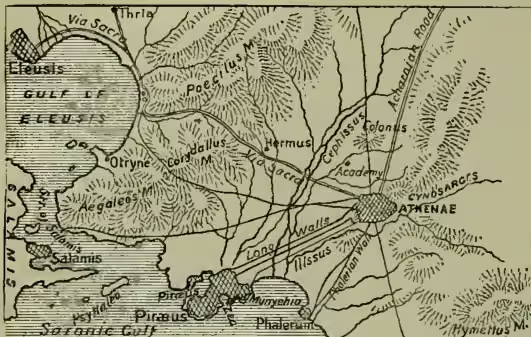
The Attic plain, which immediately surrounds the city on the east, north, and west, is bounded by the range of Hymettus (3368 feet), famous for its purple tints, on the east; by Pentelicus (3641 feet), noted for its quarries of marble, rich even to-day, on the north-east; by the range of Parnes (4634 feet), well wooded at the base, but barren at the summit, on the north; by the lower and nearer range of Corydallus (1535 feet), extending to the bay of Salamis, on the north-west; and on the west and south by the Saronic Gulf, in whose waters lie, in plain sight, the islands of Salamis and Ægina. The site of the city is itself diversified by several hills which add greatly to the beauty of the scenery.
Standing upon the Acropolis one sees to the east Mount Lycabettus, a conical-shaped mount 911 feet high, on whose summit Zeus once had a sanctuary where now stands a small chapel dedicated to St George, the patron saint of the modern Greeks. To the south-west rises the hill of the Muses, or the Mouseion, surmounted now by the ruins of a monument to Philopappus, who was Roman consul about 100 B.C. In the side of the Mouseion are three rocky chambers, doubtless ancient sepulchres, but popularly known as the 'Prison of Socrates,' according to a tradition that goes no farther back than the middle ages. Immediately adjacent to this is a lower eminence called the hill of the Pnyx, from the fact that on its slope tradition locates the place of popular assembly. At the upper end of the terrace, which is supported below by a wall of polygonal masonry, stands a cube of rock surrounded at the base by steps. This has long been supposed to be the ancient bēma or tribune of the assembly—an opinion not held by many recent scholars, who take it to be a great rock altar, probably dedicated to the worship of the 'Highest Zeus,' to whom many votive tablets have been found in the neighbourhood.
Just below the western foot of the Acropolis lies the rocky hill called the Areopagus or hill of Ares (Mars), so named from the myth according to which Ares was tried for the murder of Hallirothios before the twelve gods of Olympus, who held court on this eminence. It was here that the most venerable court of Athens had its sittings to try cases of wilful murder, to exercise judicial censorship over the life of the citizens, and to guard the sanctity of to the battle of Plataea, 479 B.C. (2) The most flourishing period of Athens, extending to the close of the Peloponnesian war, 403 B.C. (3) The decline of Athens, embracing the Alexandrian, Roman, Byzantine, Frankish, and Ottoman periods. (4) Modern Athens.
(1) The oldest history of Athens as a city is connected with the reforms of Theseus and Solon. Theseus was a mythical hero to whom, as his name may indicate, was attributed the credit of organising the scattered population of Attica into communities and of instituting several of the most important Athenian festivals. At this time the Acropolis was the abode of the king and the priests, and was the site of the Prytaneum or town-hall, as well as of the sanctuaries and altars of Athena, Erechtheus, Zeus, and Poseidon.
In the 6th century B.C., under the reforms of Solon and the fostering hand of the tyrant Pisistratus, Athens fairly began her prosperous career. Amid much that is mythical in the history of the reforms of Solon, it is certain that he gave a new place to the demos as the unit and centre of political life, and to the ecclesia or popular assembly, before which all acts of government were to be brought for discussion and approval. By him also the populace was divided for political purposes on a property basis into four classes, of which the first three were eligible to office. At this time the chief rule was already lodged in the hands of nine archons who were chosen annually. To the family of Pisistratus Athens owes the earliest structures that were at all beautiful or imposing. On the Acropolis Pisistratus erected a temple in honour of Athena, which was destroyed by the Persians, and some architectural remains of which are still seen built into the northern wall of the Acropolis. There are some who believe that the foundations of a large temple, recently exhumed between the Parthenon and the Erechtheum, are the ruins of this Pisistrate structure. Still more imposing was the temple begun by Pisistratus on the bank of the Ilissus in honour of Olympian Zeus, and ever since known as the Olympiæum. Within a peribolus of four stadia a structure was reared whose dimensions afterward became 354 feet in length, 171 in breadth, and which when completed was adorned with 120 columns of Pentelic marble, 60 feet in height and 6 feet in diameter. The ruins of this colossal temple, consisting of 16 columns, most of which have an architrave, form one of the most impressive sights of Athens.
The reforms of Clithenes in 506 B.C. gave the government of Athens a still more democratic form by making all citizens eligible to office, by enlarging the authority of the popular assembly, and by creating popular courts of justice. Doubtless these reforms stimulated the erection of new buildings for the use of the state, many of which were located about the ancient Agora, whose exact situation has been a matter of much dispute until this very day. The conflict with Persia which originated in the Ionic revolt and the destruction of Sardis in 499 B.C., indirectly led to the naval supremacy of Athens, under the wise guidance of Themistocles. In 480 B.C. the Athenians abandoned their city to the ruthless vengeance of the Persian invaders, who burnt and destroyed all its houses and temples.
(2) After the victories of Salamis and Plataea, the Athenians splendidly rebuilt their city, which now entered upon the most brilliant epoch of its career. Under the leadership of Themistocles, Cimon, and Pericles, Athens reached the zenith of her power, and became fortified by numerous walls and bulwarks, and beautified by the erection of splendid temples. To this period belong the walls around the Acropolis, and the city walls with their ninety-seven towers and ten gates, measuring a
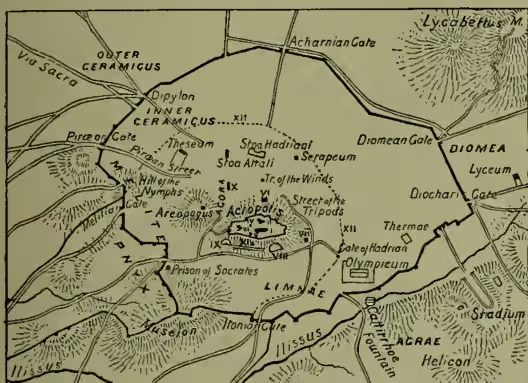
| I. | Parthenon, | } Acropolis. |
| II. | Erechtheum, | |
| III. | Propylææ, | |
| IV. | Temple of Athena Promachus, | |
| V. | Temple of Athena Ergane, | |
| VI. | Prytaneum. | |
| VII. | Choric Monument of Lysicrates. | |
| VIII. | Theatre of Dionysus, | |
| IX. | Odeum of Herod. | |
| X. | Stoa Poecile. | |
| XI. | Sanctuary of Æsculapius. | |
| XII. | Circuit of the walls before the Persian war. |
ancient law and tradition, particularly such as pertained to religion. Before this court, or at least on this hill, the apostle Paul delivered his well-known vindication of the Christian faith recorded in Acts, xvii. Just beyond the Areopagus, with a narrow valley between, lies the Hill of the Nymphs, once occupied by sanctuaries and dwellings, and now the site of the astronomical observatory. The view beyond includes the harbours of Phalerum, Munychia, Zea, and the Piræus (q.v.). The superior position and greater extent of the last-named harbour have made it, ever since the days of Themistocles, the seaport of Athens. To the south and east of the city flows the Ilissus, and to the north and west the less celebrated but more copious Cephissus. In the summer both streams are nearly dry, and at no time are they large enough to deserve the name of river. They are of great value, however, in the winter and spring for irrigating the vineyards and olive-groves that cover the plain. The most famous spot in the plain is the grove of the hero Academus, situated about a mile north-west of the city, where the 'divine Plato' taught his philosophy and founded his school, which has become famous under the name of the Academy (q.v.). Adjoining this grove is a knoll called Colonus, in the ancient demos of that name, famous as the birthplace of the tragic poet Sophocles, who celebrates the beauty of this region in one of the finest of the odes in his tragedy of Edipus at Colonus. On this hillock are the tombs of two of the most distinguished of modern archaeologists, Ottfried Müller and Charles Lenormant.
That a city so beautifully situated, enjoying a delightful climate the greater part of the year, under a sky wonderful for its clearness (as Euripides says of the Athenians of old, 'marching through an ether of surpassing brightness'), inhabited by a race so gifted as were the ancient Ionian Greeks, should play an important rôle in history, is not at all surprising. The history of the city may be most conveniently narrated by dividing it into four epochs: (1) The period from the time of Cecrops circumference of forty-three stadia, or almost five miles. The chief gate was at the north-west, and led to the Academy. It was called the Dipylon or double gate, and its form may still be seen from the foundations which have recently been brought to view by excavation. Just outside of this gate was the Ceramicus ('Potter's field') or ancient cemetery, where one sees to-day some of the most beautiful sepulchral relics known to art. For the better defence of the city and of its harbour, Piraeus, the famous 'long walls' were built by Pericles. Together with the fortifications of the Piraeus, which had previously been built by Themistocles, they formed a complete fortress, sometimes denominated, on account of its length, which was about five miles, the 'Long Fortress.' The inclosure between the two parallel walls was for the larger part of the way about 550 feet wide, and formed a continuous broad street between the city and its port. Traces of these walls are still to be seen. The age of Pericles in Athenian history corresponds to the Elizabethan period in the history of England. Among the great names of this illustrious period may be mentioned Mnesicles and Ictinus in architecture, Phidias and Myron in sculpture, Æschylus and Sophocles in tragedy, Socrates and Plato in philosophy, Herodotus and Thucydides as historians, and Pindar and Simonides as lyrists. Of the monuments of architecture and sculpture belonging to this period the most important are the Parthenon (q.v.), the Erechtheum, the Temple of Wingless Victory (Nikē Apterōs), the Propylæa, the Theseum, the Choragic Monument of Lysicrates, and the statues and reliefs that adorned these structures. It is
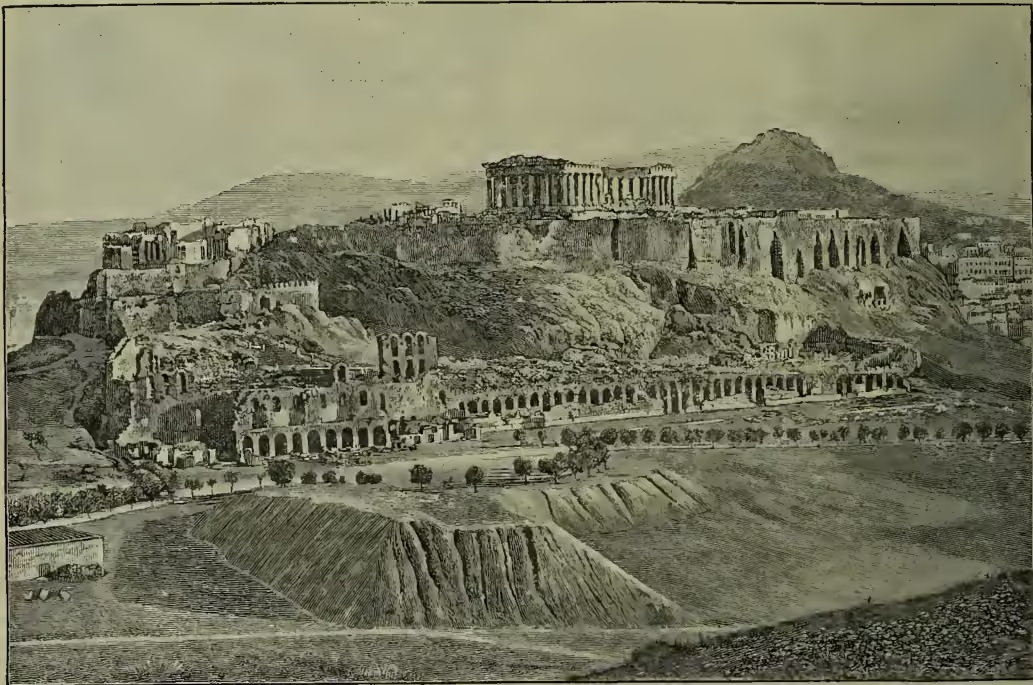
The arches belong to the ruins of the Odeum of Herod and other buildings of the Roman period.
The hill to the right is Lycabettus. from the contemplation of these ruins and remains that the beholder gains such a conception of the purity and exquisite grace of ancient art as he can get nowhere else. The simplest and most majestic structure of all is the Parthenon, built in the Doric style, and richly ornamented with polychromatic colouring. Its cella contained the chryselephantine statue of the virgin goddess from the hand of Phidias. Its pediments were adorned with groups of statuary representing the birth of Athena, and the contest of Poseidon and Athena for the possession of Attica. The frieze around its cella wall portrayed the procession of the Panathenaic festival. Of these sculptures the largest part of what has been preserved was carried by Lord Elgin to the British Museum, where the collection is known as 'the Elgin Marbles' (q.v.). The temple first became a ruin in 1687, through the bombardment of the Venetians, one of whose lieutenants had the wretched good luck to send a bomb into the powder stored by the Turks in the cella. Shattered and battered though it is, the Parthenon is perhaps the most beautiful ruin in the world. Of the Erechtheum, which was built in the Ionic style, and which has a form entirely different from that of any other known temple, the most beautiful part, the so-called 'Porch of the Caryatides,' is still in fair state of preservation, and shows six graceful female figures supporting the architrave. The Propylæa, which formed the entrance to the Acropolis, consisted of three parts—viz. a central porch with five gates, and a north and south wing. It was the most massive secular structure of ancient Athens, but, probably through the distractions and expenditures of the Peloponnesian war, was never completed. Contiguous and in front of the south wing of the Propylæa is the Temple of Wingless Victory, built in the Ionic style and of Pentelic marble. On a slight elevation north-west of the Acropolis stands the so-called Theseum, the best preserved of all the structures of the ancient city. It was built somewhat earlier than the Parthenon, is also of the Doric order, and derives its name from the tradition that here the remains of Theseus were brought from the island of Scyros and interred. Most modern scholars believe it was a temple of Heracles or of Hephæstus. In the middle ages it served as a Christian church dedicated to St George. The gold-brown tint of the weather-stained Pentelic marble presents, in the glow of the rising or setting sun, a peculiarly beautiful effect.
In an out-of-the-way corner, south-east from the Acropolis, amid squalid surroundings, stands the graceful Choragic Monument of Lysicrates. This monument owes its origin to the custom of dedicating the tripods given in the Dionysiac contests to the victorious chorus. It is in the form of a small circular temple, which served as the base of the tripod, and is one of the earliest specimens of the Corinthian architecture. On the south slope of the Acropolis was the sanctuary of Dionysus, where later was built the great theatre, the remains of which, consisting of seats hewn into the rock, marble thrones, pieces of a later proscenium, and other architectural fragments, still testify to the interest of the Athenians in the festivals of the god of the vine. Closely adjacent, on a higher terrace, lay the sanctuaries of Æsculapius, Themis, Aphrodite, and Demeter, of which little except the foundations remain.
(3) In its most flourishing period, Athens contained upwards of 10,000 dwellings, and numbered at least 100,000 free inhabitants, and more than twice as many slaves. The number of citizens who were entitled to vote and to hold office was about 20,000. The decline of Athenian power and prosperity dates from the close of the Peloponnesian war (403 B.C.), which had exhausted the resources of Athens and broken her spirit. Still, at this time there were not wanting patriots and statesmen, such as Demosthenes and Lycurgus, who secured for Athens a new though brief ascendancy among the states of Greece, and made her the bulwark of Hellenic independence, until the fatal battle of Chæronea (338 B.C.), which established the Macedonian supremacy. Lycurgus, who stood for many years at the head of the financial administration of Athens, was most active in fortifying and building up the city. A new and magnificent arsenal in the Piræus, called after its architect the arsenal of Philon, was erected under his direction, and in Athens he built a new stage structure and lined the seats of the Dionysiac theatre with marble. On the banks of the Ilissus he laid out the Stadium, used for the first time in 330 B.C. for the games of the Panathenæan festival; it had seats for no less than 45,000 persons. He enlarged and beautified the gymnasium known as the Lyceum, where Aristotle expounded his science and philosophy. During the subsequent Macedonian occupation, Demetrius of Phalerum gave the city a wise administration. Now Athens became the seat of schools of philosophy and rhetoric, and the metropolis of polite learning. The long list of benefactors of Athens during the Alexandrian period begins with Ptolemy Philadelphus (284 B.C.), who founded a gymnasium and library which bears his name. The kings of Pergamus, Attalus and Eumenes, built markets and halls and theatres, and the Syrian Antiochus Epiphanes (175 B.C.) resumed the building of the Olympiæum, which for a long time had remained half completed. With the destruction of Corinth in 146 B.C. by the Romans, and the dissolution of the Achaean League (q.v.), Athens with the rest of Greece became a Roman province. Yet for a long time the conqueror Rome sat at the feet of the conquered Athens, to learn her art and letters, and to gain from her sages teachings of philosophy and rules of statesmanship. Of the buildings of this period should be named especially the Tower of the Winds, which served as a kind of public clock and barometer, built by Andronicus Cyrrhestes, and the Gate of the Agora. The Emperor Hadrian, probably no less through a desire to gratify his vanity than from a love of Greek culture, gave Athens a fresh revival of art and a new prosperity. An entire quarter of the city, south-east of the Acropolis, was named after him, as is attested by an inscription which can still be read on the 'Gate of Hadrian.' He finished the great Temple of Zeus begun by Pisistratus, which was thus more than 600 years in course of building. About the same time a wealthy Athenian, Herodes Atticus of Marathon, built, in honour of his wife Regilla, a magnificent theatre or odeum, the ruins of which rise conspicuously above all other remains of the ancient city at the foot of the Acropolis. But here is the turning-point. From this time onwards the history of Athens is only one of spoliation and destruction, first by Romans, then by Goths, then by Christians, and last by Mussulmans. The Athenians had to pay dearly for espousing the cause of King Mithridates against the Romans. After a long siege, the Romans under Sulla took Athens and plundered it of many works of art. In 267 A.D. the city was captured by the Goths. In the next century Constantinople began to draw works of art from Athens for her adornment. The schools of philosophy, especially the Neoplatonic, still maintained their existence, and were the support of pagan religion. At last the Emperor Justinian, in 529 A.D., closed by edict the Athenian schools of philosophy, and the light of science and learning that had been shining for so many centuries, though but dimly at the last, was now wholly extinguished. The temples were converted into churches, whereby they suffered many architectural changes. In 1019 the Emperor Basilus II. held in the Parthenon, now called Panagia, or the church of the Madonna, a religious celebration in gratitude for his victory over the northern barbarians. In 1204, after the conquest of Constantinople, Boniface de Montferrat became king of Greece. Athens was ruled by a succession of Frankish dukes until 1456, when the city fell into the hands of the Turks, under whose blighting despotism, with a brief interruption of Venetian ascendancy, it remained until the deliverance of Greece was effected in 1833 through the intervention of the great powers of Europe.
(4) With the liberation of Greece from the yoke of Turkey begins the history of Modern Athens. Before the transfer of the capital from Nauplia by King Otho, who had been chosen to the throne of the new kingdom, Athens was a wretched village of a few hundred houses. Since that time it has enjoyed a prosperous growth. Modern Athens has been built chiefly on the eastern and northern sides of the Acropolis, while the ancient city lay chiefly on the southern and western sides, and in its public buildings and newer parts it reminds one of the better-built German cities. Its population in 1896 was 111,486, that of the Piræus being 42,169. It has a gymnasium on the German model, a girls' high school, several excellent private schools, a polytechnic school, and a university with 60 professors and 1800 students. A railway connects Athens with the Piræus and with the Peloponnese by Corinth. The two chief business streets, 'Hermes' and 'Æolus,' cross each other at right angles, and divide the city into four nearly equal parts. Of modern public buildings the most noteworthy are the University; the Academy, which is built almost wholly of marble and shows with beautiful effect the polychromatic decorations of the ancient Doric style; the Exposition Hall; and the Palace, externally an ugly square building, but containing some spacious and handsome salons. Among the most recent erections are a magnificent national library, and a fine theatre. Both these structures, as well as the Academy and the Exposition Hall, are the gifts of wealthy Greeks, who reside mostly abroad. Athens has many remains of antiquity in its three museums. At the eastern end of the Acropolis, the Archaeological Society of Athens has erected a low building in which are preserved the remains and fragments of ancient art exhumed on the Acropolis. The most noteworthy of these are several slabs of the Parthenon frieze, reliefs from the balustrade of the Temple of Wingless Victory, fragments of the frieze of the Erechtheum, and the archaic statues found near the Erechtheum. The museum contained in the Polytechnicum embraces the Mycenæ collection made by Dr Schliemann, figurines from Tanagra, Myrina, &c., and a rich collection of vases. The National Museum is especially rich in archaic statues and in sepulchral stelæ and reliefs. The Greek Archaeological Society affords every facility to foreign students, and carries on excavations. There are four foreign archaeological schools at Athens, of which the French school, established 1846, and the German Institute, opened in 1873, are supported by their respective governments. The American school was founded in 1882, and is maintained by the co-operation of the leading colleges, and by the friends of classical studies in the United States. The British school was opened in 1886, and is under the patronage of the society for the promotion of Hellenic studies.
See the articles GREECE, ART, GREEK ARCHITECTURE, SCULPTURE, SOLON, PERICLES, SOCRATES, PLATO, &c.; English works on ancient Athens by Stuart and Revett (1762-1816), Leake (1821; new ed. 1841); French works by Raoul-Rochette (1852), Breton (1868), Burnouf (1877); German works by Forchhammer (1842) and Wachsmuth (1874-90); Penrose, Principles of Athenian Architecture (Dil. Soc., 1851; new ed. 1889); the Atlas of Athens by Curtius and Kaupert (1878); Verrall's Attica of Pausanias, edited by Harrison (1890); Boeckh's Public Economy of the Athenians (trans. by Cornewall Lewis, 1828); De Coulanges, The Ancient City (trans. 1874); Capes, University Life in Ancient Athens (1877); W. W. Fowler, The City State (1893); and for the mediæval history, Gregorovius (German, 1889), Laborde (French, 1855), and Constantinides (Greek, 1876); and for modern Athens, Freeman (in his Historical Essays) and J. A. Symonds (in his Sketches).