Auricula (Primula auricula), a congener of the Primrose (q.v.), much cultivated in flower-gardens. The auricula has long been a florist's flower. It was highly esteemed by the Romans, and has, at least since the 17th century, received particular attention from the florists of England and Holland. It is one of those flowers the cultivation of which is often most successfully prosecuted in the little gardens of operatives near large towns. Lancashire is particularly famous for it.—The auricula has smooth, dark-green leaves, stems, and calices, covered with a mealy powder. A similar fine dust appears also on the flowers, and adds much to their beauty. Hence the popular name in Scotland of 'Dusty Miller.' The auricula is a native of the Alps and other mountains of the middle and south of Europe, and of sub-alpine situations in the same countries. It is found also on the Caucasus and the mountains of Syria; it grows in shady and moist places. In a wild state it has comparatively small flowers, of a simple yellow colour, on short stalks, forming an umbel of generally six or seven flowers, with the same delightful fragrance which aids so much to make it a favourite flower in cultivation. The leaves are used by the inhabitants of the Alps as a remedy for coughs.
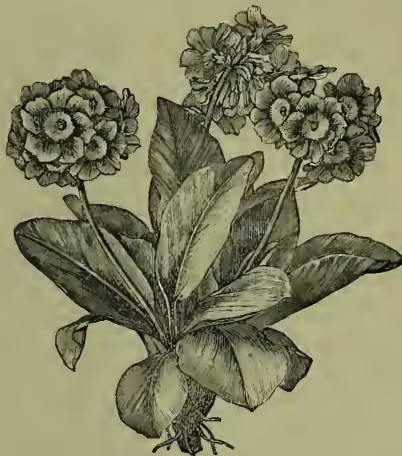
By cultivation and selection the auricula has been brought to great beauty and splendour of colour. More than 1200 varieties were reckoned as early as 1850, and new ones are continually raised from seed. All shades and combinations of yellow, maroon, and purple, usually disposed in concentric rings, are predominant; and English florists classify these into five main types, green-edged, white-edged, gray-edged, self-coloured, and alpine, the latter having the margin of two blended colours with a yellow centre. The meanness of the flower differs much in different varieties. The auricula blooms in April and May, and often also a second time at the end of autumn, which adds to the charm of the flower-border, although it is to the first or proper flowering-season that the florist looks. It succeeds best in a rich light soil, and cultivators diligently prepare for it composts of various kinds, but in general consisting chiefly of fresh loamy soil, and of well-rotted horse or cow dung, often with the addition of a little sand. The finer varieties are always cultivated in pots, and require protection from severe weather in winter, and from wind and rain while flowering. They ought, however, previous to flowering, to stand in an airy, sunny situation. They are propagated by offsets, generally in the latter part of August. When it is proposed to raise the auricula from seed, care ought to be taken to select the finest flowers, which are encouraged to ripen their seeds by exposure to sun and air, hand-glasses being placed over them during heavy rains. The seed is sown either in autumn or spring, generally in boxes placed under shelter, or in a slight hot-bed. The more weakly plants are tended with particular care, as they are generally found to produce the finest flowers.
The name auricula is derived from auris, an ear, on account of a fancied resemblance of the leaf to the ears of an animal.