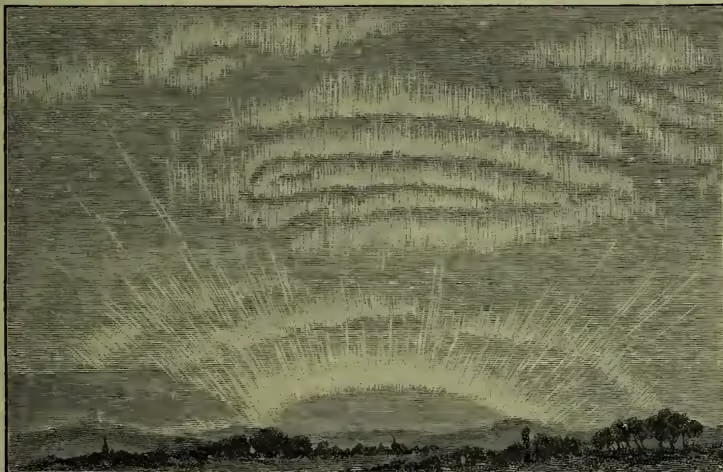
Auro'ra Borea'lis, or NORTHERN LIGHTS, the name given to the luminous phenomenon which is seen towards the north of the heavens by the inhabitants of the higher latitudes. During the winter of the northern hemisphere, the inhabitants of the arctic zone are without the light of the sun for months together, and their long dreary night is relieved by this beautiful meteor, which occurs with great frequency in these regions. Those who have explored the southern seas have seen the same phenomenon in the direction of the south pole, so that the term Polar Lights might be more appropriate than Northern Lights to designate the aurora. In the phenomenon as seen in the southern hemisphere, the name aurora Australis is used. The appearance of the aurora borealis has been described by a great variety of observers in Northern Europe and in America, all of whom give substantially the same account of the manner in which the phenomenon takes place. It is briefly as follows: A dingy aspect of the sky in the direction of the north is generally the precursor of the aurora; and this gradually becomes darker in colour, and assumes the form of a circular segment, surrounded by a luminous arch, and each end approaching near to the horizon. This dark segment, as it is called, has the appearance of a thick cloud, and is frequently seen as such in the fading twilight before the development of the auroral light. Its density must, however, be very small, as stars are sometimes seen shining brightly through it. This dark segment is bounded by a continuous luminous arch of a transparent white with a touch of green, which varies in breadth from 1 to 6 diameters of the moon, having the lower edge sharply defined, and the upper edge only when the breadth of the arch is small. This arch may be considered to be a part of a luminous ring elevated at a considerable distance above the earth's surface, and having its summit in most cases nearly in the magnetic meridian. An observer several degrees south of this auroral ring would see towards the north only a small arc of it, the larger part being hid by the earth; to one situated not so far south, it would appear as a larger and higher arch; to one placed below it, it would be seen as an arch passing through the zenith; and to one situated within the ring and farther north, it would be found as an arch culminating in the south. On this supposition nearly all the various positions of the auroral arch may be accounted for. The centre of the ring corresponds probably with the magnetic north, which is at present situated in the island of Boothia Felix. Hence it is that in Greenland, which is situated to the east of this island, the auroral arch has been seen stretching from north to south with its highest point in the west. The luminous arch, once formed, may remain visible for several hours, and is in a constant state of motion. It rises and falls, extends towards the east and towards the west, and breaks sometimes in one part, sometimes in another. These motions become all the more observable when the arch is about to shoot forth rays; then it becomes luminous at one point, eats in upon the dark segment, and a ray of similar brightness to the arch mounts with the rapidity of lightning towards the zenith. The ray seldom keeps the same form for any length of time; but undergoes continual changes, moving eastward and westward, and fluttering like a ribbon agitated by the wind. After some time it gradually fades in brightness, and at last gives way to other rays. When the rays are very bright, they sometimes assume a green, sometimes a violet, a purple, or a rose colour, giving to the whole a variegated and brilliant effect. When the rays darted by the luminous arch are numerous and of great length, they culminate in a point which is situated in the prolongation of the dipping-needle, somewhat south-east of the zenith. There they form what is called the Boreal Crown; and the whole heavens, towards the east, west, and north, present the appearance of a vast cupola of fire, supported by columns of variously coloured light. When the rays begin to be darted less brilliantly, the crown first disappears, then, here and there, the light becomes faint and intermittent, till at last the whole phenomenon fades from the sky.
The preceding description indicates the general features of the appearance of the aurora borealis; but several auroras have been described which presented striking peculiarities. Sometimes the phenomenon assumed the form of one or more curtains of light, depending from dingy clouds, whose folds were agitated to and fro, as if by the wind. Sometimes this curtain seemed to consist of separate ribbons of light, arranged side by side in groups of different lengths, and attaining their greatest brilliancy at the lower edges. In this country it is only on rare occasions, such as in 1870, that the aurora borealis occurs with the brilliancy which attends it in northern latitudes, but this description portrays the type to which such appearance of the meteor more or less approximates.
The height of the aurora has been variously estimated. The first observers were inclined to place the seat of it beyond the atmosphere; but this hypothesis is untenable, as the aurora does not seem to be affected by the rotation of the earth, but appears to be in every respect a terrestrial phenomenon. By taking observations of the altitude of the highest point of the arch of the same aurora at different stations, the heights most generally are from about 45 to 100 miles. Some authors have assigned heights as low as 5 miles, and others as high as 500 miles and even higher, but the results of recent research are not confirmatory of these extremes. The distance of the stations at which the same aurora has been visible, indicates the enormous geographical extent, and likewise the great altitude which the phenomenon frequently attains. One aurora, for instance—that which occurred on the 25th October 1870—was seen over a large portion of the northern hemisphere, and at the same time auroræ were seen at many places in the southern hemisphere. Dr Sophus Tromholt, who carried out a series of investigations on the subject of the aurora borealis in the extreme north of Norway, states that the light of the aurora is never serviceable to people in their work; its contribution to lighten the darkness is almost nil; the momentary flashes of real luminosity are very brief and of no practical value.
The noise that is alleged to accompany the aurora borealis in high latitudes would indicate for it a comparatively moderate height; but we can scarcely yet be said to be in possession of indisputable instances of its being heard by competent observers. See the subject discussed in communications to Nature, especially one by Tromholt in vol. xxxii. p. 499.
The intimate connection between the aurora borealis and the magnetism of the earth is shown by various facts. During the occurrence of the phenomenon, the magnetic needle appears very much disturbed, sometimes deviating several degrees from its normal position, and appearing to be most affected when the aurora is brightest; and this oscillation is frequently perceived far beyond the district where the aurora is seen. The vertex, likewise, of the luminous arch is almost always found to be in or very near the magnetic meridian, and the boreal crown has its seat in the prolongation of the freely suspended needle. There seems, moreover, to be a connection between the magnetic poles of the earth in regard to the aurora, for, as has been frequently ascertained, the meteor occurs simultaneously at both. The aurora borealis appears to be an electric discharge connected with magnetic disturbance. If one of Gassiot's vacuum tubes be brought near an electric machine, or between the poles of an induction coil, flashes of light pass between the ends, which bear a striking resemblance to the aurora borealis. A comparison of the spectra of the two goes far to establish identity.
The auroral spectral line, discovered by Ångström in 1867, is a yellow line near the sodium line, and is the same as the air line seen in the solar light when the sun is near the horizon. Other lines, however, have been seen, which cannot as yet be produced by the physicist from any known substance.
Lemström has shown by the observations and experiments he made at Sodankylä, that auroræ are due to currents of positive electricity illuminating the atmosphere in their passage to the earth.
Luminous appearances accompanied the setting in of a current towards the earth from the network of insulated wires with which he overspread the top of Mount Oratunturi, and this light was clearly auroral, giving the hitherto enigmatical citron line of Ångström referred to above, which is the invariable constituent of auroral radiations. Other faint and indistinct lines are enumerated as present, and Lemström is of opinion that there is a tolerable agreement between some of these and the lines in the laboratory spectrum of rarefied air, but the whole subject demands further investigation.
Loomis and Fritz have severally investigated the geographical distribution of the aurora borealis. The following woodcut is from
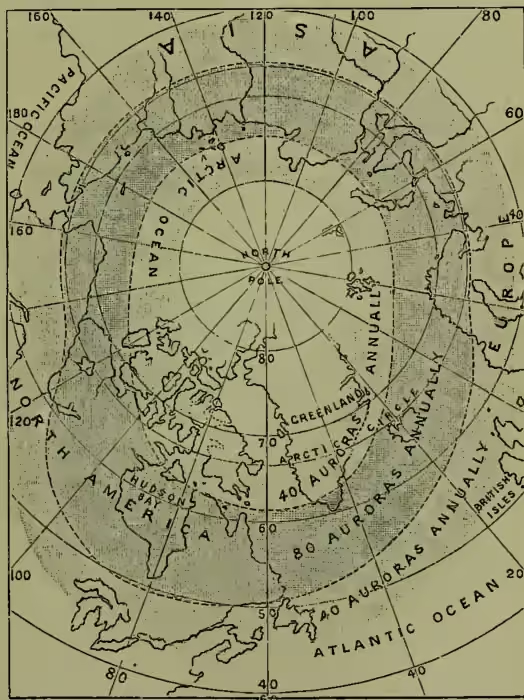
Loomis, from which it is seen that the region of greatest auroral action is an oval-shaped zone surrounding the north pole, whose central line crosses the meridian of Washington in latitude 56°, and the meridian of St Petersburg in latitude 71°. It follows from this that auroræ are more frequent in North America than in the same latitudes in Europe. Loomis points out that this auroral zone bears considerable resemblance to a magnetic parallel or line everywhere perpendicular to a magnetic meridian.
It is a fact of the greatest significance that as regards geographical distribution, auroræ and thunderstorms are complementary, auroræ being not more characteristically of polar than thunderstorms are of tropical origin. Auroræ are, however, subject to extremely complicated periodicities, indicating systematic magnetic associations; whereas thunderstorms may be regarded as completely dissociated from magnetic associations, and their periodicities are restricted to diurnal and annual variations.
The diurnal maximum of auroræ in middle latitudes, or on the equatorial side of this great auroral zone, shaded dark in the woodcut, occurs in the evening; but in Greenland and other regions on its polar side, the maximum occurs in the early morning. Further outside the auroral zone, there are two maxima in the year, one in spring and one in autumn, but at places inside this zone, the two maxima coalesce into a single maximum at the winter solstice. Thus, with an increase of solar heat, diurnal or annual, the auroral zone travels equatorwards, and with increased cold polewards; and it is extremely interesting to note that on the polar side a sunspot maximum is accompanied with auroral minimum, and the equatorial side with a maximum, thus supporting the idea that a sunspot maximum period is coincident with a maximum temperature. At the times when the solar heat is greatest evaporation is greatest, the supply of atmospheric electricity consequently more copious, increased tension brings about more speedy neutralisation, the zone of gradual recomposition travels towards the equator; and thus auroræ become more frequent in middle latitudes. See the handbooks of Meteorology, numerous articles and notes by Lemström and others in Nature (1882-87), and Dr Sophus Tromholt's Under the Rays of the Aurora Borealis (1885).