Balance (from Latin bilanc), an instrument for ascertaining the mass of bodies in grains, ounces, pounds, or any other units of mass. The ordinary balance consists of a lever called a beam, supported in the middle of its length, and having dishes or scales suspended from either extremity. As it is of importance that the beam should move easily round its support, it rests on polished agate or steel planes, by means of knife-edges of tempered steel, which project transversely from its sides, and serve as the axis of rotation. By this arrangement the surface of contact is practically reduced to a line, and the friction of the axis of the beam on its support almost entirely obviated. The scales are hung by means of chains or cords attached to hooks, which rest on knife-edges turned upwards instead of downwards as in the first case. The essential requirements of a balance of this description are: 1st, That the beam shall remain in a horizontal position when no matter is in either scale; 2d, That the beam shall be a lever of equal arms, or have the distances between the central knife-edge and those at either end exactly the same; and 3d, That the balance shall possess sensibility—i.e. shall turn readily from its horizontal position when there is a slight excess of matter in one of the scales. To insure the first of these conditions, it is necessary that the centre of gravity of the beam lie vertically below the point of support when the beam is horizontal. When such is the case, the centre of gravity at which the weight of the beam may be considered to act oscillates as in a pendulum round the point of support, and always comes to rest right under that point, thus restoring to the beam its horizontal position when it has been tilted out of it. If the centre of gravity were above the point of support, the beam would topple over; and if it coincided with that point, there being no restoring force, the beam would occupy indifferently any position into which it was thrown, the balance in both cases being useless. That a balance possesses the second of the above conditions, is ascertained by putting into the scales masses which keep the beam horizontal, and then transposing them, when, if it still remain so, the lengths of the arms are equal. Should the arms be of different lengths, a less mass at the end of the longer arm will balance a larger mass at the end of the shorter arm (see LEVER); but when transposed, the larger mass having the longer arm, and the smaller mass the shorter, the beam can no longer remain horizontal, but will incline towards the larger mass. A balance with unequal arms is called a false balance, as distinguished from an equal-armed or just balance. When employing a false balance, it is usual to place a body in both scales, and take the arithmetical mean—that is, half the sum—of the apparent masses for the true mass. This is near enough to the truth when the apparent masses differ little from each other; but when it is otherwise, the Geometrical Mean (q.v.) must be taken, which gives the exact mass in all cases.
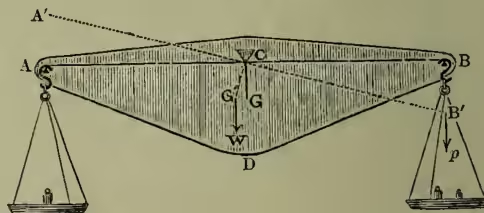
The third requisite—the sensitiveness—depends upon the weight of the beam, the position of its centre of gravity, and the length of its arms. Let ABD (fig. 1) represent the beam of a balance, C the point of suspension, G the centre of gravity, and ACB the straight line joining the knife-edges, which may be taken as the skeleton lever of the balance. We shall here confine our attention to that construction where the three knife-edges are in a line, because it is the most simple, and at the same time the most desirable. We may, without altering the principles of equilibrium, consider the beam reduced to the lever AB, and embody its weight in a heavy point or small ball at the centre of gravity, G, connected with C by the rigid arm CG. The weights of the scales and contained equal masses act at A and B, and have no influence on the position of the beam since the arms are equal. If a small additional weight, , therefore, act at B, the position of the beam is determined by its rotating tendency (moment) round C, and the counter-rotating tendency of the weight of the beam, W, acting at G. The question of sensitiveness is thus reduced to the action of the crooked lever GCB, with acting at one end, and W at the other. The relations of the arms and forces of a crooked lever will be found under LEVER. It is only necessary here to state, that the moment of the weight acting at the end of a crooked lever, increases with its size, the length of its arm, and the smallness of the angle which that arm makes with the horizontal line passing through the fulcrum. Consequently, the longer the arms of a balance are, all other things being the same, the greater will be its sensitiveness. Also, the nearer the centre of gravity of the beam is to the point of support, the greater will be the sensitiveness of the balance; and, lastly, the smaller the weight of the beam, the greater will be the sensitiveness of the balance.
In the construction of the balance, it is a matter of importance to have the sensitiveness independent of the weight of the scales and contained masses, so that, when heavily loaded, a small weight will produce the same inclination as when not loaded at all. This condition is implemented, as we have already shown, when the three knife-edges are kept in the same straight line. If the line joining the two terminal knife-edges lie below the point of suspension, then the centre of gravity of the equal masses will, upon the turning of the beam, be forced from below that point, and will accordingly have a tendency to resume its former position. The equal weights thus counteract to some extent the effect of the additional weight, and their influence in this way will be all the greater as they themselves increase.
When a balance is very sensitive, the beam keeps oscillating for a considerable time from one side to the other of the position in which it finally settles. The stability, or the tendency of the beam to come quickly to rest, depends on requirements nearly the opposite of those which conduce to sensitiveness. In the construction treated of above, the stability increases with the moment of the weight of the beam acting at G round C, so that it thus increases with the weight of the beam, and the distance of the centre of gravity from the point of suspension. The stability is also increased, as already shown, by having the line joining the scale knife-edges below the point of support.
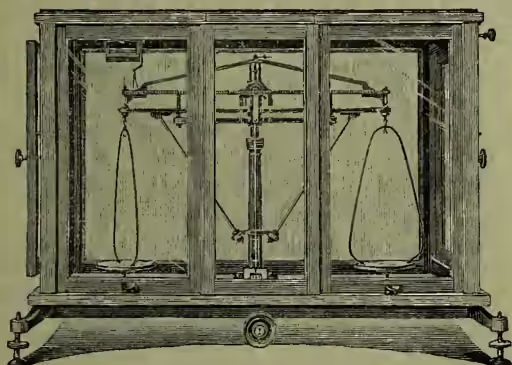
Fig. 2 is the representation of one form of the delicate balances employed in physical and chemical researches. The beam is constructed of aluminium, so as to combine lightness with strength, and rests by a fine agate knife-edge on an agate plane. The pans are also hung on agate knife-edges and planes. In the upper part of the beam is a small body moving on a screw, so that the sensitiveness may be increased or diminished according as the body is raised or depressed. In order that the knife-edges may not become blunted by constant contact with the supporting planes, a cross-bar, with projecting pins, is made to lift the beam from the plane, and the pans from the beam, and sustain their weights when the balance is not in play. The beam is divided by lines marked upon it into ten equal parts, and a small piece of fine wire bent into the form of a fork, called a rider, is made to slide along to any of the divisions. If the rider be, for instance, of a grain, and if, after the mass of a body is very nearly ascertained, it brings the beam, when placed at the first division next the centre, exactly to its horizontal position, an additional mass of of a grain will be indicated. As the beam takes some time before it comes to rest, it would be tedious to wait in each case till it did so, and for this reason a long pointed index is fixed to the beam below the point of suspension, the lower extremity of which moves backward and forward on a graduated ivory scale, so that when the index moves to equal distances on either side of the zero point, we are quite certain, without waiting till it finally settles, that the beam will be horizontal. When great accuracy is required, a microscope is used to read the oscillations. The balance is surrounded by an air-tight case to keep out dust, &c. ; sliding doors giving access to the pans. A small dish of strong sulphuric acid, or dry carbonate of potash, is kept inside to keep the atmosphere of the case dry. Even with the best achievements of mechanical skill, no balance can be made whose arms are absolutely equal ; and to remedy this defect, the method of 'double-weighing' is resorted to, when the utmost accuracy is demanded. This consists in placing the body into one scale, and sand, or the like, into the other, until exact equilibrium is obtained, then removing the body, and putting in its place known masses (weights) which produce equilibrium again. The mass of the body must evidently be equal to the sum of the known masses.
The Roman balance, or Steelyard (Ger. Schnellwage), is more portable than the ordinary balance.
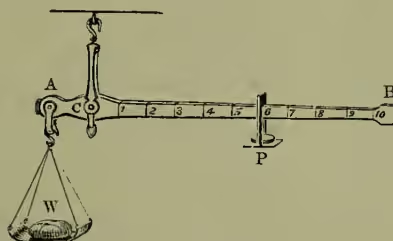
Its construction is indicated in fig. 3. AB is the beam, and C is the fulcrum. Taking the particular case indicated in the diagram, it is evident from the principles of the lever that the mass W is six times the mass P. As the steelyard is ordinarily made, the long arm is heavier than the short one, and therefore the graduation commences from a point between A and C, and not at C.
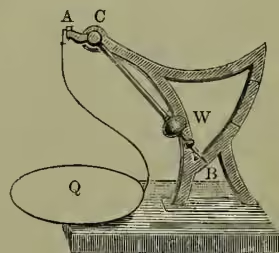
The Bent Lever Balance (Fr. peson, Ger. Zeigerwage), shown in fig. 4, is a lever of unequal arms, A, C, B, moving round the pivot C, having a scale, Q, attached to the shorter arm AC, and a fixed mass, W, to the longer arm CB. The longer arm ends in a pointer moving in front of a fixed graduated arc. When a body is put into the scale, the pointer rises from the bottom or zero point of the arc, and rests opposite the mark corresponding to its weight. The higher the mass W rises, the greater becomes the moment of its weight, and the greater must be the mass whose weight it balances. The arc is generally graduated experimentally.
For other weighing apparatus, see WEIGHING-MACHINES; and for the law of unjust weighing, see WEIGHTS AND MEASURES.
Spring-balance.—The commonest form of the spring-balance, known as Salter's Balance, is shown in fig. 5. It consists of a spring in the form of a cylindrical coil in a metal case, which it about half fills when at rest. The upper end of the spring is fixed through the top of the case to a ring by which it is suspended for use. To the lower end of the spring a rod is attached having an index-pointer working through a slot in the front plate of the case.

The substance to be weighed is fixed on a hook at the bottom end of the rod, and the weight as indicated by the stretching of the spring is read off on the scale (a part of the front plate has been removed in the figure, to show the spring inside). Another common form, called the Household Balance, is made to stand on a table, and has a dial-plate on which an index-finger registers the weight. The article to be weighed is put into a pan on the top of the balance. From the under side of the pan a rod goes down into the case; a cross bar at the bottom of this rod is attached to the lower ends of two coiled springs, the upper ends of which are fixed. A rack on the side of the rod, acting on a toothed wheel in conjunction with a system of levers, transfers the action of the rod under the weight in the pan to the index-finger, which registers the amount on the dial-plate. Spring-balances are also made in a great many other forms, and for various purposes, such as letter balances, parcel balances, &c.; but the principle in all is the same—viz. the stretching of a spiral spring. They have no pretension to great accuracy, but are in extensive use for ordinary purposes, and have the advantages of being portable and having no weights to get lost. The spring-balance is also used as a Dynamometer (q.v.).