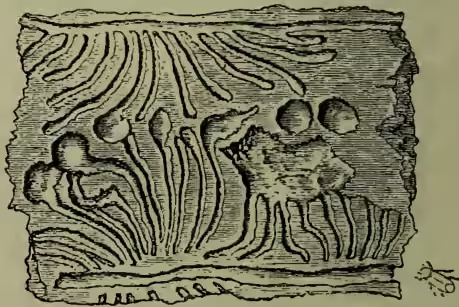
Bark-beetles, a name loosely applied to a number of Coleoptera which devour the bark of trees. Some of them are members of a family known to entomologists as Xylophaga, or wood-eaters. Many beetles eat wood and such substances, but the forms in question are of special importance as forest pests. The adults are not content, like so many other beetles, with finding underneath the loose bark of trees a safe nursery for their larvæ, but bore passages, whence the larvæ again bore outwards, so doing great damage. Thus the Typographer Beetle (Tomicus typographus) bores, pairs, and breeds in the bark of pine-trees, and the larvæ, laid in side recesses, eat their way out laterally, leaving their mark in the form of the curious galleries described by the title 'typographus.' In 1783 this beetle is said to have ravaged the Harz Forest in Germany to the extent of a million and a half of pines, and so revived its popular name of 'the Turk,' by which it is referred to in some old German liturgies. Another Pine-beetle (Hylurgus pini-perda) is also a formidable devastator. The maggots develop in recesses from the main tunnel, bore their way through the bark, fly to other trees, and eat into the tender shoots. It is this last habit which is obviously most injurious. The tender bark of the young shoots of the Scotch fir, spruce, larch, &c. is the favourite food of the Pine-weevil (Hyllobius abietis), while the maggots form winding galleries in the soft wood under the bark. The Ash-bark Beetle (Hylesinus fraxini) is a frequent pest in plantations where thinning and removal of sickly branches is insufficiently attended to. Another common form is the Elm-bark Beetle (Scolytus destructor). The female makes a burrow about 3-5 inches long, and lays a hundred or more eggs.
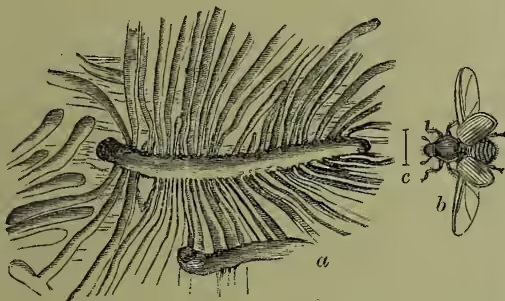
The restless grubs bore outwards as usual at right angles to the parent gallery. As a curative device, the outer bark of elms is sometimes removed, with the result of causing a vigorous flow of sap, which in some way or other kills the maggots. For further information as to these frequent and formidable pests, which are of no little practical importance, Miss Ormerod's work on Injurious Insects may be consulted. The same work gives an account of some of the necessary precautions of thinning, cleaning, &c., as well as of the curative processes of washing, scraping, and the like. See BEETLE, WEEVIL.