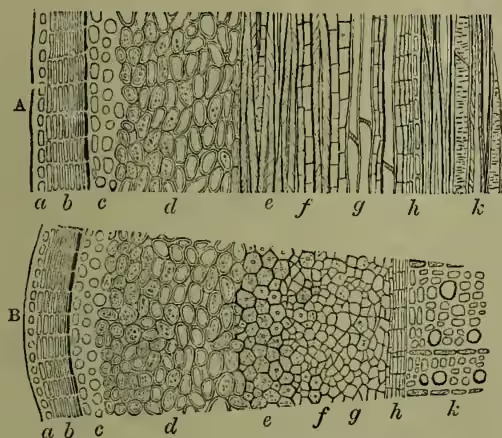
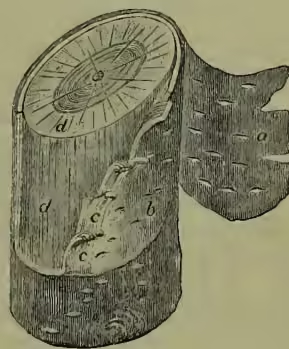
Bark. The hard outer covering of any stem is often popularly called bark, or by botanical writers, cortex. But since in ferns this may be merely a thickening of the outer layers of the cellular envelope, into which the fibro-vascular bundles do not enter, while in monocotyledons the protective layer is not merely a hardening of the epidermis and cellular envelope, but may be firmly interwoven by the fibro-vascular bundles, and in fact indistinguishable from the inner portion of the stem, save as a region so to speak mechanically differentiated by exposure, botanists are accustomed to restrict the term bark to the outer portion of the dicotyledonous stem (see DICOTYLEDONS), and especially to that of woody and perennial stems. In succulent and herbaceous plants, and young shoots of shrubby or herbaceous ones, the stem structure resembles that of lower plants; the epidermis (which may be sooner or later for practical purposes supplemented or replaced by a subjacent layer of cork) protects the green parenchymatous layer, or cellular envelope, which performs leaf functions, and is, in fact, continued upwards through the leaf-stalks into the parenchyma of the leaves. Below this layer we come to the fibro-vascular bundles, which lie simply in a loose but anastomosing ring, or rather cylinder, through the meshes of which the external cellular envelope and the internal pith are in direct continuity. When, however, the dicotyledonous stem becomes perennial, its fibro-vascular bundles continue to grow through the combined multiplication of a central layer of persistently embryonic cells, the so-called cambium; the new cells next the inner or woody portion of the bundle develop into a second layer of wood outside the first; in the same way, the new cells next the outer or bast portion of the bundle form a new layer of bast, of course lying within the first (see BAST), and this process being repeated every spring, as many layers of wood and bast tend to be formed. The formation of bast is, however, usually less regular than that of the wood. This growth of the fibro-vascular bundles limits the outer portion of the cellular matrix, or cellular envelope, from the internal portion or pith much more sharply than before; yet the cellular continuity is still kept up, although the intermediate cells become compressed and elongated into radiating plates, the medullary rays. And since the cambium elements of the bundles unite to form a continuous cylindrical layer, it is evident that it is in this region of excessively delicate and thin-walled protoplasmic cells that any mechanical force applied to the stem will cause rupture. Unlike the fibro-vascular bundles of ferns, monocotyledons, or even herbaceous dicotyledons, the bast and wood of the fibro-vascular bundles of the perennial dicotyledonous stem are thus readily split asunder; the woody layers inclosing the pith are thus left exposed, while the bast layers of the bundles, with, of course, their external coverings of cellular envelope, cork, and epidermis, are thus peeled off as a hollow cylinder, while the torn cambium covers both separated surfaces with its wet and viscous remnants. Botanists were formerly wont to regard this mechanically or accidentally separated 'bark' as a distinct structure or organ highly characteristic of dicotyledons, and to distinguish its layers as parts of a natural whole, the epidermis and cork, the cellular envelope, and the bast being respectively termed outer, middle, and inner bark, or epi-, meso-, and endophloem; but these useless and confusing terms are now happily abandoned by careful writers, since they are no more of physiological than of morphological importance. The functions of the different layers of bark are, of course, as entirely distinct as is their origin; the protective function of the epidermis, even with its cuticle, being insufficient, this is supplemented by the corky layer, which grows continuously from a layer of permanently embryonic cells, the cork cambium (see CORK). The cellular envelope continues to vegetate, more or less actively, so long as any light finds its way through the cork layer, air too finding access through loosened openings of this, the lenticels; while the functions of the bast are more complex, and are separately discussed (see BAST). The tannin and other important principles to which bark so often owes its economic importance, are usually to be regarded from the standpoint of vegetable physiology not as reserve materials, but rather as waste products of the plant's activities, which are either contained in the laticiferous vessels, or deposited in the cellular envelope and in the cells of the soft bast by the descending sap. The outer layers of thick barks usually crack as the stem expands within; but in the lace-bark tree of the West Indies (Lagetta lintearia) the bast fibres separate regularly, and layer after layer may thus be stripped off, showing lozenge-shaped meshes arranged with beautiful regularity.
Bark for Tanning.—The bark of many trees is capable of being used for Tanning (q.v.), but those kinds are usually preferred which are rich in tannin (see TANNIC ACID), although other properties besides the percentage of tannin determine the value of a bark for preparing leather. Oak bark from Quercus robur and pedunculata are used more than all other kinds in Europe, and contain from 7 to 11 per cent. of tannin; but the barks of willow, larch, Scotch fir, birch, and alder are likewise applied to a considerable extent. That of the Chestnut (Castanea vesca) is much esteemed. From both bark and wood of this tree an extract is made in France which is largely used both in tanning and dyeing. In Spain, tanners employ the inner layer of the bark of the cork oak. Three species of oak are used for tanning in the United States—namely, Quercus tinctoria, prinus, and falcata; the former two contain about 6 per cent., and the last 8.6 per cent. of tannin. West of the Rocky Mountains, the bark of the Quercus densiflora, which contains 16.5 per cent. of tannin, is preferred. But the bark most used for tanning, both in the States and in Canada, is that of the Hemlock Spruce (Abies Canadensis). It contains from 14 to 16 per cent. of tannin. This bark has become so much used for tanning, and its extract for both dyeing and tanning, that the annual production of it in the United States has reached the enormous amount of 1,100,000 tons, while the quantity of oak bark used does not exceed 355,000 tons. Hemlock bark is largely exported from America. The Acacia decurrens, a tree indigenous to Australia and Tasmania, yields a bark very rich in tannin, and it has been much used in England. The bark of the Loxopterygium Lorentzii, from the Argentine Republic, contains 20 per cent. of tannin, and is very popular as a tanning material in France. Some of the above barks are transported in the form of extracts.
The barking of trees can be accomplished with facility only in spring, when the sap has begun to circulate. The tree being felled, the rough external lifeless parts of the bark are removed as useless by means of a sharp instrument called a scraper; the smaller branches are cut into lengths of about two feet, and their bark is loosened by beating with a mallet, and easily taken off—as boys at the same season make plane-tree whistles; the bark of the trunk and main branches is cut through by a chisel-like instrument, called a barking-iron, into similar lengths, each of which is divided longitudinally, and finally stripped off by the aid of mallets, chisels, &c. The bark is sometimes dried in sheds, being placed on narrow shelves or frames in such a way that there may be a very free circulation of air about it; sometimes in the open air, when it is very generally made to rest in a sloping position against trunks of trees placed horizontally at a little distance from the ground, or against racks formed of forked sticks with cross-bars. The larger pieces of bark are placed so as to protect the smaller both from sun and rain. Great care is necessary in the drying of bark, as it is much spoiled if allowed to get mouldy, and is liable to suffer injury from rain or from the exposure of its inner surface to the sun. Bark was, and to some extent still is, a very important source of the revenue derived from many woods and coppices; but in numerous dis- tricts of Great Britain, oak and other coppice-wood is no longer a profitable forest crop, owing to the low price to which bark has fallen.
Uses of Bark by Savage Races.—In the ethnographical collections of many museums will be found some curious applications of bark. Some tribes of North American Indians make their canoes of birch bark, and in British Guiana they are made of the bark of Purple Heart (Copaifera pubiflora) and of Locust (Hymenaea Courbaril). Of birch bark, the Red Indians also construct baskets, cans, &c. In Sweden it is used as a material for carved boxes, and in Lapland for baskets and shoes. Coats are made in British Columbia from pine bark, and this garment is formed of an elm bark by the Ainos of Japan. In both cases the bark is woven in strips. Some aboriginal races make blankets and various articles of clothing of prepared bark from different trees, which in some cases is thick and woolly, and in others thin and papery. A kind of lace is obtained from the Lace-bark (q.v.) of Jamaica. Paper is made in different parts of the world from the bark of a number of species of trees, but some kinds are used quite locally (see PAPER). At least one aboriginal tribe in Australia form their shields of bark. Bread of birch bark is eaten in North-west America; and in Norway and Lapland, in times of scarcity, of that of elm and pine. One of the most primitive cooking-vessels known is made of bark, and is used by the Shompengs inhabiting the interior of the Great Nicobar.
Bark in Medicine, &c.—The principal barks used in medicine will be found noticed in separate articles. Amongst them may be noted Angostura Bark (Cusparia); Cascarilla (Cascarilla Bark, Elentheria Bark); Cascara (Sagrada Bark, Sacred Bark, California Buckthorn Bark); Cinchona (Cinchona Bark, Peruvian Bark, Jesuits' Bark, China Bark, Arica Bark, Calasaya Bark, Crown Bark, Condaminea Bark, Loxa Bark, Ledger Bark, Red Bark, Quill Bark, &c.); Cinnamon Bark; Winter's Bark; Witch Hazel (Hamamelis); Bebeerine.—When bark is mentioned without any prefix, it is usually Cinchona, otherwise called Peruvian or Jesuits' Bark, that is intended.
The barks used for dyeing, tanning, and other purposes in the arts, being generally named from the trees which produce them, particular references here are unnecessary.