Barley (Hordeum), a cereal or grass crop. In ordinary cultivation it is annual, but some hardy varieties are sown in autumn, and except in severe winters, survive and ripen the second year, or if frequently cut green and not allowed to mature seed, may continue to grow for several years. The cultivation of it extends from Italy northwards in Europe. It is better adapted than any other grain to the most northern regions of the grain-growing belt. Some of its varieties are cultivated with advantage where the climate is too cold, or the summer too short, for any other cereal crop. It extends over a wider climatic range than any of the other grains. Barley-meal is used for bread in the north of Europe, but in other parts it is used as a horse-corn, or converted into malt for the making of beer, or deprived of its outer husky covering, and so used as an article of human food called pot-barley, or when well rounded and polished in the mill, pearl-barley: this is sometimes ground into a fine quality of barley-meal.
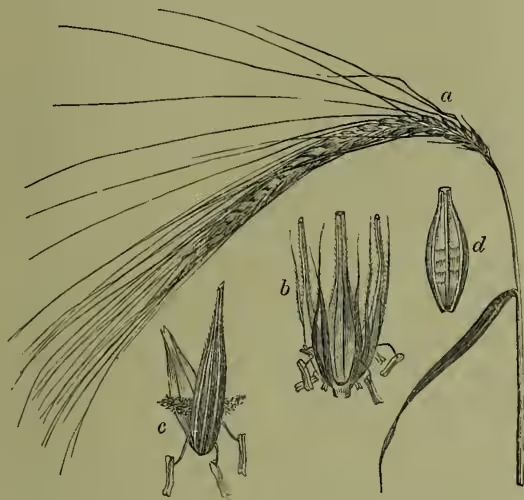
By botanists cultivated barley in England is divided into three species. H. vulgare (Scotch Bere or Bigg) is distinguished by having the grains in four rows; H. hexastichum in six rows; and H. distichum in two rows. But the lower part of the spike in the varieties ranked under H. vulgare is often six-rowed, and only the upper part four-rowed; and in rich soils, a tendency to resume the six-rowed form is otherwise manifest. A kind with naked seeds, called Siberian Barley (H. cœlcste of some writers), is cultivated in some parts of Europe, but it is liable to loss in harvest through the grain, which is slightly attached to the straw, shaking off; its straw is regarded as richer food for cattle than that of most other kinds. The Nepal or Himalaya Barley, another variety with naked seeds, has been recommended as particularly adapted for cold mountainous regions, yielding good crops in the Himalaya at an elevation of 14,000 feet above the sea.—Of the two-rowed barley there are many varieties, of which the Common or Early English, Golden Drop, Big Ben, Hallett's Pedigree, and the Chevalier are among the most esteemed, the latter being in particular demand for brewing. The Sprat or Battle-dore Barley (H. zeocriton) is also two-rowed, but is distinguished by the grains standing out from the spike, their awns spreading very widely. It is sometimes called German Rice, as it is sown by boiling in the way that rice does, and for some purposes forms a good substitute for it. It is scarcely cultivated in Britain, but is in much esteem in Germany, and succeeds well in the Alps at an elevation of 3360 feet.
H. pratense and H. murinum are barley grasses seen in natural British pastures, but are of no practical value.
Barley is most productive where the climate is moderately dry and warm. No country seems to possess a soil and climate better suited to its growth than many parts of Britain. In former times, this grain was largely employed in the British Islands as human food; and is still used in some parts of Ireland, and in the Highlands of Scotland. Fine malting barley always commands a ready demand in the London market, as well as a high price.
Barley occupies a prominent place in the rotation of the lighter class of arable lands, such as in Suffolk and Norfolk. Fine malting qualities are grown on the turnip-soils of these counties, as well as throughout the south-eastern counties, where the four-course rotation is adopted. In this rotation, the barley follows the turnip-crop. The ground is worked into a fine tilling condition on the surface, and the seed is either broadcast or drilled in February or March, depending on the weather and the condition of the soil, at the rate of two, three, or four bushels to the acre. On strong land or on very rich soils, the barley-crop is sown after a grain crop, say wheat, as it is found to give a better quality, though not such a heavy crop. In the south of England, barley is allowed to stand till the grain is fully ripe, when it is either cut with the scythe or most commonly now with the reaping-machine. In some parts, where the straw is very short and the bulk small, it is not bound up into sheaves, but remains in the swath for a few days, when it is afterwards carted, and stored in barns or oblong stacks. The produce is more influenced by the seasons than that of wheat, as it is liable to suffer from droughts in the early part of the year, and when sown late in very dry seasons, it sometimes remains for weeks and months without germinating, and never comes to a crop. This is all the more striking when it is remembered that if sown under favourable conditions, barley germinates more quickly than any other grain crop, being up within three or four days. On well-farmed land, from 48 to 60 bushels and upwards are got to the acre. In the peaty soils of the fens of Lincolnshire, barley is not raised, as it is too liable to lodge with the rain; neither is it a favourite crop in the moist climate of the west of England.
Barley has long been grown in Scotland. The level parts of the Lothians and other counties in the east of Scotland, with Moray, Inverness, and Ross in the north, are the districts in which the finest crops are raised. In these districts barley is commonly sown after a portion only of the turnip-break. Morayshire barley has long been famous for its fine sample, and is in great demand with English brewers. On the other hand, in the less genial climate of the western counties, and also of the upper parts of Aberdeenshire, Banffshire, and Perthshire, less barley is sown, and oats frequently succeed the green-crops. In these parts the variety known as bere, or bigg, is preferred to any other, as it is not so liable to lodge, and it withstands wet weather better, and comes earlier to maturity. Bere is the variety which is cultivated by many of the small cotters in the Highlands and islands. Instead of a rotation in which green-crops find a place, a succession of corn-crops is taken, and an occasional rest is given to the soil. The crop, when ripe, is cut by sickle, scythe, or reaping-machine; bound up at once, and put into stocks, to defend it from the weather till ready to cart, and to be built up in neat round stacks. The grain is invariably thrashed out by machinery.
On good turnip-soils the land is enriched by the droppings of the sheep, frequently fed on cake and corn along with the roots, and manure is not often directly applied to the barley-crop. When the turnip-crop is drawn from the land, unless the soil is very rich, the barley should have a dressing of some phosphatic manure, say 3 cwt. or 4 cwt. per acre of superphosphate bone-meal, or fish-guano, at the time of sowing, and 1 cwt. of nitrate of soda after the plant is well up, and the roots spreading through the soil.