Barnacle (or BERNICLE) GOOSE (Anser bernicla or Bernicla leucopsis), the bird which the natural history of former days gravely represented as deriving its origin from a crustacean—the barnacle. In the middle ages, during which has been well called the period of mythical zoology, the enigmatical structure of the barnacle (Lepas anatifera), known in Germany as the 'duck-mussel'
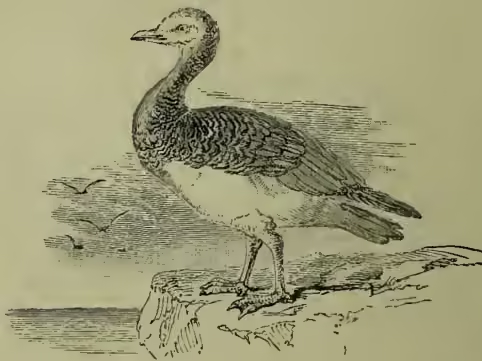
(Enten-muschel), somehow led it to be regarded as the young stage of the barnacle goose. The bird is in size smaller than the common wild goose, being a little more than 2 feet long, and about 5 lb. in weight. The bill is somewhat longer than the head, the wings long and pointed, the tail short and rounded, the black and white plumage very prettily marked. It is a common winter visitor of the western coasts of Britain and of Ireland, and retires in spring to its home in more northern regions, where it breeds, vast numbers passing northward along the coast of Norway to the Arctic Ocean. It is highly esteemed for the table.
The Brent Goose, or Brent Barnacle (Anser or Bernicla brenta of some naturalists), has frequently received the name of barnacle goose, and no little confusion has thus arisen. It is a smaller bird with much darker plumage, remarkable for length of wing and powerful flight, and for its distant migrations. It is at home in high northern latitudes, but occurs as a common winter bird-of-passage in the United States and Canada, as also in Britain and on the continent of Europe. It is excellent for the table.
Very nearly allied to these species is the Red-breasted Goose, or Red-breasted Barnacle (Anser ruficollis), a beautiful bird, of which the neck and upper part of the breast are of a rich chestnut red. In size, it resembles the brent goose. It is a very rare visitor of Britain and of the continent of Europe, and is abundant only in the extreme north of Asia.—Another species called Hutchins' Goose or Barnacle (A. hutchinsii), of dark plumage, and with a triangular patch of white on each side of the head and neck, is abundant in Hudson Bay and the extreme north of America. The limits of the genera Anser and Bernicla are rather dubious. See GOOSE.