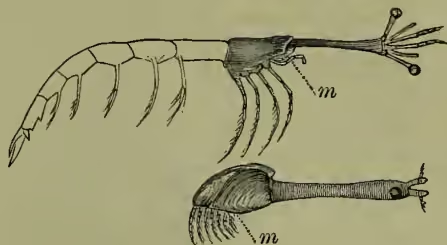
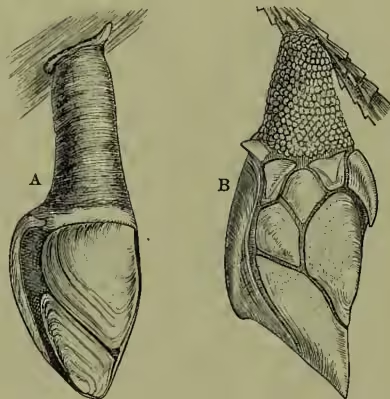
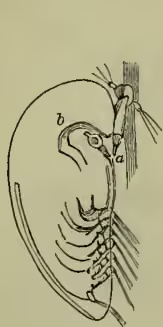
Barnacle, a common crustacean, technically known as Lepas, and belonging to the group of stalked Cirripedia (q.v.). Like the closely allied sessile acorn-shell, a barnacle may be said to be a crustacean fixed by its head, and kicking the food into its mouth by its legs. So much are they disguised, however, in their fixed state, that they were formerly referred to the class of molluscs. Careful examination of the adult or inspection of the young form at once demonstrates the really crustacean character of the animal. Though the barnacle is very markedly distinguished from the acorn-shell in the development of a fleshy and contractile stalk, the general structure is very much the same (see ACORN-SHELL). There is the same complex valved shell, the same six pairs of waving thoracic legs, the same cement-gland aiding by its secretion to effect attachment, the same hint of degenerate antennae on the fixing surface, and so on. Like most of the Cirripedia, barnacles are hermaphrodite, while some nearly related forms exhibit minute, almost exclusively reproductive, 'complemental' males in close association with the normal hermaphrodites, or with females.
What has been already noted in regard to the life-history of acorn-shells, applies equally to barnacles. Little Nauplius (q.v.) larvæ escape from the egg-cases, and after moulting several times, pass into a second stage, like such waterfleas as Daphnia or Cypris. The first pair of appendages become suctorial, and after a period of free-swimming, the pupa settles down on some floating object, mooring itself at first by means of its antennary suckers, but rapidly becoming glued by the secretion of the cement-ducts. After fixing, important changes in structure and position speedily occur, the valved shell is developed, and the perfect adult form gradually assumed. The food consists of small animals swept to the mouth by the curled waving legs. Growth is somewhat rapid, but the skin-casting of the adult is, except in one genus, much restricted. Neither the valves nor the uniting membrane, nor that forming the stalk, is moulted, but the surface gradually disintegrates and is removed, perhaps sometimes in flakes,
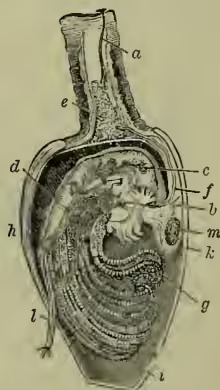
whilst new and larger layers are formed beneath. The commonest species, Lepas anatifera, is sometimes 16 inches in length, but most of this goes to the stalk.
The stalked Cirripedia have a world-wide distribution, especially, however, in the warmer seas. Nearly half of the Lepadidae are attached to floating objects, and are therefore peculiarly cosmopolitan. Some species are able to bore (Lithotrypa), and more than one form has been found on shark, turtle, or whale. The stalked cirripedes are much more ancient than the sessile Balanidae, their golden age dating back to the cretaceous period. The history of knowledge in regard to the barnacle is a striking illustration of progress. While the early naturalists, such as Gerard (1597), abandoned themselves to the citation of popular myths, according to which the barnacle was the young form of a goose (see BARNACLE GOOSE), the animal became at a later date the object of serious but not exhaustive study, and was referred to the Mollusca, or regarded as intermediate between them and Crustacea; while within the last fifty years the discovery of the life-history has made the position of these interesting forms entirely intelligible, and the monograph of Darwin has furnished an approximately complete diagnosis of all the forms known in 1857. Subsequent research has only been an amplification and corroboration of his classic work. Apart from their occurrence on ships, floating timber, &c., the stalked cirripedes have little practical interest, except that a few forms (Pollicipes) are, like some of the acorn-shells, big and dainty enough to be eaten. See ACORN-SHELLS, CIRRIPEDIA; Darwin's Ray Society Monographs; and Max Müller's Science of Language (2d series), for the myth of the barnacle goose.