Barometer (Gr. baros, 'weight,' and metron, 'a measure'), an instrument for measuring the weight or pressure of the atmosphere, invented in 1643 by Torricelli (q.v.). The term is generally understood to refer to one in which the measure is the height of a column of liquid sustained by atmospheric pressure. The fundamental principle of the construction of the barometer is best shown in the experiment which led Torricelli to the discovery of the pressure of the air. A glass tube, about 33 inches in length, open at one end, is completely filled with mercury, and, being firmly closed by the thumb, is inverted and placed vertically in a cup containing mercury. When the thumb is removed, the mercury sinks in the tube till it stands, generally, about 30 inches above the level of the mercury in the cup, leaving in the upper part a space free of air, which receives the name of the Torricellian vacuum (fig. 1). The mercury within the tube being thus removed from the pressure of the air, while that in the cup is exposed to it, the column falls, till the pressure at the section of the whole, in the same plane as the surface of the mercury in the cup, is the same within and without the tube. A similar experiment is seen when, in a U-shaped tube, having one branch much wider than the other, a column of mercury in the narrow branch balances a column of water nearly 14 times as high in the other. In the Torricellian experiment, we have the air and the space occupied by it taking the place of the wide water branch of the U-shaped tube, and the glass tube and mercury forming the narrow branch, as before; the narrow branch, however, in this case being closed above, to prevent the air from filling, as it were, both branches. In both cases, the heights of the columns are inversely as the specific gravities of the liquids of which they consist; and as air is about 10,000 times lighter than mercury, we should have the aerial column 10,000 times 30 inches high. It will be found, under ATMOSPHERE, that from the air lessening in density as it ascends, the height is considerably greater. Any changes that take place in the density of the aerial column will be met by corresponding changes in the height of the mercurial column, so that as the latter rises or falls, the former increases or diminishes. We have, then, in this simple tube, an infallible index of the varying amount of atmospheric pressure, and, in fact, a perfect barometer. The changes, however, are indicated on a scale at least 10,000 times diminished, so that the variations in the tube show very considerable changes in the weight of the atmosphere. If water be used instead of mercury, the water column would be 14, or, more correctly, 13.6 times as high as the mercurial column, or about 34 feet; and the scale on which the changes take place would be correspondingly magnified, so that a water barometer should be much more delicate than a mercurial one. Water is, however, exposed to this serious objection, that its vapour rises into the empty space above, and causes by its elasticity a depression of the column, the depressions being different for different temperatures. At zero, Fahrenheit, for instance, the depression thus arising would be half an inch, and at 77°, more than 1 foot. It would be doubtful, likewise, at the time of any observation, whether the space referred to was filled with vapour of the elasticity corresponding to the observed external temperature or not, so that the necessary correction could not with certainty be made. The vapour of mercury, on the other hand, at 77° F.—a temperature considerably above the average—produces in the barometer a depression of only of an inch, an amount practically inappreciable. After 200 years of experience and invention, we have yet no better index of the pressure of the atmosphere than the simple mercurial column of Torricelli, and in all exact observations it is, in one modification or another, taken as the only reliable standard.
Simple as the barometer is, its construction demands considerable care and experience. It is of the first importance that the mercury to be used is chemically pure, otherwise its specific gravity and fluidity are impaired, and the inside of the tube becomes coated with impurities in such a way as to render correct observation impossible. Mercury as usually sold, is not pure; and before being employed for barometers, must be shaken well with highly dilute but pure nitric acid, to remove extraneous metals and oxides. The same object is effected more thoroughly by keeping it several weeks in contact with the dilute acid, stirring every now and then. After either process, the metal must be thoroughly washed with distilled water, and dried. In filling the tube, it is essentially necessary to get the column free from air and moisture. To effect this, the mercury, after filling, is boiled in the tube, so that air and moisture may be expelled, partly by the heat, and partly by the vapour of the mercury. This process demands great experience and skill, but the same end may be more easily and as effectually attained by boiling the mercury, in the first instance, in an atmosphere of carbonic acid, and then pouring it into the previously heated tube by a filler reaching to the bottom of it. Such care is only expended on the best instruments; ordinary weather-glasses, not needing to be quite accurate, are more simply filled. Notwithstanding all these precautions, minute bubbles of air may manage to keep secreted, and creep up in the course of time into the Torricellian vacuum. To obviate this risk of error, an air-trap is recommended by which any air that may accidentally find its way into the tube, or may be left in it, is arrested in its ascent to the top, and any damage to the instrument averted.
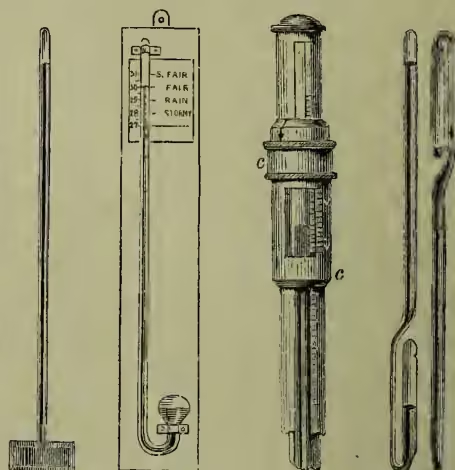
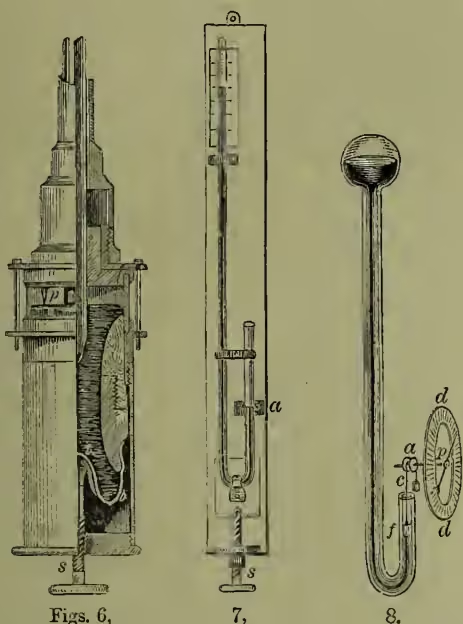
Barometers are usually divided into two classes—cistern barometers, and siphon barometers. The simplest form of the cistern barometer is that shown in fig. 1, which only requires to be set properly in a frame, and provided with a scale, to make it complete. Fig. 2 presents another form of that class, being that generally seen in weather-glasses or ordinary barometers. The tube is bent at the bottom, and the cistern is merely an expansion of the lower end. Very generally, the cistern is hidden from view, and protected from injury by a wooden cover in front. There are two causes of inaccuracy in cistern barometers—one being the capillarity, which tends to lower the column; and the other being the difference of level in the cistern caused by the fluctuations in the tube, which renders the readings on the fixed scale at one time too great, and at another too small, according as this level rises above or falls below the original level, or zero-point, from which the scale is measured. The effect of capillarity may be avoided by using tubes of more than half an inch in bore, in which the depression becomes so small that it may be left out of account. In smaller tubes it is estimated from tables constructed for the purpose. Wide tubes have the additional advantage, that atmospheric changes are seen earlier in them than in narrow tubes, there being less friction in the wider than in the narrow. With reference to the error of level, it must be borne in mind that the height of the column sustained by the atmosphere is always to be reckoned from the surface level of the mercury in the cistern. The larger the capacity of the cistern compared with that of the tube, the less becomes this error; for then a very considerable rise or fall in the tube, when spread over the surface of the cistern, makes only a slight difference of level. Care should then be taken to make the cistern as large as possible. The barometer in which the error of level is completely obviated, is that invented by Fortin, which, from its being in every respect the most perfect cistern barometer, deserves particular notice. The cistern, and the lower portion of the tube of this barometer, are shown in fig. 6. The cistern is made of boxwood, with a movable leather bottom, bb, and a glass cylinder is inserted into it above, all except the glass being encased in brass. In the bottom of the brass box a screw works, on the upper end of which the leather rests, so that by the sending in or taking out the screw, the bottom of the cistern, and with it the cistern level of the mercury, can be raised or depressed at will. A small ivory pin, p, ending in a fine point, is fixed to the upper frame of the cistern; and when an observation is made, the surface of the mercury is made to coincide with the point of the pin as the standard level or zero-point from which the barometric column is to be measured. The tube of the barometer—the upper part of which is shown in fig. 3—is inclosed in one of brass, which has two directly opposite slits in it for showing the height of the column, and on the sides of these the graduation is marked. A brass collar, cc, slides upon the tube with a Vernier (q.v.), vv, marked on it for reading the height with great exactness, and in which two oblong openings are cut, a little wider than the slits in the
7,
8.
brass tube. When a reading is taken, the collar is so placed that the last streak of light is cut off by the two upper edges of the openings, or until they form a tangent to the convex mercurial curve. By this means, the observer is sure that his eye is on a level with the top of the column, and that the reading is taken exactly for this point. This is the contrivance usually adopted to prevent the error of parallax, or that caused by the eye being slightly above or below the top of the column, by which the scale and the top of the column are projected too high or too low, the one upon the other, as the case may be. The only other arrangement worthy of mention for effecting the same object is that by Weber, who etches the scale on a piece of silverised glass placed over one side of the tube; and when—the mirror and tube being vertical—the image of the eye appears along with the vertex of the column, the eye is in the same horizontal line with it. Fortin's barometer is generally arranged so as to be portable, in which case the screw, s, is sent in until the mercury fills very nearly the whole cistern, by which the air is kept from entering the tube during transport, the leather yielding sufficiently at the same time to allow for expansion from increase of temperature. It packs in a case, which serves as a tripod when the instrument is mounted for use. On this tripod it is suspended about the middle, swinging upon two axes at right angles to each other, so that the cistern may act the part of a plummet in keeping the tube vertical—the position essential to all correct measurements.
The siphon barometer consists of a tube bent in the form of a siphon, having the same diameter at the lower as at the upper end. Fig. 7 represents a simple form of it. The tube travels along the board on which it is placed by passing easily through fixed rings or collars of brass. A scale, divided in inches and parts of an inch, is fixed on the upper part of the board; and when an observation is taken, the tube is adjusted by the screw, s, working below it, so that the top of the lower mercurial column may be on a level with the fixed mark, a, or the point from which the fixed scale is measured. In the best forms of the siphon barometer, both tube and scale are fixed, the latter being graduated upwards and downwards from a zero-point near the middle of the tube, and the height of the column is ascertained by adding the distances from it of the upper and lower levels. The siphon barometer is in some respects a more perfect instrument than the cistern barometer. In the first place, the bore at the upper and lower ends of the tube being the same, the depression arising from capillarity is alike for both, and the error from this cause disappears in taking the difference of the heights. In the second place, since the final reading is got from a reference to both upper and lower surfaces, the error in the cistern barometer produced by the different capacities of the tube and cistern is effectually avoided. On the other hand, the taking of two readings, one for each column, is a serious addition to the labour of observation, and means also additional risk of error. Gay-Lussac's siphon barometer (fig. 4) is bent near the bottom, so as to allow of the lower branch being placed in the same straight line as the upper one—a position highly favourable to accurate observation. When constructed for transport, the tube at the bend is narrowed, as in the figure, to a capillary width, which effectually excludes the air; and when the tube is inverted (fig. 5), being the position in which it is carried, the mercury is nearly all held in the longer branch. Such a tube when mounted, like Fortin's barometer, makes an excellent travelling instrument, and is comparatively light, from the small quantity of mercury it contains (see ANEROID).
The wheel barometer, originally invented by Hook, and generally seen as a hall or parlour ornament, has nothing to recommend it as a trustworthy instrument. Fig. 8 shows the main features of its construction. It is essentially an ordinary barometer, like the siphon barometer below, but having a cistern above, to increase the amount of variation in the lower branch. A small piece of iron or glass, f, floats on the open surface, and a thread is attached to it, and passed over a small wheel, a, fixed to a horizontal axis, to which it is kept tight by a small weight, c, hanging at the other end. A pointer, p, is fixed to the other extremity of the horizontal axis, which moves to the right or left of the dial, dd, according as the mercury falls or rises in the lower branch. The great sweep which the index takes, as compared with the comparatively minute variations of the mercurial column, is the only merit of this instrument. It is easy to see, that with so much intervening between the mercury and the index, the chances of error from hygrometric variations, friction, and other causes are very considerable.
The correction of the barometer for temperature is essential. Mercury expands of its bulk for every degree of Fahrenheit's thermometer; if, then, a barometer stands at a height of 30 inches when the temperature of the whole instrument is , it will stand at if its temperature be raised to . This increase of the length of the column by the tenth of an inch is not due to any increased pressure, but solely to the expansion of the mercury under a higher temperature. In order, therefore, that all observations may be compared correctly with each other, the observed heights are reduced to what they would be, if the temperature of the whole instrument with its contained mercury was at . The rule for reduction is very simple: Multiply the number of degrees above or below F. by the observed height, divide the product by 9990, and subtract or add the quotient from or to the observed height for the reduced height. Tables for this purpose have been published by the Royal Society, from which the corrections are found at once.
The variations of the barometer are both periodical and irregular. Periodical variations are those taking place at stated and regular intervals, and irregular, such as have no regular period of recurrence. Perhaps the only truly periodical variation is the daily one, which varies from about 0.150 to 0.001 inch. In most regions of the globe there is also a well-marked annual variation, widely different for different regions. Accidental variations give a range of about inches. The lowest hitherto observed is 27.333 inches, reduced to sea-level, at Ochertyre, Perthshire, on January 26, 1884 (see ATMOSPHERE); and at Barnaul, in Siberia, a pressure of 31.630 inches was recorded on December 16, 1877, where the temperature on that day fell to .
The uses of the barometer may be classified into physical, hypsometrical, and meteorological. It is of essential use in all physical researches where the mechanical, optical, acoustical, and chemical properties of air or other gases are dependent on the pressure of the atmosphere. Its use in hypsometry, or the art of measuring the heights of mountains, is very valuable. When a barometer is at the foot of a mountain, the pressure it sustains is greater than that which is at the top by the weight of the column of air intervening between the top and bottom. A formula of considerable complexity is given by mathematicians for finding approximately the true height of a mountain from barometrical and thermometrical observations made at its base and summit, the interpretation of which does not come within the compass of this work. The following rules give very nearly the same result: (1) Reduce the mercurial heights at both stations to F. (2) Take the logarithms of the corrected heights, subtract them, and multiply the result by 10,000, to give the approximate height in fathoms of the upper above the lower station. (3) Take the mean of the temperature at both stations, take the difference between this mean and 32, multiply the difference by the approximate height, and divide the product by 435. This last result is to be added to the approximate height, if the mean temperature is above 32, and subtracted, if below, to find the true height in fathoms.
The best known use of the barometer is as a meteorological instrument or as a weather-glass. Opticians sometimes attach to certain heights of the barometer particular states of weather, and at certain points of the scale the words 'Rain,' 'Changeable,' 'Fair,' &c., are marked; but the connection thus instituted is very misleading. All who would examine carefully the connection of barometric heights with changes of the weather, must discard entirely the use of these terms, seeing that it is not the actual height of the barometer at any place, but this height as compared with that of immediately surrounding regions, which indicates the weather and the strength of wind accompanying it. Several elaborate codes of rules have been drawn up to serve as a key to the variations, but as these are more or less of a local and hypothetical character, they would be here out of place. Generally speaking, a falling barometer indicates rain; a rising barometer, fair weather. A steady barometer foretells a continuance of the weather at the time; when low, this is generally broken or bad, and when high, fair. A sudden fall usually precedes a storm, and the violence of the wind is in proportion to the barometric gradient. An unsteady barometer indicates unsettled weather; gradual changes, the approach of some permanent condition of it. The variations must also be interpreted with reference to the prevailing winds, each different wind having some peculiar rules. The connection between changes of weather and the pressure of the atmo- sphere is by no means well understood. One or two points may, however, be stated. Since, as has been shown by Dalton, moist air is lighter than dry air, the barometric column will read relatively low wherever a large amount of aqueous vapour has displaced a part of the drier air. The south and south-west winds, which are, in Western Europe, more than any other, the rain-bringing winds, are warm and moist winds. Now, a column of such air, to be of the same weight as one of cold dry air, must be higher; but this cannot occur in the atmosphere, for no sooner does the warm moist column, by its lightness, ascend to a height where the pressure of the surrounding air is less than its own, than it ceases to rise farther, and thence flows over as an upper current in the directions where pressure is less. It follows that pressure is relatively low over any region where for the time the air is moister and warmer than in adjoining regions. On the other hand, the northerly and easterly winds, being comparatively cold and dry, are accompanied with fair weather and a high barometer. The rain attendant on a low barometer, as well as the fine weather accompanying a high barometer, are in a considerable degree to be regarded as the necessary concomitants of our geographical position—of our having the land to the east, and the ocean, with its large evaporating surface, to the west of us. In Great Britain a high and rising barometer frequently accompanies east winds with a drenching drizzle. On the La Plata River, on the other hand, matters are often the reverse of what they are with us; for there the cold south-east wind, coming from the ocean, brings rain with a high barometer, and the land winds, heated by the plains of South America, maintain fine weather with a low barometer. That the temperature, as well as the moisture of the air, is an important cause of the changes of the barometer, is also shown by the fact that, in the tropics, where the variations of the temperature are slight compared with the temperate zones, the barometer experiences almost no change; and also that the region of lowest mean barometer in Asia in summer is not the region of largest rainfall, but the region of highest temperature. See the standard works on Meteorology, such as the books by Blanford, Buchan, Kaemitz, Loomis, and R. H. Scott.