Bat. Bats form an order of mammals in which the fore-limb is modified for flight. To this fact their technical name Chiroptera (Gr., 'hand-winged') refers. The order includes a large number of widely distributed forms, and most people are familiar with the swift and curious flight of some of the common species which hunt for food in the twilight.
History.—Aristotle is often libelled by being accused of regarding these mammals as birds; but he was quite incapable of such a crude mistake. His successors were not, however, and many naturalists down to a couple of centuries ago were content to accept the popular appreciation of these animals as 'unclean fowls,' or to regard them as altogether hopeless puzzles. In 1683 John Ray referred them, with his usual clearness, to the class Mammalia; and Linnæus in 1748 gave them an honourable position along with man and monkeys in the highest mammalian order of Primates. Though often regarded as birds by those who are careless of zoological system, such popular names as Flitter-mouse (Ger. Fledermaus) indicate some appreciation of their true position. They are now most accurately described as a special order of much modified Insectivora.
General Characters.—Since bats are Insectivora modified for aerial locomotion, the most striking general character concerns the structures used in flight. A true wing is present, and consists of a skin-expansion spread out between the four fingers, and extending to the sides and to the hind-legs. An accessory membrane extends from the tail to the hind-legs. The fore-legs are much better developed than the hind pair—a marked exception to the general rule. The strong shoulder-girdle, the capacious chest, the very hollow bones of the limbs, the keel on the breast-bone, the position of the teats on the breast, the simple uterus and generally single birth, and many other general characters, are to be interpreted as adaptation associated with the flying habits of these mammals. The discoidal deciduate placenta, the comparatively low brain with uncovered cerebellum, and other features are shared with the Insectivora, and point to the origin of the bats from that group.
Classification and Distribution.—Two natural sub-orders may be distinguished—I. Megachiroptera, fruit-eating forms—generally large, with smooth crowns on the longitudinally grooved grinders, usually with a claw on the third joint of the first finger, inhabiting the warm parts of the eastern hemisphere; II. Microchiroptera, mostly insect-eating forms—generally small, with sharp insect-crunching tubercles on the transversely grooved grinders, with a usually single-jointed, never clawed, first finger, inhabiting the tropical and temperate regions of both hemispheres. (1) The frugivorous large bats form the family Pteropodidæ, including the African Epomophorus, the 'flying fox' Pteropus, most abundant in the Malayan and Australian regions, but never occurring in Africa, the Cynonycteris of the Egyptian pyramids, the very common Indian bat Cynopterus, and other genera. (2) The smaller insect-eating bats form much the larger sub-order. They comprise five families: (a) the Vespertilionidæ, including the common Pipistrelle and other Vesperugo species, the abundant North American Nycticejus, &c.; (b) the family Nycteridæ, such as the large
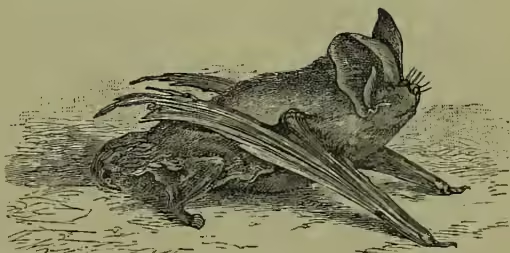
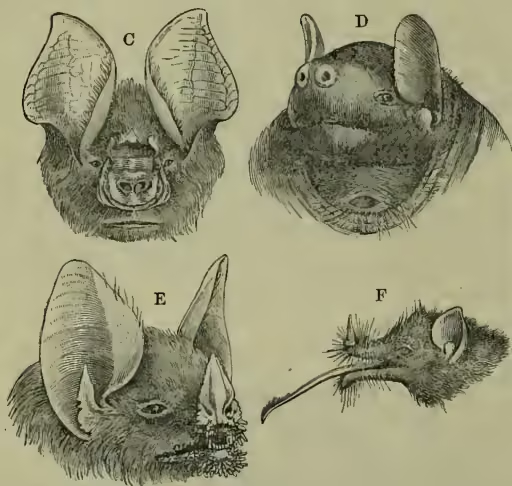
Queensland form (Megaderma gigas) (fig. 3), the common Indian species (M. lyra), and the very peculiar genus Nycteris of the Ethiopian region; (c) the family Rhinolophidæ, very highly developed bats, with complicated sensory nasal appendages—e.g. Rhinolophus and Phyllostomus; (d) the family Emballonuridæ, cosmopolitan forms with obliquely truncated snouts—e.g. Emballonura, Noctilio, Molossus, the New Zealand Mystacinus, &c.; and (e) the family Phyllostomidæ, inhabiting Central and South America, and often characterised by nasal appendages, including the remarkable Mormops, the Vampire genus, the blood-sucking Desmodus, &c.—The known fossil forms, going back apparently to the Upper Eocene, are all highly specialised, so that the Chiroptera must have diverged from the Insectivora at a very early date.
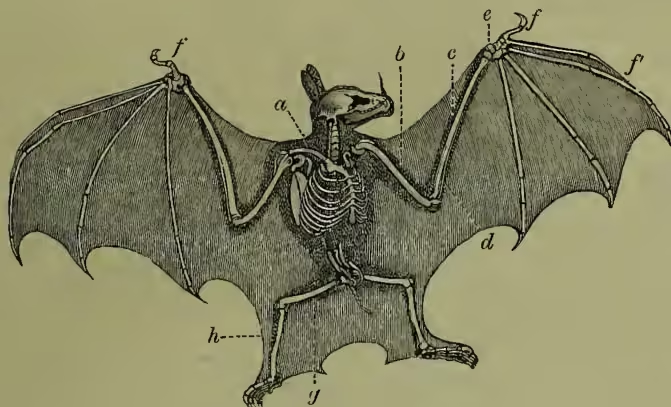
Structure.—The membranes of flight, the short hind-legs, the capacious chest, the frequent presence of nose-leaves, have already been noticed as external features which at once catch the eye. Some of the characteristic structures must be noted, however, at greater length: (a) Skin—The skin is more highly developed in bats than in any other order of mammals. On the one hand it is modified to form the flying fold, extending (1) from the shoulder along the upper arm to the thumb; (2) between the four fingers, and thence onwards to the legs; (3) between the back of the legs and the posterior extremity of the body. On the other hand the skin comes into close association with the sensory function of touch which bats are well known to possess in such a remarkable degree. Spallanzani showed that bats deprived of sight, hearing, and smell, could in a marvellous way fly about a room without colliding with numerous threads hung across it; they could fly through crooked passages, and detect the approach of a hand and the like. Fine nerve-filaments are spread out on the skin of various regions, such as the sides of the muzzle, the outer ear, the nose-plaits, the wing-membrane, &c. The margins of the nostrils and glandular eminences on the sides of the snout are in many forms developed into curious, much folded, leaf-like appendages, kept soft by the secretion of numerous oil and sweat glands, and rendered sensitive by the abundant distribution of nerve-endings. In some cases attaching suckers are developed near the thumbs. Scent glands and bags are frequently present as secondary sexual characters. (b) The skeleton—Three types of true wing occur among vertebrates. In the extinct Saurian Pterodactyls (q.v.) the skin forming the wing was mainly stretched on the greatly elongated little finger. In the wing of birds the digits are greatly reduced and modified. In bats, the bones of the palm (metacarpals) and joints of the four fingers are greatly elongated to serve as supports to the greater part of the membrane of flight. The clawed thumb is not included in uterus, is discoidal and deciduate (see PLACENTA), and the two mammary glands are situated on the chest or under the armpits.
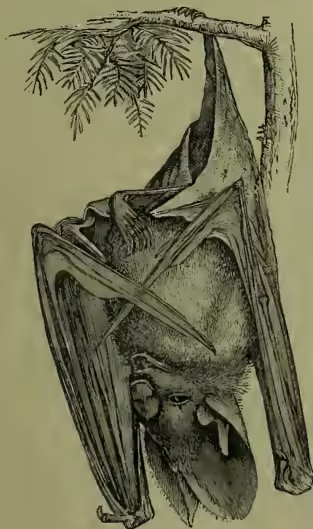
Habits.—Almost all the bats are nocturnal, and sleep during the day hitched up by their hind-legs, with their wings drawn over them. They come out in the twilight to hunt for food, and then their shrill squeak may not unfrequently be heard. The proverbial simile 'as blind as a bat,' must refer to their dazzled behaviour during the day, for they can see exceedingly well with their sharp eyes. Even apart from eyes they are able to steer their way adroitly, as the experiments of Abbé Spallanzani and others have shown. What Cuvier demonstrated in regard to the abundant distribution of nerves on various parts of the body is now known to be the correct explanation of their marvellous sensitiveness. It is also interesting to notice that the circulation of blood in the wings is so active as to amount almost to an inflammation—a suggestive fact in connection with their tender sense the wing, but is used for attachment or in the shuffling and awkward attempt at walking. The hind-leg is also utilised in flight as the support of the posterior membrane, and has undergone a curious rotation so that the knee is directed backwards. The claws of the hind-feet are used to attach the bat to the branch or support on which the animal usually rests head downwards. The breast-bone has a keel for the attachment of the powerful muscles working the wings, and thus to some extent recalls the similar structure on the sternum of flying birds. The whole shoulder-girdle is very powerful, and the hip-girdle very weak. In the insect-eating forms, where skilful steering through the air is required, the long tail serves as a sort of rudder. The skull and teeth vary greatly in relation to the different kinds of food. The bones are all slender, and the marrow canals in those of the limbs are especially large. (c) Other structures—The alimentary canal varies with the nature of food, being simpler and shorter in the insect-eating smaller bats. An exceptional type is exhibited by the blood-sucking Desmodus, where the blood is probably stored up in a long blind process from the stomach region. The brain is of a low type, but the tactile sensitiveness of the bats exceeds that of any other order. How the lips, nostrils, external ears, &c. come to be delicate organs of touch has been already noticed. The testes are on the abdomen or on the groin. The placenta by which the young bat—generally only one—is attached to the wall of the simple or horned of touch. Bats hibernate in winter, and are found in caves, barns, belfries, forests, &c. in large numbers. A minority feed on fruits, but most are insect-eaters, while a few (not including the vampire) suck the blood of small, and occasionally even of large mammals. The males and females often live apart.
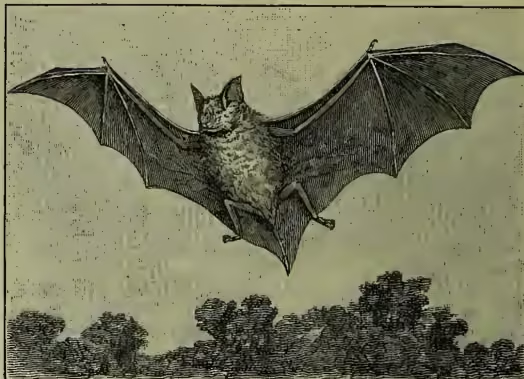
Important Forms.—Among the large fruit-eating bats, the Flying Foxes (Pteropus); the Great Kalong (Pteropus edulis), the largest of the bats (14 inches long); the fig-eating South African Epomophorus; and the destructive Indian Fruit-bat (Cynopterus marginatus) may be mentioned as representative. Some of these do great damage to fruits of various kinds. Among the smaller insectivorous forms, the Vespertilio alliance includes the Horse-shoe Bats, of which two species (Rhinolophus ferrum-equinum (fig. 1) and R. hipposideros) occur in Britain; the Lyre Bat (Megaderma lyra), often called vampires in India, and said sometimes to eat smaller bats, frogs, fish, &c.; the Desert Bat (Nycteris thebaica), which inflates its skin with air so as to form a balloon; the common Long-eared Bat (Plecotus auritus), often in church towers; the
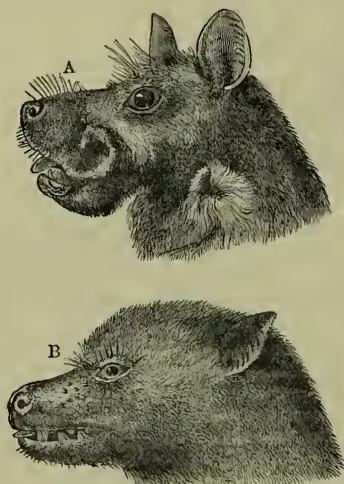
Barbastelle (Synotus barbastellus); the Noctule (Vesperugo noctula), the Pipistrelle (V. pipistrella), and two other species of Vesperugo occurring along with the four last-named bats in Britain; one of the two New Zealand bats (Chalinolobus tuberculatus); the Whiskered Bat (Vespertilio mystacinus), common in Europe, and also recorded in England. The thick-legged bats, or Emballonuridae, are represented by such forms as the Mountain Bat (Emballonura monticola), living a social life on the solitary mountains of the Eastern Archipelago; the Tomb Bat of Egypt (Taphozous perforatus); the curious Egyptian Rhinopome (Rhinopoma microphyllum), abundant in the darkness of the Pyramids; the very ugly Collared Bats with folded skin (Chiromes torquatus); the short-tailed New Zealand Bat (Mystacina tuberculata), which is fonder of walking than most of its kind. This species of bat, and the Chalinolobus noted above, 'represent the whole indigenous mammalian fauna of New Zealand.' The 'vampires,' or
Phyllostomidae, include a number of blood-sucking forms, but the chief guilt in this connection must be laid to the charge of Desmodus, which sometimes attacks mammals of considerable size, and even man. The Vampire Bat itself (Vampyrus spectrum) must be acquitted.
Bats form an order of great interest and importance to the naturalist. From a practical point of view they are of some importance so far as the one set destroy fruit-crops, and the others make up for this by destroying insects, while only a very few are somewhat more sanguinary. See MAMMALIA,
FLYING FOX, VAMPIRE; also Professor Flower's article 'Mammalia' (Encyclo. Brit. 9th ed.); G. E. Dobson's Catalogue of Chiroptera in British Museum (1878); and the same naturalist's Monograph of Asiatic Chiroptera.