Sword-fish (Xiphidae), a family of spiny-rayed Teleostean fishes, abundantly represented in tropical and subtropical seas. They are among the largest bony fishes, sometimes measuring 12 to 15 feet in length. The sword, which may be over 3 feet long, is formed from a compressed prolongation of the upper jaw, and is often strong enough to stab whales fatally, or less advantageously to pierce the bottom of a ship or the planks of a boat. The genus Xiphias is well represented by the common sword-fish (Xiphias gladius), abundant in the Mediterranean and in
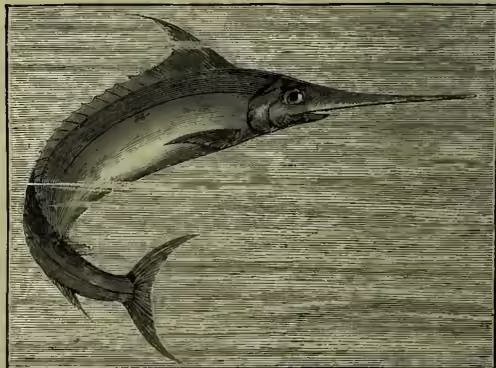
the warmer parts of the Atlantic and Pacific, and of rare occurrence on British coasts. They are found in schools, but never in close company; they feed on such fishes as mackerel, menhaden, and herring, which they kill with the sword, and also it seems on cuttle-fish. The flesh is somewhat oily, but is highly esteemed, both fresh and salted. With the regular sword-fish fishermen, harpooning is the mode of capture. The genus Histiophorus, the members of which are also called sail-fishes or bill-fishes, has a greatly developed dorsal fin or sail, and has long, compressed ventral fins which are absent in Xiphias. As in the true sword-fish, the young, with undeveloped swords, are very different from the adults. In summer Histiophorus occurs in the American seas as far north as New England, but it is strictly a tropical fish. Another form—the spear-fish—of similar distribution, is generally referred to a distinct genus, Tetrapturus. The bony sword-fishes must not be confused with the cartilaginous Sawfishes (q.v.) belonging to the Elasmobranch genera Pristis and Pristiophorus.