Sword. a weapon of offence consisting of a blade fitted into a hilt or handle, with a guard, the blade being formed to cut or to pierce, generally to do both. The sword is the most highly honoured of all weapons, a symbol of military dignity and authority; and it is the instrument with which the monarch confers knightly honours. Its forms and modifications, and the names under which, in different shapes, it has been known in different lands, and in successive ages, are beyond computation. It is sufficient to say that the general term includes weapons so diverse as the short cutting and piercing daggers and poignards and the ponderous two-handed swords of the 15th century. The blade may thus vary in length from a few inches to four feet and upwards. It may be furnished with a cutting edge on one side only, or on both sides. It may be uniform in breadth throughout with a truncated end, or it may taper from the hilt to a fine point. The blade, moreover, may have a piercing point alone, as in the rapier, and it may be curved throughout its entire length, as in the oriental scimitar. The hilt, with its many forms of guard, grip, and pommel, similarly adds to the variations of the weapon.
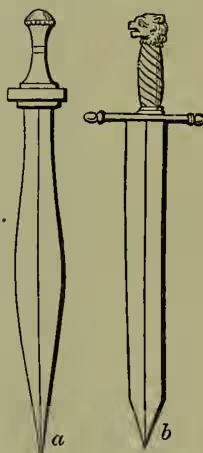
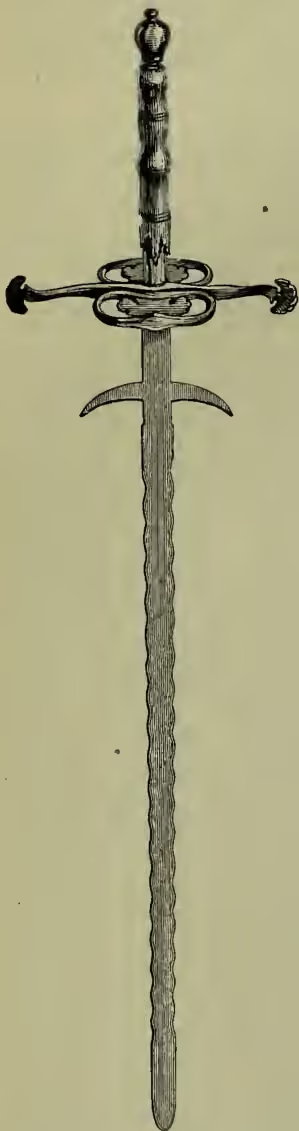
The sword, of course, could not be a weapon of primitive man; but it is easy to trace its development from the forms of weapon in use in the stone and early bronze ages. The sword came into use only when men had attained considerable skill in casting and working bronze, and the ancient bronze swords, many of which have been found throughout Europe with two-edged blades measuring two feet in length, are well finished weapons (see Vol. II. p. 477). The early Greek sword (fig. 1, a) was merely a strong two-edged knife; but about 400 B.C. its form was improved and its size doubled by Iphicrates. The gladius of the Romans (fig. 1, b) was still of the same form—a straight two-edged blade, heavier and longer, however, than the Greek weapon. During the early middle ages there does not appear to have been much development in the form of the sword in Europe. As shown by the Bayeux Tapestry (q.v.) and other contemporary illustrations, it continued to be a short cutting weapon, with a blade of uniform breadth bluntly pointed, and to give it balance it was channeled from the hilt for about two-thirds of its length. The cross-guard, subsequently called the quillons, was short, projecting at right angles from the blade, but sometimes bent forward in the direction of the point. With the development of armour in warfare it became necessary to give much greater heaviness and strength to the sword; the blade was greatly lengthened and tapered from hilt to point, the guard and the hilt were also lengthened, and in this way the two-handed sword—the distinguishing arm of the 15th century—was evolved. In Scotland several of these ponderous weapons are preserved, and traditionally associated with the names of Wallace, Bruce, and other contemporary heroes; but such swords were really not in use at so early a period, and so late as 1567 Lindsay proposed to meet Bothwell in single combat at Carberry, armed with 'the famous two-handed sword of Archibald Bell-the-Cat.' With the introduction of the two-handed sword, the use of a shield being no longer possible, the guard gradually became more complicated, so as to give greater protection to the hands of the swordsman, and from the use of shell-guards and ring-guards, &c. the basket-hilt, as applied to lighter swords, by degrees developed. The ordinary basket-hilt sword, such as is worn by officers of Highland regiments at the present day, is of Italian origin, and grew out of the Venetian schivavone. The rapier—a piercing weapon only, with a blade tapering to a fine point—came into use in the early part of the 16th century, and in the 17th century it became the weapon of fencing and duelling. From very early times Toledo, Seville, and some other Spanish towns had a high reputation for the excellence of the swords made by their armourers, and when to their own skill was added the perfect craftsmanship of their Moorish conquerors the renown of Spanish blades became supreme. In the North Italian towns also, as well as at Solingen and Passau in Germany, swords of famous quality were fabricated. In Scotland during the 17th and 18th centuries Ferrara blades were held in the highest esteem, and were a very common possession. Who the original maker of these famous blades was is not known, but in the 16th century there was a family of armourers named Ferrara (q.v.) in North Italy, one member of which, called Andrea, was born in 1555. It is, however, obvious from the long period over which the manufacture extended that 'Ferrara' became more a trade-mark than a maker's name. Many magnificently finished examples of swords from the Renaissance period downwards are preserved as art treasures in public and private collections. On the enrichment of these the highest efforts of artificers and artists have been expended, and they have been lavishly adorned with gold enamels and precious stones. Additional interest is given to some of these swords by the legends attaching to them, and by the historical importance of the personages to whom they belonged. Mythical stories are also numerous of craftsmen endowed with marvellous powers, and with whose blades unheard-of feats could be performed. In modern warfare the sword possesses little more than an honorary military significance.
See DAMASCENING, and, besides works cited at FENCING and DUELLING, James Drummond's Ancient Scottish Weapons (1881), Sir R. Burton's Book of the Sword (vol. i. 1884), Sir F. Pollock's Oxford Lectures and other Discourses (1891), Captain A. Hutton's The Swordsman (1891), and Vigeant's Ma Collection d'Esgrime (1892).