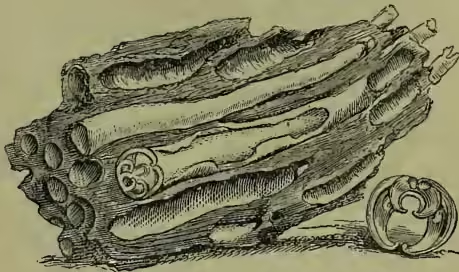
Teredo, a genus of Lamellibranchiate molluscs of the family Teredinidæ (Gray), commonly known as shipworms, from the fact that they perforate and live in ships' timber, the woodwork of harbours, &c., causing considerable damage. They are of an elongate and worm-like form, measuring from a few inches to 3 feet in length. Two small valves form the bivalve shell situated at the anterior part of the body, in close proximity with the principal organs, which form a visceral mass. At the opposite end a pair of shelly paddles or 'pallets,' which vary in different species, close the burrow at the will of the animal. Their perforations are made usually in the direction of the grain of the timber, and the burrows are always distinct from one another. The burrow is lined with a calcareous substance secreted by the mollusc. The teredo does not feed upon the wood which it excavates. Whether the excavation is caused by the sucker-like application of the foot or the rasping action of the shell has not yet been satisfactorily demonstrated. The teredines reproduce themselves in large numbers, and grow with great rapidity. Extreme cold is fatal to them. As a protection from the ravages of these molluscs timber is often driven full of short broad-headed nails, which rust and form a coating which they do not penetrate. The teredo is often said to have been introduced into Europe from warmer climates, but facts do not bear out the statement. Tropical species will not live in European seas, and vice versa. T. norvegica, which occurs in the North Atlantic, is found in the bordering countries in a fossil condition. The teredines were well known to the ancients, and are mentioned by Theophrastus, Pliny, Ovid, &c.