Termites (Termitidæ), a family of insects in the order Corrodentia, or, according to some systems, Pseudo-Neuroptera. They are often called 'white ants,' but ants are Hymenopterous insects, and do not occur before Tertiary times, whereas the Termites seem to have lived from Carboniferous ages onwards. Yet, like the ants, the termites are social insects, living in colonies and building 'nests' or 'hills.' They are widely distributed in tropical countries, but they also occur in the temperate parts of North and South America, and a few have established themselves in Europe. As their food consists for the most part of wood, especially in a state of incipient decay, they help many trees to their fall, and they are destructive pests in human dwellings. As they form earthen tunnels up the stems and branches of the trees which they attack, and as the rains wash down these constructions, it seems just, as Henry Drummond points out, to recognise that termites, like earthworms, may help in making the fruitful soil.
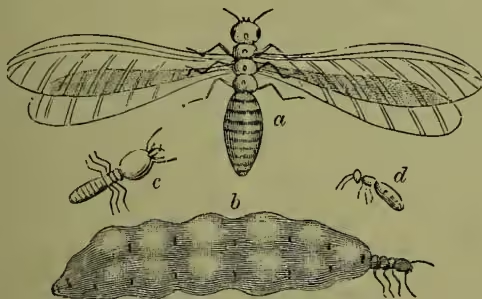
The termite society consists for the most part of wingless, sexually immature individuals, children, potentially of both sexes, which do not grow up. Besides these workers there is a less numerous caste of large-headed, strong-jawed soldiers. 'They stand,' Drummond says, 'or promenade about as sentries, at the mouths of the tunnels. When danger threatens, in shape of true ants, the soldier termite advances to the fight. With a few sweeps of its scythe-like jaws it clears the ground, and while the attacking party is carrying off its dead the builders, unconscious of the fray, quietly continue their work.' The workers collect food, form burrows and tunnels, build 'hills,' and care for the males, females, eggs, and larvæ. The males and females have wings, which the latter lose after impregnation. Then, indeed, the female or queen undergoes a remarkable change, becoming enormously distended with eggs and sometimes attaining a length of 2 to 5 inches or more—'a large cylindrical package, in shape like a sausage, and as white as a bolster.' As only the abdomen swells, the resulting disproportion between anterior and posterior parts is very striking. The queen is extremely prolific, having been known to lay 60 eggs in a minute, or about 80,000 eggs in a day. In the royal chamber a male is also kept. It is hardly necessary to say that the queen could not leave if she would. But to understand this imprisonment we must notice that in spring the young winged males and females leave the nest in a swarm, after which pairing takes place; the survivors becoming the imprisoned 'rulers' and parents of new colonies.
But Fritz Müller has shown that besides the winged males and females there are (in at least many cases) wingless males and females which never leave the termitary in which they are born, being kept as complementary or reserve reproductive members, useful should not a winged royal pair be forthcoming. Sometimes this casualty occurs, and then the wingless pairs become parents. The complementary kings die before winter; their mates live on, widowed, but still maternal, till at least another summer. Müller points out that, though the production and parentage of wingless males and females involves less mortality, the winged males and females probably cross with those from other nests, thus securing the advantages of cross-fertilisation. The workers are diligent in tending the king and queen, in removing the laid eggs, and in feeding the larvæ.
In general appearance and size a wingless termite is ant-like, but the winged forms are much larger and flatter, and their wings are quite different. The workers have large broad heads and strong jaws adapted for gnawing; the soldiers have still larger heads and longer jaws. Besides the jaws and the two pairs of maxillæ the head bears a pair of beaded antennæ, two eyes, and two ocelli, but the workers and soldiers are blind. The thorax has the usual three segments, and bears simple legs; the abdomen consists of nine segments.
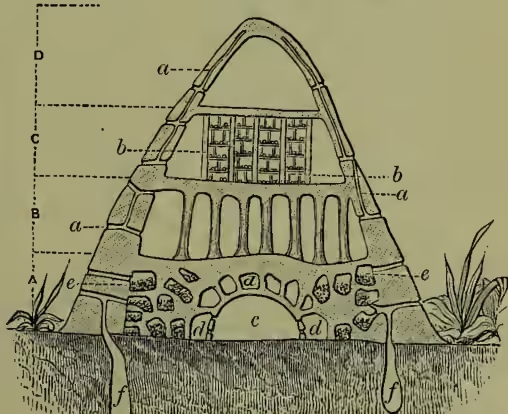
In the walls there are winding passages, a; uppermost is a well-aired empty attic, D; the next story, C, is a nursery where the young termites are hatched on shelves, b; the next is a hall, B, supported by pillars; beneath this is a royal chamber, e, in which the king and queen are imprisoned; around this are the chambers of worker-termites, d, and some store-chambers, e; excavated in the ground are holes, f, out of which the material used in making the termitary was dug.
The most remarkable termitaries are those of Termes bellicosus, abundant on the west coast of Africa. They are sugar-loaf-like in shape, 10 to 20 feet in height, and, though built of cemented particles of earth, are strong enough to bear a man's weight. Internally, as the figure shows, there are several stories and many chambers, some for the workers, one for the king and queen, others for the eggs and young, others for storing supplies of compacted minced wood. But the termites do not all build such gigantic nests; for some build their homes on the branches of trees and apparently out of masticated woody material.
In Africa Termes bellicosus and T. arborum are common species; in North America T. flavipes is very common. A few species—T. lucifugus, T. flavicollis, and T. flavipes—all probably introduced—occur in Europe. Besides Termes there are other genera, such as Euterms, Calotermes, and Anoplotermes.
The termites seem to be of use in destroying decaying wood and in loosening the soil. They also afford food for ant-eaters and other insectivorous mammals and for birds. But to dwellers in warm countries they are pests, destroying the timbers of houses and all sorts of wooden furniture. Effecting entrance from underground, they hollow out the interior, leaving only a deceptive shell, which at length collapses. Even in Europe T. lucifugus has proved very destructive in some parts of France, notably in the navy-yard of Rochefort. Yet to the naturalist their social life, their reproductive relations, and their architectural instincts are most interesting marvels demanding further research.
See H. A. Hagen, Monographie der Termitiden in Linnæa Entomologica (vols. x.-xiv. 1855-59); Ch. Lespès, Recherches sur l'Organisation et les Mœurs du Termité lucifuge (Ann. Sci. Nat. 4th series, vol. v. 1856); Fr. Müller, Beiträge zur Kenntniss der Termiten in Jenaische Zeitschr. f. Naturwiss. (vols. vii.-ix. 1873-75); Smeathman, Some Account of the Termites which are found in Africa, &c. (Trans. Roy. Soc. 1781); Grassi, Memoria sulla Società dei Termiti (Accad. Linei, Roma, 1892).