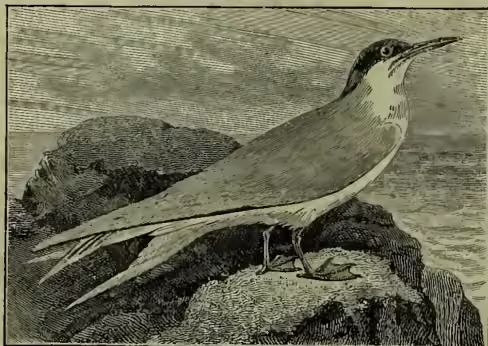
Tern, the name applied to several genera of birds of the Gull family (Laridæ), by some made into a sub-family (Sterniæ); they have the bill as long as or longer than the head, nearly straight, compressed, slender, tapering; the wings long and pointed; the tail usually long and more or less forked, sometimes graduated; the legs and feet short and small. In plumage the terns resemble the gulls, but are usually smaller. From this, and from their forked tail, they are often called Seabirds, though their flight is more like that of a gull. They are constantly on the wing, swooping on small fishes and other small animals in the water, or catching insects over the land. The species are numerous, and found all over the world, frequenting fresh as well as salt water. Those which occur in the north migrate south in winter. Some species have a very wide range. Thus, the Common Tern (Sterna fluviatilis), abundant on the more southern coasts of Britain, is also found on the coasts of Europe, western Asia, western
Africa as far as Accra, and eastern North America. In Cashmere, Tibet, and south Siberia it is replaced by a nearly allied species, S. tibetana, which visits Ceylon and South Africa in winter. Terns make little or no nest, laying their spotted eggs on sand or shingle, from which they are often with difficulty distinguished. Some, however, breed in marshes, and some build on trees and bushes, as the Noddy (Anous stolidus). This bird derives its name from the ease with which it is caught when it alights on ships to rest; it has a graduated tail, and is sooty-brown, with a gray cap. It is found in all tropical waters, and has even occurred on the Irish coast. The Sooty Tern (S. fuliginosa) breeds in vast numbers on Ascension Island, where it is known as the 'Wideawake.'