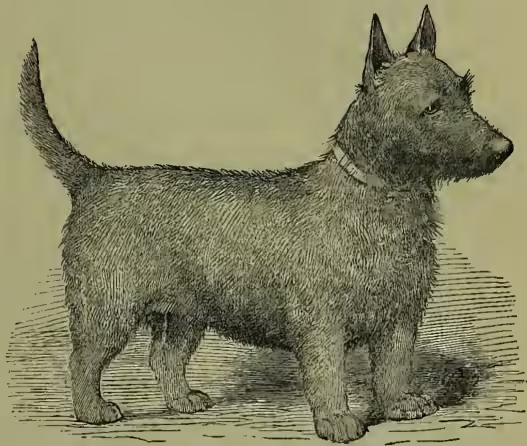
Terrier, a name originally applied to any breed of dog used to burrow underground, but now applied to any small dog. Terriers may be divided into three classes: those able to follow their game into its earth, those kept for hunting above- ground, and those kept merely as companions. Among terriers proper the Fox-terrier (q.v.) holds the position of greatest popularity. The Scotch terrier, though long familiar in Scotland, only became generally known about 1870, but is spreading so rapidly that it threatens even the popularity of the fox-terrier. The Scotch terrier is identical with the breed often erroneously alluded to as the old or working Skye terrier. He is a small, compact dog, short in the leg; coat short, hard, and dense; ears erect; and with a keen, bright expression. In character he is generally alert and active, and makes a splendid companion. The third variety used for going to ground is the Dandie Dinmont, called after the character in Scott's novel of Guy Mannering, a character founded on Mr Davison, a well-known Border farmer, who was one of the founders of the breed. The Dandie is a low and powerful dog, very courageous, a quality probably gained by an admixture of bulldog blood, but head-strong and difficult to keep under control. Dandies are divided into 'peppers' and 'mustards'—i.e. those coloured slate-blue and those of a light yellow. The coat is rather longer than the Scotch terrier, but not so hard.
Among terriers kept for hunting above-ground the most popular is the Irish terrier, a dog larger and considerably leggier than the fox-terrier, but built on the same lines. The coat is like the Scotch terrier's, but a light red in colour. The ears used always to be cut to a fine point, standing erect, but are now allowed to fall over in their natural shape. The Bedlington (q.v.) is popular in the north of England; the Bull-terrier (see BULLDOG) also makes a good sporting dog, but is kept mainly as a companion. The Airedale is growing in popularity, but its large size (some specimens weigh 60 lb.) unfits it for any proper terrier work. It somewhat resembles an overgrown blue Bedlington, but lacks the same courage. Among terriers kept as companions the Skye (q.v.) is probably the most common. The Black-and-tan terrier, though a breed of great antiquity, is fast being supplanted by the white English terrier. Both breeds are identical in shape, and resemble a light and elegant bull-terrier. The Toy terrier is a cross from the black-and-tan, as is the Yorkshire terrier. Both varieties are fit only for house-dogs, and are not true terriers.