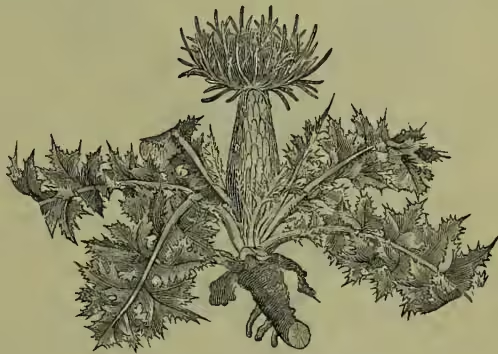
Thistle (Carduus), a genus of plants of the natural order Compositæ, sub-order Cynarocephalæ, with spinous leaves, imbricated involucre, and heads of flowers, consisting of tubular hermaphrodite florets alone, very rarely dioecious, stamens free, pappus deciduous, the receptacle having chaffy bristles. The flowers are sometimes large, generally purple, rarely white or yellowish. Recent botanists have divided this genus into two genera—the True Thistle (Carduus), in which the pappus is composed of simple hairs, and the Plume Thistle (Cirsium or Cnicus), in which the pappus is feathery. The species of both genera are numerous, and are found in most of the temperate and cold parts of the northern hemisphere, annual, biennial, and perennial herbaceous plants of considerable size. The Milk Thistle (Carduus marianus), a biennial, native of Britain and other parts of Europe, attains a height of 4 to 6 feet, and is remarkable for the milky veins of its large waved leaves. Its blanched leaves are used in winter salads; they may also be used as a boiled vegetable, along with the young stalks, and the root is used as salsify. The plant used to be cultivated. The creeping Plume Thistle (Cirsium arvense, or Cnicus arvensis), a species about 1 to 3 feet high, with creeping roots, pinnatifid leaves and numerous dioecious flowers, is a very troublesome weed in fields, very common in Britain, and now too common, not only in Europe, where it is indigenous, but in America (where it is called Canada Thistle) and other countries to which it has found its way; in Australia the thistle has become a serious plague. Cirsium lanceolatum (the Spear or Bur Thistle) and C. palustre, both common British plants, are also troublesome weeds. Cirsium oleraceum is a native of the north of Europe, but not of Britain. The Blessed Thistle (Carduus benedictus of the pharmacopœias, Cnicus benedictus or Cirsium benedictum of modern botanists) is a native of the Levant and of Persia, resembling in appearance a Centaurea, with yellow flowers enveloped in leaves, and abounding in a gossamer-like down; it is a powerful laxative-tonic medicine. The Cotton Thistle (Onopordon) is a distinct genus, known by its receptacles being destitute of bristles, and coarsely and deeply honeycombed. The Common Cotton Thistle (O. acanthium), a native of Europe, and found in England, but rarely wild in Scotland—if, indeed, it is a true native of that country—is nevertheless very generally called by gardeners and others the Scotch Thistle. The national emblem of Scotland is not, in all probability, any one species of thistle in particular, as botanically distinguished; though the Stemless Thistle (Cnicus acaulis, or Cirsium acaule) is in many districts of Scotland so designated. The cotton thistle has large elliptic leaves, and a broadly-winged stem. The young fleshy root and stem are boiled and eaten. Plants of the genus Silybum, and of the genus Echinops, which belongs to a very different section of the Compositæ, are often to be seen in flower-gardens, where they are known as Thistles. The name is also, generally with some addition, very often bestowed upon many plants which have little resemblance to any of these, except in their spinous character. Centaurea calcitrapa is the Star Thistle (see CENTAUREA); the Jersey Thistle is Centaurea isnardii; the Fuller's Thistle is Teasel (q.v.); Torch Thistle, Melocactus; and the Golden Thistle, Protea scolymus. And see SOW-THISTLE, SAFFLOWER, BURDOCK, &c. Among American species are the Swamp Thistle (Cnicus muticus), the Tall Thistle (C. altissimus), and the Mexican Thistle (Cnicus (Erythrolæna) conspicuus). The Carline Thistle has a separate article.