Thrashing is the separating of the grain or seeds of plants from the straw. The earliest method was doubtless the beating out of the grain from the ears with a stick. An improvement on this was the practice of the ancient Egyptians and Israelites of spreading out the loosened sheaves of grain on a circular piece of hard ground 50 to 100 feet in diameter, and driving oxen backwards and forwards over it, so as to tread the grain out; but, as this damaged part of the grain, it was partially superseded by the thrashing sledge, a heavy frame mounted on three rollers, which was dragged over the heaps of sheaves. Similar methods of thrashing were employed by the Greeks and Romans—the stick, the treading by men or horses, and the thrashing-sledge being found in common use among them. The primitive implement in northern Europe was the stick, and an improved modification of it, the flail (two sticks loosely fastened together at one end by stout thongs), has not yet disappeared.
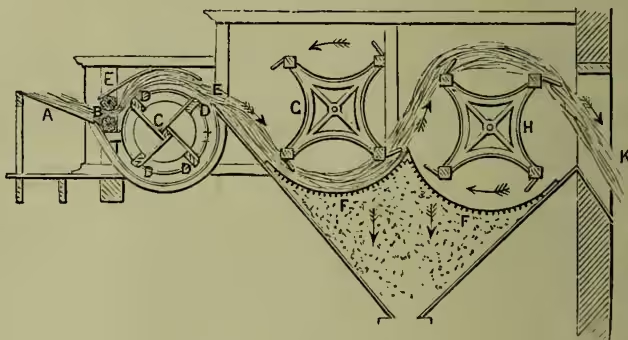
Various attempts were made to supersede the flail by a machine, but with little success, till 1787, when Andrew Meikle, an ingenious Scotch mechanic, produced a thrashing-mill so perfect that even after having run the gauntlet of nearly a century of improvers it is essentially the machine of its original inventor. In Meikle's mill the sheaves are loosened and spread out one by one on the feeding-board, A (fig. 1), with the ears towards the machine; they are then pushed forward till caught between two revolving fluted rollers of cast-iron, B; and as soon as one sheaf disappears between the rollers another is presented to them. Behind the rollers is a rapidly revolving drum or cylinder, C, having four beaters, D, D, D, D, or spars of wood armed with iron placed along its surface parallel to its axle; and these beaters, striking the heads as they are protruded from between the rollers, detach the seeds and husks. Grain and straw then pass together over the cylinder, the former falling through the wire-work, F, F, while the straw is carried forward by the circular rakes, G, H, and, being by them thoroughly tossed and separated from the grain and chaff, is ejected at K. The grain which has fallen through the wire-work is received into a winnowing-machine, where it is cleansed from chaff, &c., and then is either discharged upon the barn-floor or, as is the case with the most improved machines, is raised by a series of buckets fixed on an endless web, and again winnowed, to separate the perfect grains from the light and small seeds. Barley is, previous to the second winnowing, subjected to the process of 'hummelling,' by which the awns are removed; but the rest of the process is the same as above.
The earlier alterations upon Meikle's invention were chiefly confined to modifications of the drum; such as diminishing the distance between the drum and its cover, E, E, increasing the number of the beaters, and accelerating the speed of the drum. The speed of the thrashing-machine was next increased, while appliances were attached by means of which at the one operation the grain was thrashed, dressed ready for market, elevated to the granary, and perhaps even sacked, the straw being carried on endless webs to any given part of the straw barn.
The portable thrashing-machine, now so generally employed in America and England, and to a lesser extent in Scotland, has not the two grooved rollers, the loosened sheaf being at once submitted to the action of the thrashing-machinery; the drum, which is a high-speed drum, is provided with six or eight beaters, and its cover is capable of being set at any required distance from it by means of screws.
The attention of inventors and manufacturers of thrashing-machines has been turned of late not only to the question of securing increased speed and more finished work, but also to providing against the risk of accidents to those employed about the mills. The feeding of those high-speed drums which were getting so common was attended with considerable danger, and to prevent this safety-drums of different patterns have been introduced by the various makers. The best of these are so effective that accidents in feeding now rarely occur. Some of the modern machines thrash from 12 to 16 or even more quarters of oats per hour. From 6 to 8 quarters per hour are common quantities even for comparatively small machines.
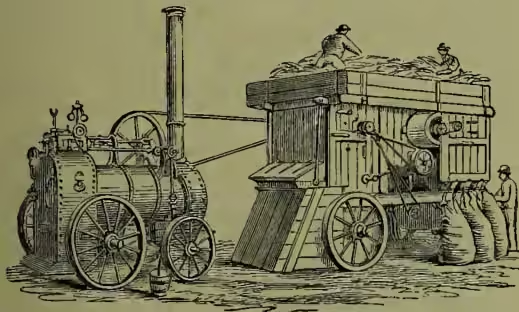
The driving-power is wind, water, horse-power, or steam; but the first is so very uncertain and unequal in its operation that it has nowadays been mostly superseded by the others. Water-power is always desirable, and when it can be had in sufficient quantity or regularly it is much to be preferred in point of economy, its mode of application to thrashing being either by the ordinary Water-power (q.v.) or by Barker's Mill (q.v.). Horse-power was the agent in most common use in the earlier days of thrashing-mills, the horses being yoked to beams attached to a vertical revolving shaft which communicated motion by means of bevelled gear to the thrashing-machine. But it was found that this kind of work was very trying for the horses, and interfered considerably with the other work of the farm; and accordingly steam-power, as being more economical, has extensively superseded horse-labour, engines of 4 to 10 horse-power being generally employed. Portable thrashing mills and engines (fig. 2) are thought by many to be more economical, from their saving the labour of transporting the crop from the stack to the barn, and from their adaptability to the requirements of a farmer who may rent more than one holding in a district. On the other hand, however, some prefer the fixed machine on account of cheapness and diminished liability to derangement. Hand-power thrashing-machines are made for use on small holdings. They are hard to drive, but do their work admirably.