Tin (sym. Sn; atomic weight, 118.76; sp. gr. 7.3). Either tin itself or an ore of it must have been known from a very early time, as all ancient bronze objects contain a certain proportion of this metal (see BRONZE, and METALLURGY). Ingots of metallic tin and articles made of it have been found in several of the Lake-dwellings (q.v.) discovered on the continent of Europe. It was therefore smelted more than 2000 years ago. Pliny refers to Cornish tin, and the metal is known to have been taken to Italy through Gaul after the Roman conquest of Britain. See also CASSITERIDES.
Tin has a silvery-white colour with a faint yellow tinge, and objects made of it have a brilliant lustre when new or newly cleaned. It does not tarnish readily. When melted and slowly cooled it is obtained in crystals of considerable size. A bar of the metal with a cross section of say a quarter of an inch in area is easily bent, and during the bending emits a crackling sound due to the crushing together of its crystalline particles. Tin is of greater hardness than lead, but it is softer than gold. It is very malleable, and can be beaten into foil as thin as of an inch. Its tenacity is not great, a wire of the metal of an inch thick breaking with a weight of 56 lb. At the temperature of about 442° F. (228° C.) it becomes brittle enough to be reduced to powder by hammering. At St Petersburg a bar of the metal has been known to break up into small granular particles during a very low winter temperature. The same result may be obtained by lowering its temperature artificially to -39° C.; at least it is very brittle at this temperature. Tin conducts heat and electricity moderately well. Its melting-point is 455° F. (235° C.), being considerably under that of lead. It is volatile, but only at a very high temperature. Among common metals it is least acted on by air and water, hence its utility for a great many purposes. With the exception of nitric, no acid attacks tin vigorously unless with the aid of heat.
(Phleum pratense).
There are two oxides of tin—viz. stannous oxide and stannic oxide, with corresponding series of salts. Protoxide, monoxide, or stannous oxide, , is prepared by first adding to dichloride of tin a solution of carbonate of soda. The white precipitate produced is the hydrated oxide, which absorbs oxygen from the air; but when heated to redness in a current of carbonic acid, or dried in a stream of this gas in the absence of air, anhydrous stannous oxide is obtained as a black powder. The hydrated oxide dissolves readily in acids, but these act more slowly on the anhydrous oxide.
Dioxide, binoxide, or stannic oxide, , forms on the surface of tin kept at a heat above its melting-point with access of air. This is removed as it forms, and again heated to completely oxidise any of the finely divided tin mixed with it. Stannic oxide is also produced when tin is acted on by nitric acid. It is this oxide of tin which, when finely ground, forms the hard white material known as Putty Powder (q.v.), and used for polishing hard stones and other bodies. It also enters into the composition of one kind of opaque white glass. Stannic oxide occurs in nature as the mineral cassiterite, the ordinary ore of tin.
Hydrated stannic oxide or stannic acid, , is obtained by adding carbonate of lime to tetrachloride of tin; also by adding an acid to stannate of potash or soda. It is a white gelatinous substance, acting as a base by combining with acids, as in tetrachloride of tin, or as an acid combining with bases to form salts, stannate of soda (sodium stannate), , for example. But there is another state in which this acid occurs with quite different properties, when it is termed metastannic acid. If tin is placed in nitric acid of about 1.3 sp. gr., it is rapidly converted into a white crystalline powder having the same composition as stannic acid, but represented by the formula of this acid multiplied by five to account for its salts having only the quantity of base; thus, metastannate of soda is . Metastannic acid is insoluble in all ordinary acids (except undiluted sulphuric acid), but it is readily soluble in alkalies, and the salts thus formed are converted into stannates by heating with excess of the base. The stannate of soda is used in calico-printing.
Sulphides of tin.—The monosulphide of tin, or stannous sulphide, , is black, and stannic sulphide, , yellow, the latter being soluble in sulphide of ammonium. Under the name of mosaic gold stannic sulphide is used as a bronze powder for bronzing articles made of plaster of Paris, wood, &c. There is a native sulphide of tin and copper.
Dichloride of tin or stannous chloride, , is obtained by boiling the granulated metal with moderately strong hydrochloric acid. It crystallises with two molecules of water. A solution of this salt, unless made slightly acid, soon shows a slimy whitish deposit by which it is easily recognised. It is a powerful deoxidising agent, persalts of iron being converted into protosalts when it is added to their solutions, and with other salts, such as those of mercury, causing a deposit of the metal. It is used as a test for gold in solution, giving a purple colour.
Tetrachloride of tin or stannic chloride, . This salt is formed when chlorine gas is passed over melted tin. It is also got as an anhydrous volatile liquid when powdered tin is distilled along with corrosive sublimate. It fumes when it meets the air, and has long been known as fuming liquor of Libavus. A more or less pure salt of this kind is used by dyers, made by dissolving tin in a mixture of hydrochloric and nitric acids. The chlorides of tin, like the stannate of soda, are used as mordants in dyeing. All the salts of tin give a bead of the metal when heated on charcoal in the inner blowpipe flame.
Ore and Smelting.—Tinstone or cassiterite, which is the binoxide of tin (often found in a nearly pure state), is the chief ore of the metal. Nearly all the tin of commerce is obtained from it. This mineral is usually of a dark-brown or blackish colour, but it is sometimes yellowish brown or gray. Its specific gravity is high—viz. from 6.3 to 7.1—and it is also very hard. It is found crystallised in quadrangular prisms, terminated by four-sided pyramids, and in more complex forms; and when pure consists of tin 78 and oxygen 22. Tinstone occurs in veins or lodes in granite or granitic rocks, gneiss, clay-slate, and mica-slate.
Wood-tin or fibrous tin is a fibrous form of cassiterite occurring in globular, botryoidal, or wedge-shaped fragments, usually of a small size. In colour and structure it has some resemblance to dry wood. Stream tin is again the same mineral found in the alluvial debris forming the beds or sides of streams. It has in course of time become separated by the disintegration of the vein-stone, and is washed out of the gravel or debris.
The older tin-producing countries are England (Cornwall), Germany (Bohemia and Saxony), and, for small quantities, France and Spain, in Europe; Malacca, Banca, and some neighbouring islands in southern Asia; and Chili, Peru, Bolivia, and other South American states. The most important of recently discovered tin districts are in Australia, those in New South Wales and Victoria being as yet most productive. Tasmania also yields a considerable supply. In the United States, though none is yet largely worked, there are rich deposits of both vein ore and stream tin, from the opening up of which great results are expected. These occur at Harney Peak, South Dakota; Martha Cash, Virginia; Temescal, California; and a few other places.
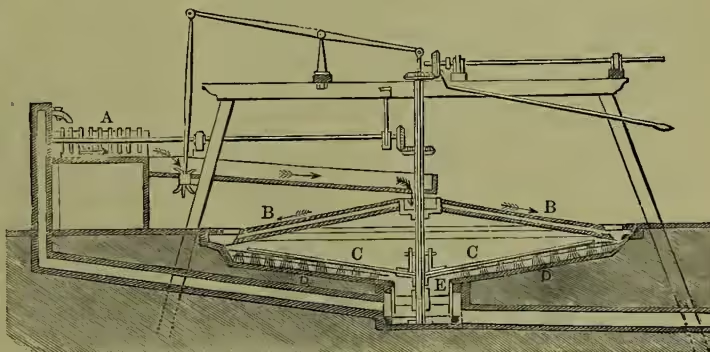
Tin ore from the mine is subjected to a complicated series of dressing operations. The tinstone of Cornwall especially is associated with a large number of other minerals, which require to be as much as possible separated from it before smelting. Of these copper and arsenical pyrites and wolfram (when this is present) are got rid of by special chemical processes. For the mechanical dressing processes stamps, buddles, pulverisers, &c. are required, and these are noticed under METALLURGY. The following is a summary of the stages in the dressing of the ore: (1) it is reduced to grains by stamps; (2) a portion of the waste material is then removed by centre head and concave buddles (see figure); (3) more waste is next separated in the tossing tub; (4) at this stage the sulphur and arsenic are driven off by heat—calcining; (5) after the calcining the ore is reduced by a pulveriser, of which there are several kinds, to a fine sand; (6) the sand is then finally washed on slime frames or biddles to separate the 'black tin'—i.e. the pure, or comparatively pure, tin ore.
In order to separate the arsenic and sulphur which, in the form of arsenical and common pyrites so commonly accompany Cornish tin-stone, the ore in the fourth stage of dressing (see above) is calcined. There are two kinds of calciners in use—viz. Brunton's, which has a revolving circular hearth, with stirrers, and Oxland and Hocking's, the chief feature of which is a revolving iron cylinder, lined with firebricks. This cylinder is fitted up in a sloping position, with a fireplace at the lower end. The ore is fed at the top, and as it descends parts with the sulphur and with the arsenic, which, as 'crude arsenic' (arsenious acid), is collected in the specially constructed flues of a chamber in connection with the cylinder-furnace. See ARSENIC.
Tin ores which contain the mineral wolfram (tungstate of iron and manganese) are treated by a special process, patented by Mr R. Oxland of Plymouth. This mineral and tin ore are so nearly the same in specific gravity that no mechanical method of washing will separate them. Oxland's process consists in treating in an iron pan in a reverberatory furnace the tin ore with sulphate or carbonate of soda, for the purpose of converting the insoluble tungstate of iron and manganese into the soluble tungstate of soda, which is easily removed by lixiviation. The oxides of iron and manganese, which are left in a finely divided state, can then, from their lower density, be readily got rid of by washing. The tungstate of soda procured in the operation has been employed for rendering cotton cloths non-inflammable and as a mordant in dyeing and printing calico.
In England the dressed tin ore is reduced in a reverberatory furnace, somewhat similar to that used for smelting copper (see COPPER, fig. 1). It is mixed with one-fifth of its weight of anthracite coal, broken into small pieces, and a small quantity of lime or fluor spar to combine with siliceous matter in order to form a fusible slag. The heat is slowly raised with as little admission of air as possible, so as to maintain a reducing atmosphere. When the charge has been some hours in the furnace it is occasionally stirred to assist the aggregation and separation of the slag, and in about six hours the metal is ready to be run off. The tin flows out of the furnace by an aperture in the middle of one side—towards which all the rest of the bed slopes—into a cast-iron pot, from which it is cast into bars. The tin at this stage contains other metals, such as arsenic and iron, as impurities, so that it requires to be refined, and this is done by liquation and poling. The process of liquation consists in placing the bars of tin on the hearth of a furnace, such as has been described, and slowly heating them to just above the fusing-point, when pure or nearly pure tin melts and runs down the sloping furnace-bed into a cast-iron vessel, fresh bars being added until enough of the metal is collected. What remains on the hearth is a less fusible alloy of tin with arsenic, iron, and other metals. The nearly pure tin is kept by a fire in the melted state, and stirred up with a pole of green wood, the operation producing a current of gas that agitates the molten metal and causes a scum to rise to the surface, which is skimmed off. The tin is then run into moulds for the market, grain-tin being the name given to the best quality of the metal. It is known by its property of becoming brittle when heated to just below its melting-point, so that when it is then let fall from a height, or struck with a hammer, it breaks up into prismatic fragments. Banca tin is the purest kind made on a commercial scale, and is nearly chemically pure. English tin comes next to it as regards purity.
Applications.—The great consumption of tin is in the formation of alloys, such as bronze, gun-metal, Britannia metal, &c. (see ALLOY), and in the manufacture of tinned iron plates. In the form of an amalgam it is employed for 'silvering' mirrors, and as tinfoil for lining boxes and wrapping up perishable articles. The small gas-pipes of houses are best made of block-tin. Ordinary commercial tin tarnishes very slightly in the air, and is not acted upon by vinegar or the acids of fruits. It is consequently very suitable for coating the inside of cooking vessels, whether made of iron or copper. Large vessels for other purposes formed of these metals are also occasionally coated with tin. In some parts of India vases, jugs, and other useful and ornamental articles are made entirely of tin. The uses of some tin salts are noted above.
The quantity of tin ore raised in Cornwall amounted (with the trifling addition from Devon) in 1890 to 14,911 tons of dressed ore, yielding of metallic tin 9602 tons, the value of which was £937,760. In the same year the total imports into Great Britain were 2663 tons of tin ore, value £96,593, and 27,038 tons of metallic tin, value £2,547,416. In 1897 the quantity of tin yielded in Britain was only 4453 tons, value £291,336; the imports of tin in 1897 were valued at £1,623,798. Of the total, counting both ore and tin imports, the Straits Settlements furnished more than one-half.
See TIN-PLATE, and STANNARIES; P. W. Flower, History of the Trade in Tin and Tin-plates (1880); A. G. Charleton, Tin-mining Abroad (1884); and L. F. Blinn, Companion for Tin-workers (1891).