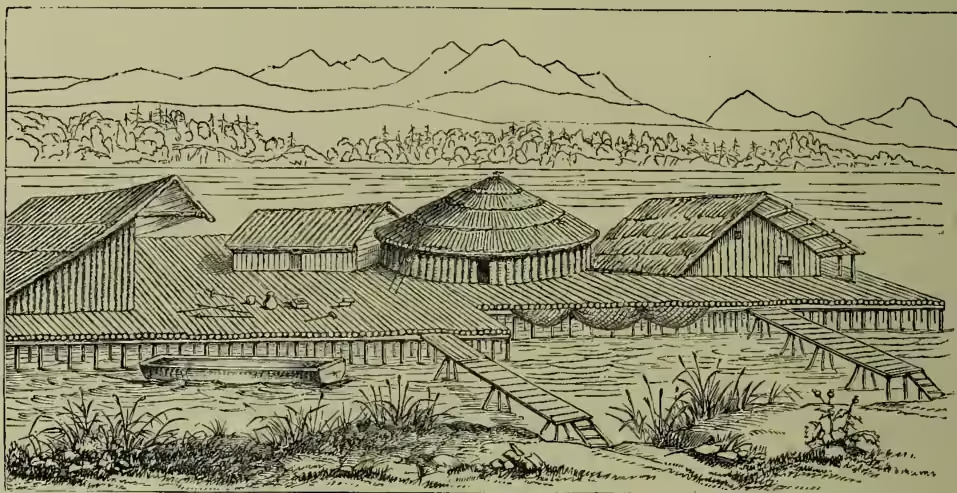
Lake-dwellings (Ger. Pfahlbauten, 'pile-dwellings'), habitations placed on platforms supported by piles, or other substructures, in the shallows around the margins of lakes, have only recently become known to archaeologists, although the first notice of a lake-dwelling community was written by Herodotus in the 4th century B.C. He describes certain tribes on Lake Prasias in Macedonia as living in huts on platforms supported on piles which were approached from the land by a single narrow bridge. It now appears that from the very earliest times down to the commencement of the historic period there were lake-dwellings of various descriptions in the lakes of central Europe, and that a similar custom continued in Scotland and Ireland to much later times. Owing to an extraordinary subsidence of the waters of the Swiss lakes in 1854 the remains of a lake-dwelling were discovered at Meilen in the lake of Zurich, and it was speedily found that similar remains of pile-dwellings, each indicating the site of a relic-bed in the mud of the lake-bottom, existed in proximity to the shores of most of the lakes in Switzerland. Since their first discovery the sites of these ancient settlements have been thoroughly explored and systematically described by Dr Keller, F. Troyon, and others. The relics of this singular phase of early civilisation, which have been carefully gathered into the museums of Switzerland, disclose the condition of the industrial arts among the lake-dwellers, as manifested in the successive stages of the stone, bronze, and iron periods of their culture and civilisation. There is nothing known of the origin of the lake-dwelling phase of social life. It has been suggested that a desire for greater security from attack than could be afforded by a cluster of dwellings situated on the mainland first led to the selection of natural islets as the sites of habitations, and when this had become an established custom the transition was easy from the selection of natural islands to the construction of artificial islands where natural sites for habitations isolated by water did not exist. As a matter of fact there are several varieties of artificial lake- dwellings of which the sequence is not certainly known. The substructure is usually all that remains. It has been found in some instances to be a mass of stones, and in others a mass of brushwood, built up from the bottom of the lake. The more common form in Switzerland, however, is a substructure of piles, driven into the lake-bottom, and the heads brought level to support the platform for the huts. Where the water is deep and the bottom soft, the piles are driven only for a short distance, and stones accumulated around and among them to keep them in position. In some cases the lower ends of the piles have been mortised into a kind of horizontal framework of logs, to give greater stability to the superstructure. The piles are usually tree-trunks with the bark on, and the platforms were frequently the same, though sometimes the trunks were split or roughly boarded. On this platform the huts were erected. Nothing usually remains of them, but in some instances the remains of the lower tiers of boarding have been detected. In all cases in which the form of the huts could be determined it has been rectangular. But it seems deducible from the curvature of some pieces of hardened clay, with the marks of interwoven branches upon them, that circular huts of wattles and daub were also constructed. They were doubtless thatched with straw and reeds. There were many huts on one platform, and a narrow gangway was generally carried on piles from the platform to the shore. Sometimes a dug-out canoe seems to have been used instead of a gangway, but as they seem often to have had horses, sheep, goats, and cattle on the platform, the gangway would be in such cases a necessary adjunct to a settlement, the piles of which have been occasionally found to indicate a superficial area of 100,000 square feet, and which was therefore practically a village on piles. The number of lake-dwellings discovered in the lakes of Switzerland exceeds one hundred and forty. The best known of these are Meilen in the lake of Zurich, Wangen in the lake of Constance, Robenhausen in the small and partially dried-up lake of Pfäffikon, and Moosseedorf in the small lake of that name, all stations of the stone age; Moringen in the lake of Bienne, Estavayer in the lake of Neuchâtel, and Morges in the lake of Geneva, all stations of the bronze age; and Marin, otherwise known as La Tene, in the north end of the lake of Neuchâtel, a station of the iron age.
In the settlements of the stone age the cutting implements, such as axes, knives, saws, are made only of stone. As flint is not abundant in Switzerland, the larger implements, such as axes, are generally made of diorite, serpentine, and other hard and tough stones, and sometimes even of nephrite and jadeite. The smaller implements, such as knives, saws, arrow-points, and spear-heads, are usually made of chipped flint, but the axes are cut out of the block by a sawing process, the cuts being made to some depth on opposite sides, and the parts separated by a blow. Those axes or axe-hammers that were perforated by a hole for the haft were bored by a drill of soft wood worked with sand. The stone axes were, however, for the most part mere wedges not perforated for the haft, but fixed in a socket in the end of a short piece of stag's horn, through which the perforation for the handle was made. Sometimes the handle itself was perforated, and one end of the stag's horn mounting, which carried the stone axe socketed into its other end, was mortised into the handle. Bitumen was used as a cement to fix the stone tools of all kinds in their handles of horn or wood. Arrow-points, notched or barbed, and harpoon-points for spearing fish were made of bone. The pottery of the stone age settlements was coarse but plentiful, and the cooking vessels were occasionally of large size. The lake-dwellers of the stone age were agriculturists, cultivating on the adjacent mainland their crops of wheat, barley, millet, and flax, and rearing flocks and herds, the cattle being sometimes stalled upon the platforms. They were hunters and fishers, and their food seems in consequence to have been both varied and plentiful. Amongst the animals they hunted, and whose remains have been found in the relic-beds underneath the dwellings, are the urus and bison, the elk, the ibex, the chamois, the wild-boar and stag; and they kept the domestic ox, the horse, swine, sheep, goats, and dogs. They stored nuts and dried apples cut in halves; and among the charred remnants of their food fragments of their cakes of bread have been discovered. To the same charring action of the fire which seems in several cases to have consumed the huts we owe the preservation of many specimens of their textile fabrics, woven of well-spun flaxen threads, and of their fishing-nets, and mats made of bast or fibre of the lime-tree, and ropes and lines of plaited twigs, or cords of flaxen thread.
The pile-dwellings of the bronze age appear to have been placed farther from the shore than those of the stone age. The settlements of the bronze age also exhibit an increase in the number of domestic animals, and a corresponding decrease in the number of wild animals used for food. The pottery, though not thrown upon the wheel, is finer in form and much more highly ornamented, often with patterns of great elegance, painted in black or red, and sometimes inlaid with strips of tin. In settlements founded in the bronze age, such as that at Morges in the lake of Geneva, bronze is almost the only material used in the manufacture of their implements and weapons; and consequently stone and bone implements are as rare in them as bronze implements are in the earlier settlements. But there are a number of settlements which seem to have existed during the transition period, in the relic-beds of which the implements of stone and bronze are found mingled together. The forms of the bronze objects found in the lake-dwellings do not materially differ from those generally found diffused over central Europe. One feature of the lake-dwellings is the abundance and variety of the bronze ornaments, and the extraordinary development of the pius with ornamental heads, which are found of all sizes up to 15 inches in length. The bracelets are penannular, often hollow, or C-shaped in section, and decorated on the convex surface with a variety of sunk patterns composed of combinations of straight lines and circles. The principal varieties of the implements and weapons of bronze are axes, chisels, gouges, saws, sickles, knives, daggers, spear-heads, swords, hammers, and anvils. The knives are very abundant, and there is one large variety, with a curved and almost scythe-shaped blade, having a thick back, which is characteristic of the lake-dwellings. There is a smaller knife with an oval or crescent-shaped blade, so thin and sharp that it has been taken for a razor. The swords are mostly of the broad-bladed and slightly tapering form found in central Europe, and often have their handles also of bronze. Moulds of stone for casting the different varieties of bronze implements, weapons, and ornaments have been found in the relic-beds, showing that the articles were manufactured in the settlements in which they were used. In the principal settlement of the bronze age at Morges the number of bronze articles found exceeds 500.
The settlement of Marin in the lake of Neu- châtel is the best known of the lake-dwellings of the iron age. As the area occupied by the piles is about 1200 feet long by 250 feet wide, the settlement was undoubtedly a large one. Several caldrons of thin bronze with iron ring-handles attached to the rim were found here; and a number of small articles of bronze were also found, none of which were of bronze-age types. The weapons were all of iron. They consist of short double-edged swords, the edges straight to within a short distance of the point, and large, broad, and thin-bladed spear-heads, sometimes oval or leaf-shaped, but usually with wavy or indented edges. Several of the sword-blades are damascened, after the ancient method of damascening by welding together strips of metal differently prepared, and some have makers' marks. The sheaths are of iron, beaten very thin, and are remarkable both for their elegance of form and the peculiar nature of their decoration. This has been sometimes supposed to be Etruscan, but it much more closely resembles the style of ornamentation which is now known in France as Gaulish, and is common to a series of grave-mounds occurring both in France and Switzerland. The other articles found at Marin are shield-mountings, fibulae, buckles, bridle-bits, and hachets, all of iron, a number of rings or bracelets, beads, &c. of coloured glass, playing dice and other small objects of bone, pieces of Roman pottery, and Roman and Gaulish coins. The latest of the coins is of the reign of the Roman Emperor Claudius, 41 to 54 A.D.
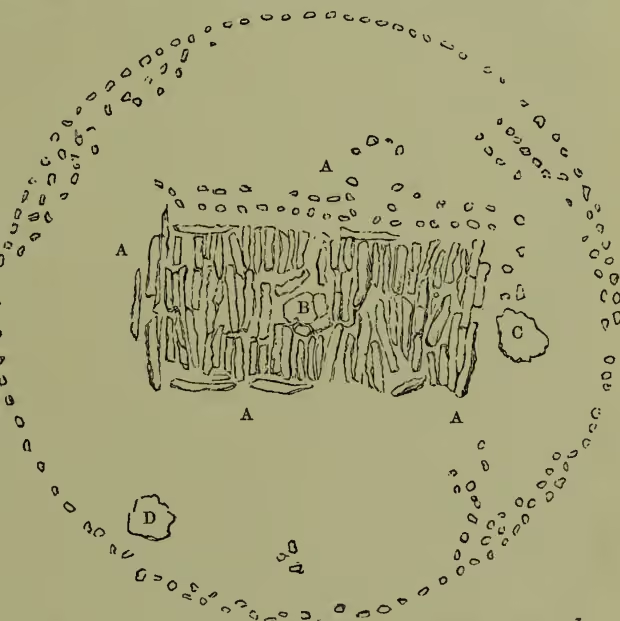
There is no means of computing the antiquity of the earlier lake-dwellings of Switzerland, but Dr Keller remarks on this point that, 'although the actual determination of the age of the lake-dwellings is doubtful, yet we may say with perfect certainty that they are more than 2000 years old, and with a considerable amount of probability that they reach back from 1000 to 2000 years before Christ.' Lake-dwellings have also been found on the Italian side of the Alps in the lake of Garda and the Lago Maggiore; in Savoy in the lakes of Bourget and Paladru; in Austria in the bed of a dried-up lake at Laibach, and in several small lakes near Salzburg, and in Bavaria and Pomerania. In Scotland and Ireland, where they are numerous, they are known as Crannogs (q.v.), from the Celtic word crann, 'a tree.' The crannogs, however, are not constructed like the Swiss pile-villages. They are either palisaded refuges on small islets of natural formation, or artificial islets formed of brushwood, stones, and earth, and steadied and protected by piles driven through and around the mass. The problem presented to the crannog-builders was to construct, in a maximum depth of 10 or 12 feet of water, a solid, compact, and generally circular island, with a radius of 50 feet or thereby, capable of providing a permanent means of refuge and shelter for a considerable number of men and animals. The process is thus described by Dr Munro: 'Over the site chosen a circular raft of tree-trunks laid above branches and brushwood was formed, and above it additional layers of logs, together with stones, gravel, &c., were heaped up till the mass grounded. As this process went on, poles of oak were inserted here and there, the rough logs forming the horizontal layers were pinned together, and at various levels oak-beams mortised into one another were stretched across the substance of the island and joined to the surrounding piles. When a sufficient height above the water-line was attained, a prepared pavement of oak-beams was constructed, and mortised beams were laid over the tops of the encircling piles which bound them firmly together. The margin of the island was also slantingly shaped by an intricate arrangement of beams and stones, constituting a breakwater.' Frequently a wooden gangway stretched to the shore; in other cases the only means of access was by canoes, hollowed out of oak-tree trunks. Much the same system of construction appears to have been followed in Ireland. The plan (fig. 2, p. 487) of one of two crannogs in Drumaleague Lough, in the county of Leitrim, given on a scale of 1 inch to 20 feet, shows a circle of piles enclosing a space of 60 feet in diameter, with remains of supplementary circles at several points in the interior of the main or outer circle. In the centre is the log-pavement, A, about 35 feet by 25 feet, probably the floor of the log-house, which was the principal building on the crannog. In the centre of this pavement is a hearth-place, B, covered with flat stones, still showing traces of fire. On the outside of the pavement is another hearth-place, C, on a bed of stiff clay, while around a large tree-root, D, the top of which has been dressed with a hatchet, and which may have served as a table, were found the refuse of the daily food in the shape of the broken and split bones of deer and swine. The crannogs are generally very much smaller than the Swiss lake-settlements, and from the nature of their construction there is no relic-bed. Those of Ayrshire and Galloway in Scotland have yielded objects dating from the time of the Roman occupation of Scotland to quite recent times. The most characteristic objects recovered from the Irish crannogs belong to the period of the Norse incursions, ranging from the 8th to the 10th and 11th centuries. There have been a few exceptional instances of the discovery of implements of stone and bronze age types in apparent association with the crannog structures, but so far as is yet known there is no crannog in Scotland or Ireland that can with any degree of certainty be assigned to the age of stone, or to the age of bronze. They seem to belong exclusively to the iron age and the historic period. There are frequent references to the use of crannogs as refuges and strongholds in the early Irish annals, and in Scottish and Irish historical documents of the 16th and 17th centuries. The first traces found in North America of anything resembling the lake-dwellings of Europe are at the mouth of Naaman's Creek, a tributary of the Delaware.
The custom of living in wooden houses erected on piles over the waters of a lake, river, or inlet of the sea is still practised by barbarous tribes, and has been described by many travellers in the Malayan Archipelago, New Guinea, Venezuela, and in central Africa. When Ojeda, Vespucci, and the other discoverers entered the lake of Maracaybo in 1499, they found an Indian village constructed on piles above the water, and thence called it Venezuela ('little Venice'). The dwellings of the Papuans along the coasts and river-banks of New Guinea are built of bamboo and raised on stakes, and are grouped together. Cameron saw regular villages of pile-dwellings on Lake Mohrya in central Africa, each separate, and accessible only by jealously-guarded canoes.
See Munro, The Lake-dwellings of Europe (1890); Keller, The Lake-dwellings of Switzerland (trans. by Lee, 2d ed. 1878); Munro, Ancient Scottish Lake-dwellings, or Crannogs (1882); Wood-Martin, The Lake-dwellings of Ireland (1886).