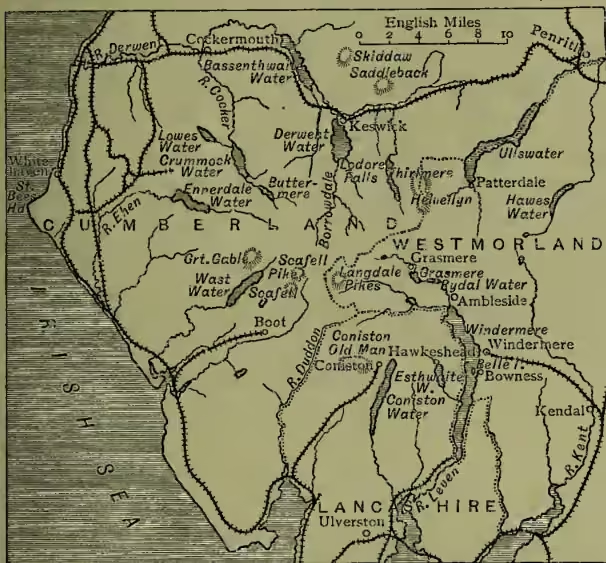
Lake District, the name applied to the picturesque and mountainous region comprised within the counties of Cumberland, Westmorland, and a small portion of Lancashire, within which are grouped as many as sixteen lakes or meres, besides innumerable mountain tarns and streams, and a series of mountains rising in four points to a height of over 3000 feet. The district extends about 30 miles from north to south by about 25 from east to west, and contains within its compass the utmost variety and wealth of natural scenery, soft and graceful beauty ever alternating closely with grandeur and sublimity. Indeed nowhere else in the world perhaps is so much varied beauty to be found within so narrow a space. The district is visited every year by thousands of tourists, who are able, from Keswick or Ambleside as a centre, to explore the whole region, and climb all its chief mountains within a week. But it must not be forgotten that many of the most lovely spots lie out of the ordinary routes, and that for those travellers who can afford the time there is ample occupation for a much longer period. The Lake District is fringed by such considerable towns as Penrith, Kendal, Lancaster, Barrow, Cockermouth, and Whitehaven; and already railways bring the traveller, from different points of the compass, to Keswick, to Windermere, to Coniston, and to Boot. The principal lakes are Windermere, Esthwaite Water, and Coniston in the south; Ullswater and Hawes Water in the east; Bassenthwaite in the north; Wast Water, Ennerdale Water, Buttermere, and Crummock Water in the west; and Derwentwater, Thirlmere, Grasmere, and Rydal Water in the heart of the district. The highest mountain-summits are Scafell Pike (3210 feet), Scafell (3161 feet), Helvellyn (3118 feet), and Skiddaw (3060 feet), all easily accessible, in great part even on pony-back. Besides these there are hundreds of mountains and pikes, many clothed with the richest greenery. The lakes are fed and emptied by beautiful mountain-streams and becks, often forming noble waterfalls and forces, like Lodore Falls, near Derwentwater; Dungeon Gill Falls, near Grasmere; Stockgill Force, near Ambleside; Scale Force, near Crummock Water; Aira Force, near Patterdale; and Dalegarth Force, near Boot. Among the places most visited, besides these, are the towns or villages of Keswick, Coniston, Bowness, Hawkshead, Ambleside, Ulverston, Rosthwaite, Grasmere, Patterdale, and Borrowdale; the Langdale Pikes; the Duddon Valley, celebrated in Wordsworth's series of sonnets; Honister Pass, and Kirkstone Pass; the Castle Rock of St John, celebrated in Scott's Bridal of Triermain; and such minor but imposing mountain-peaks as Blencathara or Saddleback (2847 feet), near Keswick; Coniston Old Man (2633), near Coniston; and the Great Gable (2950), near Wastdale Head.
But far more even than its romantic natural beauty is the rare interest that has been added to this district by the group of illustrious poets who made it their home about the beginning of the 19th century, and who were somewhat unintelligently grouped together by unsympathetic critics as forming the 'Lake School' of poetry. Of these the most illustrious was Wordsworth, who has interpreted for us with marvellous fidelity and force the life—animate and inanimate alike—of the country which he knew and loved. His Excursion is the best of all guide-books to the Lakes—Wordsworthshire, as Lowell aptly terms the district; and students of English poetry will never lose an interest in those hallowed scenes in which the modern High-priest of Nature first expounded the co-operative spiritual harmony between man and nature herself, and taught how the mute life in nature ever leads upwards to the conscious life in man and the creative force in God. He was born at Cockermouth; he had his education at Hawkshead school; he lived thirteen years in three houses at Grasmere, and thirty-seven at Rydal Mount; and he lies fittingly, with his wife, his children, and his gifted sister Dorothy, in Grasmere churchyard, in the midst of the scenery he has made enchanted. His first house at Grasmere, Dove Cottage or Town End, his home from December 1799 to May 1808, and of De Quincey for more than twenty years thereafter, was bought in 1890 by public subscription for permanent pre- servation as a memorial of Wordsworth. His lifelong friend and brother-poet, Southey, lived for forty years at Greta Hall, near Keswick, and rests in Crosthwaite churchyard hard by. Here also at Greta Hall Coleridge lived awhile, often visiting the Wordsworths; and here his children were brought up by Southey. The hapless Hartley Coleridge lived long at Nab Cottage, near Rydal Water, and is buried beside Wordsworth in Grasmere. Christopher North lived at Elleray, near Windermere; Shelley lived some time at Keswick after his marriage, and Mrs Hemans at Dove Nest on Windermere. Harriet Martineau had her home at the Knoll, near Ambleside; and not far off is Fox How, where Dr Arnold found rest from the strain of Rugby, and where he died. James Spedding was born at Bassenthwaite, and here was visited by Edward Fitzgerald and Tennyson; and the latter lived some time at Tent House on the east bank of Coniston Lake. At Brantwood, near Coniston Lake, Ruskin resided during the latter years of his life. The poet Gray spent a fortnight of 1769 in traversing the Lake District, and his Journal shows that he looked before his time at nature with 'distinctness and unaffected simplicity,' in Wordsworth's phrase. Hither came in the summer of 1802 Charles Lamb, with his sister Mary, to spend three weeks with Coleridge at Keswick. He appears to have thoroughly enjoyed the new experiences, yet in a letter to his friend Manning (24th September 1802) he writes with a spirit worthy of Dr Johnson: 'After all, Fleet Street and the Strand are better places to live in for good and all than amidst Skiddaw.'
Wordsworth himself wrote a Description of the Scenery of the Lakes in the North of England (1822), in which it is interesting to see how the descriptions glow with recollected love, and how hot is his indignation against all wanton attempts to artificialise the face of nature. He would have denounced the Manchester scheme for bringing water from Thirlmere, and actively supported the aims of the 'Lake District Defence Society' (established in 1883).
See Professor Knight's English Lake District, as interpreted in the Poems of Wordsworth (1878), and his Through the Wordsworth Country, with 56 engravings by Harry Goodwin (1887); also Harriet Martineau's English Lakes, with illustrations by W. J. Linton (1858), T. G. Bonney's English Lake Scenery (1876), and Edwin Waugh's Rambles in the Lake Country (1861) and In the Lake Country (1880). Of the innumerable guides may be mentioned those of W. Hutchinson (1776), T. West (1780), J. Hudson (1843), Miss Martineau (1855), James Payn (1859 and 1867), H. I. Jenkinson's Practical Guide and his Tourist Guide (1879), Baddeley's Thorough Guide (1880), and G. R. Mill, The English Lakes (1896).