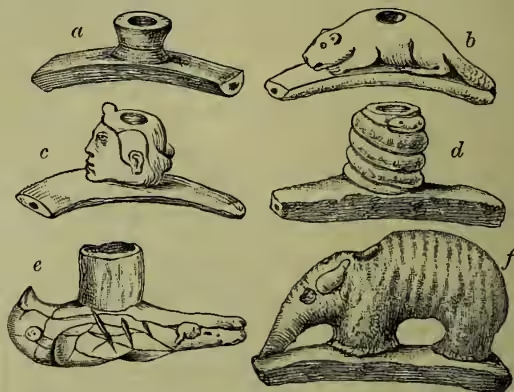
TOBACCO-PIPES. The oldest tobacco-pipes known are those which have been found in the ancient grave-mounds of the Mississippi Valley. These are in various kinds of stone, some being carved into the form of human heads and others into the shape of various animals, but the most common kind have a plain, more or less conical bowl. All have a short, broad, slightly-curved, perforated stem, forming a sort of base for the bowl. Among the animals represented are the beaver, the bear, the seal, the frog, and various kinds of birds. But the most interesting of all are what are called 'elephant-pipes' (fig. 3, f), of which only two appear to have been found. These unmistakably represent an animal like the elephant, only the tusks are wanting. As the remains of the Mastodon (q.v.), which, however, had tusks, are found in America, the curious question arises, has this animal become extinct on that continent since the time of the people who carved these pipes? This matter has given rise to an animated controversy among archaeologists in the United States, some of whom, apparently without much reason, maintain that the two pipes found are of doubtful authenticity.
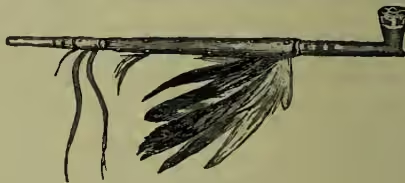
Of modern or comparatively modern American pipes, the most interesting are the Calumet (q.v.) or pipe of peace, the tomahawk-pipe (see TOMAHAWK) or war-pipe, and the elaborately and grotesquely carved stone-pipes made by the Indians of the North Pacific coast, which at first glance do not look like tobacco-pipes at all. The pipes of wood and whale's bone made by the Stickeen Indians, in the form of boats bearing houses, are also very curious.
Except what were made in earlier times in America there are, of course, no tobacco-pipes of a date prior to the end of the 16th century. The first common clay-pipes manufactured in Europe were perhaps those of England and Holland. Some of them, of small size, are known as Elfin Celtic, or fairy pipes. Pipes of baked clay show great diversity of shape and ornament. The finest kinds of these were made during the later half of the 18th century at Sèvres, Chelsea, Dresden, Vienna, and other famous European porcelain works, many clever artists having been employed in decorating them. Porcelain pipes, but mostly of a plain kind, are still largely made in Germany. Modern French clay-pipes often display skilful modelling. Meerschaum-pipes, many of which are exquisitely carved, are made in large numbers in Austria, and artificial meerschaums in much greater quantities. 'Briar-root' pipes are cut out of the wood of the tree heath (Erica arborea; Fr. bruyère), which grows in southern France and Italy, and are manufactured at Nuremberg and at St Claude in the east of France.
A great variety of other materials are or have been used for tobacco-pipes. Among these may be mentioned silver, brass, and other metals, glass, ivory, horn, cane, bamboo, and various kinds of stone. Equally numerous have been the ways of decorating their stems and bowls, such as by enamelling, chasing, engraving, carving, and inlaying. The same thing may be said of pipe-cases and tobacco-boxes. In some parts of the world tobacco-pouches are beautifully embroidered. The Hookah (q.v.) or narghileh bowls of India and Persia are often most elaborately ornamented. Pipes made by the Kookies (Manipur) have reservoirs for collecting the tobacco-juice, which is afterwards put into the mouth. The pipes used by the Kirghiz, or at least some of them, have three bowls. Some singular forms of tobacco-pipes are found in uncivilised countries. In New Guinea they consist of capacious hollow cylinders of bamboo, the large volume of smoke which these contain being drawn into the mouth by an aperture at the end. In the Zambesi district of East Africa the stems are formed of an antelope's entire horn, from the middle of which a vertical piece of wood rises, carrying the bowl. The western Eskimo uses pipes with remarkably small metal bowls, and such pipes, though different in form, occur also in China and Japan. The largest collection (7000) of tobacco-pipes ever formed was that made by William Bragge of Birmingham (1823-84), of which he printed a catalogue, Bibliotheca Nicotiana (1880). This collection, now dispersed, included almost every known kind of pipe, as well as varieties of tobacco and snuff boxes.