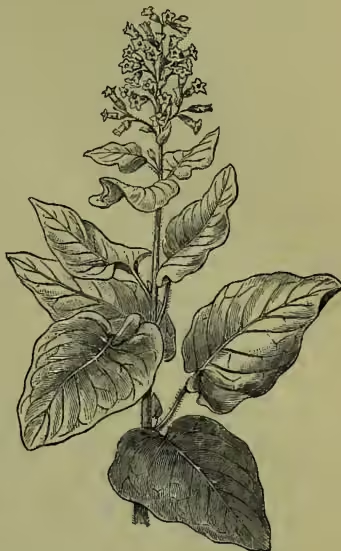
Tobacco. The origin of the word is uncertain, but it is generally supposed to have been derived from tabaco or tabac, the West Indian or Carib name of the instrument in which the leaves were smoked by the natives. The plant belongs to the genus Nicotiana, of the order Solanaceæ. The various species are mostly herbaceous, rarely shrubby, generally with large broad leaves, and covered all over with small clammy hairs. There are said to be in all about fifty species of the plant, with many varieties belonging to each, but of these three stand out in importance apart from the rest. The first of them is the Nicotiana tabacum, or American tobacco, which furnishes the bulk of the tobacco of commerce. It is a handsome plant, standing sometimes 6 or 7 feet high, with large oblong leaves which embrace the stem at their base, and with a pink or rose-coloured flower. It is now grown in all parts of the world, and the commercial American tobacco is almost exclusively of this species, although the varieties differ so widely as sometimes to give rise to a doubt as to whether they are not of different species. It includes, amongst other kinds, the famous Virginian, Kentucky, Maryland, and Havana tobaccos.
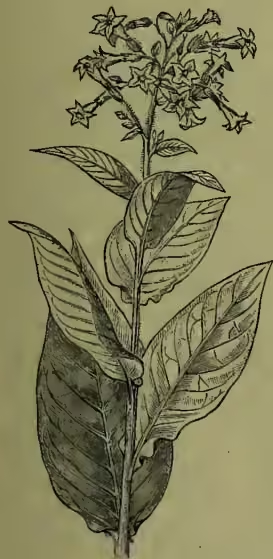
The N. rustica is a smaller plant, about 3 or 4 feet in height, with leaves of a more ovate form which are attached to the stem by stalks, and with a green flower. It is a native of America, but is now cultivated chiefly in Europe, Asia, and Africa, and furnishes the Turkish, Syrian, and probably the Latakia tobaccos of commerce. It is a hardy plant, and ripens earlier than N. tabacum. It is called green tobacco, because the leaves in drying do not entirely change to brown.
The N. persica, which furnishes the famous mild Shiraz tobacco, is a native of Persia, and has oblong stem-leaves and a white flower. The N. finis, popular in the private gardens of England, is often a long straggling plant with small leaves widely separated, but by continually nipping the stem it may be made to assume a bushy form. The flower is white and droops somewhat during the day, but towards sunset it opens out, becomes firm, and then emits for the remainder of the evening a powerful and delicious perfume, which is, of course, quite unlike that of prepared tobacco.
History.—It is a matter of conjecture whether the use of tobacco as a narcotic was known in the East before the discovery of America. It is possible that the Chinese had long been accustomed to smoking it. The habit, however, did not spread to surrounding countries; whereas on the introduction of tobacco into Europe from America its use rapidly extended and soon became very prevalent in Oriental countries. The custom was in full force in America when that continent was first discovered by Columbus. The natives of the West Indies at that time made the tobacco into cylindrical rolls wrapped in maize-leaf.
Fra Romano Pane, whom Columbus had left behind in Hayti, in 1496 wrote Peter Martyr an account of tobacco; but an exact description of the plant was first given in 1525 by Gonzalo Hernandez de Oviedo, viceroy of San Domingo, who also introduced it into Europe, and cultivated it as an ornamental plant in Spain. Its medicinal properties caused its cultivation to spread to other European countries. Jean Nicot, French ambassador at Lisbon, purchased some seed there which had just been brought over from Florida, and sent some of it home. In 1561, upon his return, he presented some of the plants to Catharine de' Medici. Various names were given to the plant at this time, but finally it was designated Nicotiana, and this word, which has been retained by botanists, gives rise to Nicotine, the name of the characteristic alkaloid of the plant. The custom of smoking the dried leaves quickly succeeded the cultivation, to be followed soon after by the habit of snuffing—luxuries at first confined to the wealthy. Therewith commenced a literary warfare, not yet ended, in which the vituperators of the 'stinking habit' produced most of the writings. Popes Urban VIII. and Innocent XI. issued decrees. Sultans of Turkey made smoking a crime punishable by the offenders having their pipes thrust through their noses. In Russia the noses of smokers were cut off. Into England tobacco was first brought by Sir John Hawkins in 1565. Probably Sir Walter Raleigh had much to do with its popularity by encouraging its growth in 1586, but he was not the introducer; we read in Lobel's Stirpium Adversaria Nova (Lond. 1571) that tobacco was at that time successfully cultivated in England and Scotland.
In 1602 appeared the first book against its use, Work for Chimney Sweepers. In the same year came A Defence of Tobacco; and in 1604 the famous Counterblaste to Tobacco of James I., in which that monarch expressed his disapproval of smoking in the following terms: 'A custom loathsome to the eye, hateful to the nose, harmful to the brain, dangerous to the lungs, and in the black, stinking fume thereof nearest resembling the horrible Stygian smoke of the pit that is bottomless.' In 1614 the Star-chamber imposed a tax on tobacco, and at about this time stipulations began to appear in respect to responsible appointments, one of the necessary qualifications of a teacher being that he should be 'no puffer of tobacco.' All this proved of little or no avail, and plantations sprang up in all parts of the country. Under Charles I. denunciations continued to issue forth until it was discovered that by taxation a considerable addition to the revenue of the crown could be realised. It was Charles II. who forbade the cultivation in England, and placed a duty on the imported article. Shakespeare makes no reference to the use of tobacco. Ben Jonson, knowing the prejudice of James I., roundly abused the weed in his Metamorphos'd Gypsies (1621).
Consumption and Use.—The consumption of tobacco at the present time is greater than it ever was. Thus the annual consumption per head of population in England was 11.7 oz. in 1821, 16.3 oz. in 1851, 22.3 oz. in 1881, and close upon 26 oz. in 1891, the quantity consumed in the latter year being 60,929,915 lb. for a population of about 38 millions. The present average for the whole of Europe is calculated at 2½ lb. for each inhabitant, which is of course 3 oz. per month. Taking the number of smokers as 30 per cent. of the whole population—a fair proportion, allowing for women, children, and non-smokers—it will be seen that throughout Europe each smoker on the average is responsible for 10 oz. of tobacco per month, or about 2½ oz. per week. In England the quantity is below this—1¾ oz. per week. A careful German estimate thus states the annual consumption in the various European countries: Holland, a trifle over 7 lb. for each inhabitant; Austria, 3.8 lb.; Denmark, 3.7 lb.; Switzerland, 3.3 lb.; Belgium, 3.2 lb.; Germany, 3 lb.; Norway, 2.3 lb.; France, 2.1 lb.; Sweden, nearly 2 lb.; Spain, 1.7 lb.; Great Britain and Ireland, 1.34 lb.; Italy, 1.25 lb.; and Russia, 1.2 lb. In the United States the amount is 4½ lb. Therefore it follows that each smoker in Holland must consume close upon 8 oz. per week, and in the United States about 5 oz. In Turkey the pipe is omnipresent; in many Asiatic countries all classes and both sexes smoke. Until recently a large quantity of tobacco used to be disposed of as snuff, but the habit of snuffing has decreased very rapidly, and 'plugging' or stuffing the nostrils with quids of tobacco has died out altogether. Chewing is now practised by Englishmen chiefly as a consequence of restrictions placed upon smoking, as, for instance, by sailors at sea and by workmen during working hours; it is comparatively common in the United States. In the early days of smoking, when the price of tobacco was high, it was usual to expel the smoke through the nostrils, as is still the custom of some cigarette smokers.
Cultivation.—Although the tobacco-plant is essentially a tropical one, it readily acclimatises itself to temperate regions, and the hardier kinds can be easily cultivated in comparatively cold climates; but the produce is less valuable the farther north we go, and in some countries, as in Germany, tobacco deteriorates if continually grown from its own seed. Unquestionably the best varieties are those of the tropical countries. One of the most remarkable characteristics of the plant is its rapacious appetite for mineral constituents or what ultimately becomes the ash; and it very soon drains the soil of all its nourishing food. The plant is not over particular as to the quality of the mineral constituents, which, nevertheless, materially affect the quality of the leaf. For instance, if salt is employed as a fertiliser the plant will take up enormous quantities of its chlorine—an element with which it can do without almost entirely—and will be ruined by this as regards its burning properties. Then again, a lime soil will produce a large crop, but the general quality will be somewhat impaired by it. The size of the leaf or the fullness of the crop is no guarantee that that crop will produce a good tobacco. The best kind of soil is an alluvial or a light sandy one containing plenty of potash. In America it is found that on new land the plant has larger stems and fibres than on old, the leaves have a coarse texture, and the tobacco a strong acrid taste, although at the same time the yield is larger. Generally speaking, old soil is preferred, not only because it produces a sweeter tobacco, but because it is more easily prepared. The soil should be watched and deficiencies made good. Potash should be present in larger quantity than is necessary for ordinary agriculture, and when deficient should be added in the form of sulphate. In growing the small garden plant the ash of smoked tobacco may be advantageously used by throwing it on the adjacent mould.
The details of the cultivation vary of necessity according to the climate and the country in which it is carried on, but the following is a general description of what usually takes place. The seed-bed, which should be a light friable soil, is well broken up to a depth of 1½ foot some months before sowing. A drain is dug round it after the style of an asparagus-bed, and a brush heap is burned over the ground to kill weeds and supply potash. The seed, which is very small (one ounce containing about 100,000), is mixed with wood-ashes or sand to assist in its even distribution, and is sown in America between the middle of March and the early part of April. About half an ounce of seed is usually required to produce plants necessary for an acre. In cold climates the seeds are sown in hotbeds. When the seed has been sown the bed is covered first with a thin layer of manure, then with a sprinkling of ashes to keep off ants, and finally with cut straw and small branches of trees to protect the seedlings from cold. In India protection from sun and rain is necessary. The soil is kept moist but not wet, and the plants, which appear in about a week, require frequent but gentle watering. They are thinned out after two or three weeks, and in about seven or eight they are transplanted into the fields. The field is prepared by several ploughings, and by being ridged or raised into hillocks about 2 or 3 feet apart. These ridges or hillocks are flattened at the top and the seedlings planted in small hollows on them, one seedling to each hillock, or, in the case of the ridges, about 3 feet apart. If the weather is dry the plants should be watered night and morning. They rapidly shoot up, and are then watched carefully for insects—in some parts a flock of turkeys being kept for this purpose. When the flower begins to shoot it is nipped off, so that it shall not take away from the leaves any of the nutriment of the plant. This 'topping' is not done in Turkey and some eastern countries where small leaves are required, and where leaves, buds, and flowers are all used. Generally the leaves are classified into three sorts—the strongest nearest the roots, the medium in the middle of the plant, and the mild at the top. The number and the quality of the leaves may be regulated by nipping off the stem at any desired stage of its growth. Thus a plant may be made to yield eight or ten leaves of a strong flavour, a few more than this of a medium strength, or a still larger number of a mild kind. After the plant has been nipped 'suckers' begin to appear, and must be removed as quickly and as completely as possible. This, together with the removal of worms, can only be adequately performed by a daily examination. Nothing else is now required to be done until the leaves are sufficiently ripe for the harvest, which generally takes place in August or the early part of September. In some places a uniform quality of leaves is aimed at by first cutting a few of them nearest the roots, then leaving the plant eight or ten days for the other leaves to strengthen, cutting a few more of the lower ones, and so on, until the stem is stripped. Another plan is to bring down the whole plant at once by cutting the stem close to the ground.
In India, Ceylon, and some other eastern countries the leaves are simply sun-dried and sent into the market, while in Europe artificial drying is resorted to in the shape of drying-houses heated generally to a temperature of about 70° to 90° F. In America both natural and artificial methods are adopted, nearly always conjointly. Sometimes the leaves are hung in sheds till the spring and then bulked, but more often they are dried in the drying-house, after perhaps being partly sun-dried, then placed in heaps, covered over, and left for a week or two to ferment, with occasional turning to prevent excessive fermentation and firing. The leaves are then sorted, tied into bundles of about a dozen, called 'hands,' and packed under pressure in barrels or hogsheads.
Manufacture.—Tobacco may be selected on account of its colour, its aroma, its body, or its drinking power—i.e. its power of absorbing and retaining water without becoming too wet, a very useful kind of tobacco to some manufacturers in past years. Again, it may be chosen as a fiery tobacco which is used to mix with other kinds difficult of burning, while a material like Chinese tobacco, which is of a very light yellow colour, without body and almost flavourless, is bought solely for producing variety of colour in mixtures. Leaves for cigar-making must be of a good colour and fair body, possess a pleasant aroma to begin with, emit an agreeable odour on burning, have a fairly fine texture, a certain amount of toughness, the ribs and veins must be small, and finally, they must answer the burning test, which is that the leaves should continue to smoulder after they have once been lighted.
Tobacco is imported always tightly compressed and apparently quite dry and crisp. Sometimes it is in the full leaf in bundles tied round by one of its own leaves; sometimes the midribs have been removed—when the material is then known as 'strips.' American varieties are exported in these conditions roughly and tightly packed in hogsheads. The more tender kinds, such as Turkish, Chinese, and Ceylon, are carefully packed leaf upon leaf. The names of some of the better known varieties in the market are those of Virginia, Kentucky, Maryland, Big Frederick, Western (leaf and strips), Indiana, &c. from America; Java, Japan, China, India, and Ceylon from the East; and Turkish and German from Europe. The dry-looking imported article contains from 10 to 20 per cent. of water, or on an average about 14 per cent.; but before manufacture it must be impregnated with more water and steamed, when the leaves rapidly become flaccid and easily open out.
In the manufacture of cigars the leaves, after being thus treated, are stripped of their midribs, smoothed and sorted, the perfect half-leaves being put on one side to be used as wrappers. One of these strips is cut into the shape of a balloon gore, and fragments of imperfect leaves and cuttings, known as the 'fillers,' being placed at one end, the strip is wrapped round them. Over this is then wound spirally a long narrow rectangular slip called the 'wrapper,' commencing at the lighting end and finishing at the pointed or mouth end. The cigars are then gauged and cut to length, dried and packed. Cheroots differ from cigars only in the matter of shape, being open at both ends, generally with one of them much broader than the other. Good cigars should consist of the same tobacco throughout, but very often the seductive wrapper conceals an inferior and even bad material. Cigars are rarely adulterated; the interior is at worst nearly always tobacco of a cheap kind. The best Havana cigars all come from Cuba; but it is a common practice to place home-made cigars in imitation foreign boxes. Cheroots come chiefly from the Philippine Islands. Mexican tobacco has met with much favour of recent years for cigar-making. The high import duty for cigars has fostered the practice of importing the leaves, on which less duty is paid, and manufacturing them in England. The difference between the foreign and British made articles is easily detected, and, as a rule, the latter are more glossy, better made, and more uniform in their appearance than the former. In the United States cigar-making is an important industry, and the best brands of 'domestics' bring a good price. Cigar-smoking in northern Europe is of recent origin. The first cigar-shop in Germany was opened in Hamburg in 1788. French soldiers brought the habit of smoking from Spain early in the 19th century.
The greater portion of the imported leaves, however, is manufactured into pipe tobacco, of which there are two classes—the cut and the cake or twist. As a rule, for the former class the leaves are stripped of the midrib, damped, allowed to ferment a little, and are then placed in a square iron box and pressed into a large cake. The dark-coloured liquor which is squeezed out is used as 'sauce' for a stronger product. The cake is then cut in a cutting machine into shreds of the desired fineness. The cuttings are gently steamed, pulled, well mixed, and scented if desired. Shag is prepared in this way from a rather strong variety of leaf. In the case of Bird's-eye the midribs are not removed. Returns is so called from being prepared from broken and rejected pieces and sittings.
In the second class there are also many kinds, such as Cavendish, Negrohead, Pigtail, Bogie, &c. The strongest kinds of leaf are employed in their preparation, and generally plenty of sauce is mixed in. For Cavendish the leaves are stripped, sauced, fermented, and are then laid one upon another and pressed into cakes of the desired size. They are sometimes made into sticks about 9 inches long and 1 inch thick, which are then laid across each other equally and pressed together: this kind is called Negrohead. In the case of twist tobacco the stripped fermented leaves are twisted either by hand or by a spinning-wheel after the style of making string. The rope so obtained, if thin, is known as Pigtail, and if thick, generally as Bogie. It is wound into balls or reels. All these kinds are oiled with sweet-oil, which prevents them from sticking together and from becoming too dry. In America mild cakes are impregnated with molasses or liquorice to give them a sweet flavour in chewing, but in England the sale of such tobacco is illegal. Cigarettes are usually made of the Syrian species, such as fine-cut Turkish, Salonica, &c.; but American tobacco has of late years been rather extensively used.
When the British duty on tobacco was reduced in 1887 there was a limit placed on the amount of water to be allowed in the manufactured article. The maximum amount permitted is 35 per cent., whereas in cake and twist 45 to 50 per cent. used to be of frequent occurrence. The adulterants of tobacco are legion. All kinds of vegetable substances, gums, saccharin, and mineral matters have at different times been detected. Manufacturers in Britain are prohibited, under a penalty of £200, not only from using but from having in their possession sugar, honey, molasses, treacle, leaves, herbs, or plants, powdered wood, weeds, ground or unground, roasted grain, chicory, lime, sand, umber, ochre, or anything capable of being used to increase the weight of tobacco and snuff. Any water over and above 35 per cent., of course, is now an adulterant; the excise penalty in this case being £50 and the forfeiture of the tobacco.
Snuff used to be made from tobacco leaves, but now it is prepared almost entirely from the stalks and ribs which are not used by the tobacco-manufacturer. The dry snuffs include the well-known Welsh, Scotch, and Irish varieties, and are prepared by finely grinding the stalks in a mortar after they have been allowed to ferment. The characteristic odour of the Irish and Welsh kinds is obtained by gently roasting the stalks previous to grinding. The moist snuffs include most of the preparations with fanciful names. These are generally made by grinding the stalks wet, allowing the fermentation to take place after grinding, mixing with various salts sanctioned by the excise, scenting and moistening to the desired degree. Snuff has been, and is sometimes now, adulterated to an enormous extent. It is no uncommon thing at the present day for the tobacco-manufacturer to add the sweepings of his whole factory to the parcel of scrap pieces intended for the snuff-maker. Besides this, many adulterants are purposely added, including many kinds of vegetable matter, salts, red-lead, chromate of lead, and oxide of iron.
Constituents.—The green leaf, and even the bulk of the dry imported leaf, contains a large ratio of complex organic bodies which retard combustion, and which, on forcing the burning, give off very objectionable odours. It is the processes of curing, fermenting, and manufacturing which get rid of or modify these objectionable bodies, and so render the material fit for use. Excessive fermentation has to be avoided, especially with cigar tobacco, because it blackens the leaves and produces ammonia compounds. Some leaves, especially those grown in tropical climates, do not require fermentation. The mineral constituents remain the same throughout, except in their combination with the organic substances, and on burning they constitute the incombustible residue or ash. The ash should be white or grayish white in colour, and not excessive in quantity—generally between 12 and 20 per cent. of the dry leaf; redness denotes iron in the soil, and blackness is due to carbon, the result of imperfect combustion. The characteristic constituent, however, of all tobacco is the alkaloid nicotine, which varies in quantity from about 1 to 9 per cent. The best flavoured kinds, such as Havana and Manila, contain only about 2 to 3 per cent., while some of the commoner varieties of French and German run up to 9 per cent. American Virginia and Kentucky average about 4 or 5 per cent. It is believed by many that the spotted appearance is a good indication. The origin of these spots has given rise to many opinions; but it is now understood that the pale spots are formed by the sun's heat being concentrated by transparent globules on to the leaf and locally burning.
Commerce.—The revenue of Great Britain from the import duty on tobacco is close upon 10 millions sterling, and in 1891 constituted for the first time more than half the whole revenue of the customs department. This is, of course, because it is taxed so enormously out of proportion to its own value, and so much more heavily than the other articles. The duty, which was raised in 1878 from 3s. 2d. to 3s. 6d., was lowered again, with a restriction as to the ultimate moisture, in 1887, and the present rates are as follows: Unmanufactured, containing 10 per cent. or more moisture, 3s. 2d. per lb.; unmanufactured, containing less than 10 per cent. moisture, 3s. 6d. per lb.; cigars, 5s. per lb.; cave-dish, 4s. 6d. per lb.; other manufactured tobacco, 4s. per lb. As the price of unmanufactured tobacco in bond varies roughly between 4d. and 1s. per lb., it will be seen that the amount paid as duty is nearly ten times the actual value of the material in the case of the poorer qualities, and more than three times in that of the better kinds. This disproportionate tax naturally offers a strong temptation for surreptitious trading or Smuggling (q.v.). The authorities keep up a rigorous supervision to prevent it, and are assisted in their work by the stringency of the law, which stipulates that no packet be allowed to be imported of less weight than 80 lb. (except samples), and this must not arrive in any vessel of less than 120 tons burden. Furthermore, the imports are not allowed to enter the United Kingdom except through specified ports duly approved by the commissioners. Passengers entering the United Kingdom from abroad may carry 8 oz. of cigars or manufactured tobacco free of duty, but persons from the Channel Islands are allowed only 4 oz. Duty can be paid on amounts not exceeding 3 lb. by passengers from the Continent (unless they are frequent visitors), and on any quantity up to 7 lb. if from the West Indies and other more distant parts. Of unmanufactured tobacco the traveller may pay duty on any quantity not exceeding 9 lb. If these conditions are evaded the goods are always confiscated, and usually double or treble duty is charged.
The actual revenue receipts for tobacco for 1897 were £11,018,000, an increase of £1,484,000 over 1890, the total revenue from the customs for 1897 being £21,266,000. The imports in 1897 were 80,728,432 lb. of unmanufactured tobacco and 4,615,123 lb. of manufactured and snuff, together worth £4,066,581; in 1891, respectively, 59,996,176 lb. and 63,493,554 lb., worth £3,423,971. The annual exports are about 7,000,000 lb. of unmanufactured and 2,000,000 lb. of manufactured, worth over £500,000.
More than two-thirds of the unmanufactured tobacco comes from the United States, a considerable amount from Germany, and smaller quantities from Japan, India, China, and other countries. Cigars are chiefly brought from the West Indies, Philippine Islands, Germany, and of recent years Mexico. The country which derives the greatest revenue from tobacco is France, where the home-grown crops are purchased by the government. Then follow in the order named the United Kingdom, Austria-Hungary, Spain, and Italy.
Physiological Effects.—Tobacco acts in various ways on the system, depending, first, on the individual, and secondly, on the time and circumstances of its being consumed. It acts most frequently as a sedative or a narcotic. In some instances it will rouse the sluggish mind into activity, while in others it will moderate excessive mental excitement. It will often correct the disagreeable effects of nervousness; while, on the other hand, it will likewise act as a laxative. The most noticeable characteristics perhaps are the effects of smoking on the nervous system in such cases as those in which it is upset by mental distress or anxiety. At the same time it must not be forgotten that there are persons whose nerves are disarranged and quite upset by smoking. By such people the habit should be tabooed altogether. Others again are only inconvenienced after an excess, while there are those who can stand any amount. Consequently, if the use of tobacco is ever to be governed by a single law, it will be by that of common sense. The amount to be consumed must be regulated by the individual who consumes it. Although even excess has never been known to originate a specific disease, still it reduces the system to a low condition, and unfits it to fight against ailments brought on by other causes. Until the system is near maturity, tobacco should be only lightly indulged in, or avoided in toto, as it acts prejudicially, even in small doses, in early life, and if used in excess is liable to have a permanent ill effect. The immediate effects of tobacco poisoning are very transitory, and they soon work off.
The usual effects of an overdose of tobacco are faintness, nausea, giddiness, general relaxation of the muscular system, loss of power of the limbs, cold perspiration, and vomiting. In some cases there is purging, and in others a sense of sinking or depression in the region of the heart. Attendant on these symptoms are a dilation of the pupils, dimness of sight, weak pulse, and difficulty of breathing. In mild cases a little stimulant and fresh air are the best remedies. Some of these disturbances of the functions are occasionally felt by the inveterate smoker, who also is liable to suffer from what is known as 'smoker's sore throat.' This makes itself evident by an irritable state of the mucous membrane at the back of the throat, with dryness, producing a tendency to cough and an enlarged, soft, sore condition of the tonsils, which renders it painful to swallow. It may exist without detection for a long time; but if a damp, cold, foggy state of the air arises, the throat becomes troublesome and painful, enlargement of the tonsils is detected, and the symptoms become much aggravated by any attempt to smoke. When smoking is altogether suspended it soon disappears, but it is incurable while the habit is persisted in, although the more troublesome symptoms may be temporarily alleviated.
The combustion of tobacco in smoking is never a complete one. While there are large quantities of carbonic acid and water—the ultimate products of complete organic combustion—produced, there are also many organic substances which are formed or become released by the heat, and which distil over with the gaseous bodies. It is the condensation of these volatile substances in very minute particles, in a similar manner to the condensation of steam at the kettle spout, which gives rise to the appearance of smoke. The colour of the smoke is dependent on the quantity of these substances present, and the rapidity with which they are condensed. The burning of tobacco should be free, with a clean ash, but not too rapid. If it is retarded from any cause, such as the improper fermentation of the leaf, or by containing the wrong mineral constituents, then objectionable products are obtained which possess both a disagreeable taste and odour. Moreover, carbonic oxide—a distinctly poisonous gas—is produced in considerable amount. All these substances tend to create the unpleasantness so often experienced with a badly burning cigar. A large proportion of the nicotine is consumed or destroyed in the burning, the ratio depending on the freeness or completeness of the combustion. The bulk of it, therefore, is not absorbed into the system, as some would make out. Indeed, it is impossible for it to be so, as one ordinary cigar contains enough nicotine to poison two men. A tenth of a grain will kill a medium-sized dog, so that a quarter of an ounce of mild tobacco would contain sufficient to poison twenty or thirty of these animals. The other principal products of the burning are ammonia and its compounds, an empyreumatic oil, and a dark, bitter, resinous substance. The first named is very objectionable both to taste and smell if in undue proportion. The last two are very evident, the former in the odour of stale tobacco, and the other in the bitter taste of the oil in the stem of a foul pipe, and both largely impregnate the smoke. These organic substances begin to be deposited directly they are formed, so that some remains in the mouth, and if the smoke is swallowed or passed through the nostrils much more will be retained and absorbed into the system—certainly an undesirable result.
It will be quite evident that the least harmful method of smoking is the use of a long pipe made of an absorbing material, such as clay or meerschaum. After this a short pipe, then the cigar and cigarette. In the progress of smoking a cigar the oils, &c. partly become condensed in it, and at the same time driven farther along until the end becomes nearly saturated with them. This end piece is often consumed with great eagerness and relish, but it is the most harmful part, and is liable to produce dyspepsia, especially with an empty stomach. The specifically deleterious effects sometimes due to cigarette-smoking may depend on poisonous substances used in preparing the cigarette-papers. The best time for smoking is unquestionably after a meal, and it should not be indulged in immediately before one. The habit of snuff-taking is perhaps the least harmful of the varied uses of tobacco, as the amount consumed must be within reasonable limit. Chewing, on the other hand, is doubtless the most deleterious. Owing to the rapid growth of cigarette-smoking, laws had been passed, up to 1891, in about three-fourths of the United States prohibiting smoking by youths.
Although on its introduction into Europe the cultivation of the plant was advocated on account of its medicinal virtues, it is now very little used for them. It has been found effective in spasmodic cases, but at the present time there is only one preparation in the British Pharmacopoeia—an infusion of the leaf in water—and this is rarely used. Nicotine is an antidote in poisoning by strychnine, and vice versa strychnine will act as an antidote to nicotine. An infusion of tobacco is an excellent insect destroyer, and the spraying of the leaves of a plant with water containing it is very effectual. The juice or 'sauce' squeezed out of the leaves in their preparation for tobacco is occasionally sold and used as a sheep-wash.
English-grown Tobacco.—In consequence of the depressed state of agriculture in England, the idea of the home-cultivation of tobacco was started, and in 1886 the necessary permission from the Inland Revenue authorities was obtained, and a fair number of trials were made. The results were so encouraging that permission with less severe restrictions was obtained again for 1887, in which year, with an early start, a thoroughly fair trial was made. Every grower reported favourably on the results of his experiments, and the ability to grow the plant in Britain was fully established. But when the authorities were approached with a view to enable the cultivation to be commenced in earnest, and as a source of profit to the grower, there was not the slightest hope held out that any facilities would be granted; any scheme likely to interfere with the machinery responsible for the annual collection of £9,000,000 could hardly be viewed with favour by the officials concerned.
Had this been foreseen it would hardly have been necessary to try experiments to show that tobacco could be cultivated in England, since history fully demonstrates the fact. From the time of its introduction down to nearly the end of the 18th century, when it was finally banished, the successful cultivation had always more or less been carried on. James I. and Charles I., of course, prohibited it, but without effect. Charles II., when he commenced to derive revenue from the imported leaves, imposed so heavy a tax on the home-grown article as it was hoped would stop its cultivation. The surreptitious growth was continued, in spite of all laws to the contrary, right down to the reign of George III., when it was finally stopped by an act passed in 1782. The plantations in Yorkshire were then destroyed, and the planters imprisoned and heavily fined—the large sum for those days of £30,000 being exacted as penalties. In Ireland the treatment was less severe, and the culture was not finally stopped until about the year 1831, when it was found to be making too much progress. In those days the profit would be more certain and the competition from foreign markets not so great as now, but against these might be weighed the greater technical knowledge of the modern farmer; and the collecting of duty should be easier now than it was then. The recent experiments may be held to have proved that in many parts of England tobacco might be expected to produce a crop worth £50 an acre, and that there is time in the English summers to ripen a fair quality of leaf. What was grown never had a fair trial in regard to curing. English soil is not all equally suited for tobacco-culture; and the statement that tobacco poisons the land merely means that it drains it of certain constituents which can be supplied again by proper treatment with manures, &c.
The total quantity of tobacco grown in the United States in 1880 was 472,661,159 lb. (of which 171,120,784 lb. were grown in Kentucky); and in 1881-90 the average crop was nearly 490,000,000 lb. The value of a year's crop in 1880-90 varied from 30,000,000 to 45,000,000. The Inland Revenue receipts alone reach some 34,000,000. The exports of unmanufactured tobacco from the United States in 1890 amounted, with stems and trimmings, to 255,647,026 lb., valued at 21,479,556; and of manufactured tobacco, including cigars and cigarettes, the value in the same year was 3,876,045. The total exports in 1897-98 had a value of 26,990,000; the imports in the same year of 9,092,000. Prior to 1890 the import duties ranged from 40 cents to 2.50+25 per cent. ad valorem, but under the McKinley tariff they range from 35 cents to $4.50+25 per cent. ad valorem per lb.
See works on tobacco and tobacco-growing by Billings and by Lock (1886); on its history and associations by Fairholt (1859; new ed. 1876) and Taylor (1886); Reports and other papers published by the American government; German works on tobacco-growing and manufacturing by Tiedemann (1854), Wagner (5th ed. 1888), and Becker (2d ed. 1883); Bragge's Bibliotheca Nicotiana (1880); on English and European tobacco-culture, see a work by Beale (1887), and papers in the Journal of the Royal Agricultural Society, vols. xxii. and xxiii.; and on the hygienic question, see Hare, The Physiological and Pathological Effects of Tobacco (Phila. and Lond. 1886), and Jolly, Études Médicales sur le Tabac (1865).