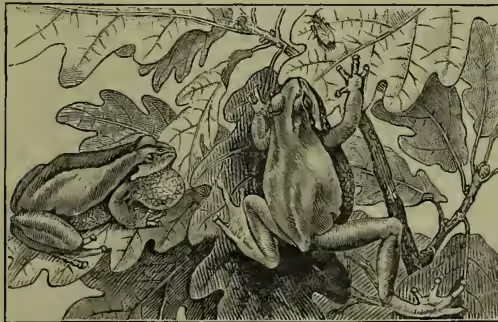
Tree-frog (Hylidae), a family of Amphibians, more closely related in structure to the Toads than to the Frogs proper. The family is a large one, the typical genus Hyla alone including ninety-five species. Of these by far the greater number are peculiar to America; about twenty species are found in Australia and two in Asia, while only one (H. arborea) occurs in Europe. The tree-frogs show various interesting adaptations to their arboreal life. The last joint of each toe bears a claw, on which is supported a disc or sucker, by means of which the animal can cling to a perfectly perpendicular surface. Most of them also exhibit in a greater or less degree the power of colour-change. This power is seen most perfectly in H. versicolor, where the colour varies from a dark brown to a lichen-like gray or a brilliant green. The name tree-frog is often extended to Hyloides, a genus of the family Cystignathidae, and to various species of Ranidae, which are arboreal in habit, and are furnished with suckers like those of the true tree-frogs. In the male of the common tree-frog the skin of the throat may be distended into a resonant bladder, which greatly increases the sound of the creature's voice.