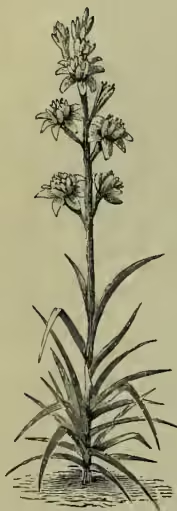
(Polianthus tuberosa).
Tuberose (Polianthus), a genus of plants of the natural order Liliaceæ, having a funnel-shaped perianth, with six-parted limb, stamens inserted in the tube of the corolla, a superior capsule, and flat seeds. The Common Tuberose (P. tuberosa) has rounded bulbous roots; a cylindrical, upright, unbranched stem, 3 or 4 feet high; both root-leaves and stem-leaves sword-shaped, and very acute; flowers spiked and somewhat aggregated, large, pure white, the tube a little in-curved. The plant grows well in the south of Europe, but only bears the open air in more northern climates during summer. The roots are a considerable article of export from the south to the north of Europe. The plant is in high esteem for the beauty and fragrance of its flowers, the odour of which is most powerful after sunset, and has been known to cause headache and asphyxia in a room. The fading flowers emit, in certain states of the atmosphere, an electric light and sparks. The flowers yield an essential oil, which is used by perfumers. The native country of the tuberose is Mexico. The tuberose has been known in Europe for about three centuries. There are double and single flowered forms in cultivation, the former being the more highly esteemed. They are very extensively grown by British and American florists, who, by planting the roots successively, manage to keep up a supply of flowers at all seasons.
Of the double-flowered form there are several varieties, known in commerce as the Double African, the Double American, the Double Italian, and the Pearl. The last named, being less in stature than the others, is preferred.