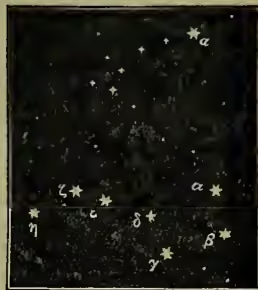
Ursa Major, 'the Greater Bear,' and Ursa Minor, 'the Lesser Bear,' are two celebrated constellations in the northern hemisphere of the heavens. Ursa Major was distinguished as early as the time of Homer by the names Arktos, 'the Bear,' and Hamaxa, 'the Wagon,' the vivid imagination of the Greeks discovering a fanciful resemblance between these objects and the group of brilliant stars in this constellation. The Roman name Ursa was a translation of the Greek Arktos; the Romans also called its seven bright stars the Septentriones, 'the seven ploughing oxen,' whence the adjective septentrionalis came to signify north. The common names throughout Europe for these seven stars are 'the Plough,' 'Charles's (Charlemagne's) Wain,' 'the Wagon'—evidently derived from the classical epithets above mentioned; the common American name is 'the Dipper.' The remarkable group of stars in the hinder part of the Great Bear, being within 40° of the north pole, never sinks below the horizon of any place in a higher north latitude than 40°, a peculiarity alluded to by Ovid in his Metamorphoses. It contains a considerable number of stars, seventeen of which are easily visible to the naked eye; but of these only one () is of the first magnitude, two ( and ) of the second, and eight (among whom are , , , and ) of the third. The accompanying figure shows the arrangement of the seven stars constituting 'the Plough.' and are known as 'the Pointers' from their use in detecting the Pole-star (q.v.). A line drawn from the Pole-star through of the Great Bear, and produced its own length, passes close to the star Arcturus of the first magnitude.—Ursa Minor is less prominent in the heavens. It was also Arktos and Hamaxa among the Greeks, but was besides distinctively denominated Cynosura, 'the Dog's Tail,' from the circular sweep formed by three of the stars in it. The star in the extremity of the tail of the Little Bear, at present the Pole-star (q.v.), is the brightest in the constellation, though only of the third magnitude.
According to a Greek legend Ursa Major was the metamorphosis of Callisto, one of Diana's nymphs, who having violated her vow, and being transformed by her indignant mistress into a bear, was slain by her son Arcas, and afterwards transferred to the heavens as a constellation by Zeus; Arcas being at the same time metamorphosed into Boötes, the Arktophylax, 'Bear-warden,' of the Greeks. See STARS.