Vancouver Island, belonging to British Columbia, lies in 48° 19'—50° 53' N. lat. and 123° 17'—128° 28' W. long., and is separated from the mainland by Queen Charlotte Sound, Johnstone
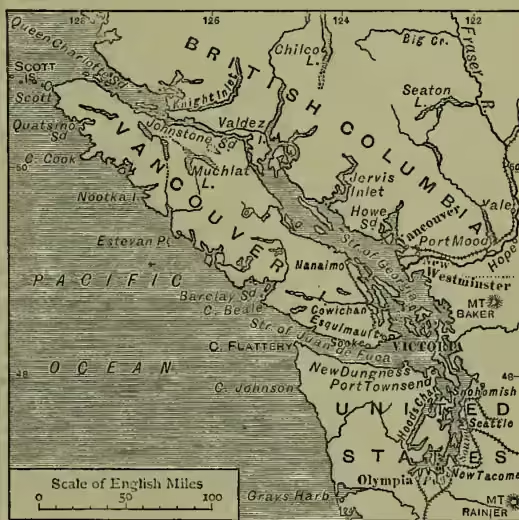
Strait, and Strait of Georgia, which taken together form an open sea-way. The island is 278 miles in length, and from 50 to 65 miles in breadth; area, 15,937 sq. m.; pop. 30,000. Its outline is boldly picturesque. The shores are marked by abrupt rocky cliffs and promontories, by pebbly beaches and sheltered coves, with fine harbours. The western shores are gloomy and frowning in aspect, deeply indented by fiord-like arms of the sea, the banks of which are formed by steep rocks rising like walls. The whole country is more or less densely wooded, except where the mountain-summits afford no foot-hold for plants, or where open grass-lands occur. There are no navigable rivers, and the streams, which are torrents in winter, and are nearly dry in summer, are short, and are valuable only as supplying power for mills. The climate resembles that of southern Britain; the warm Pacific Gulf Stream striking the coast preserves a mild and agreeable temperature; and in the south-east, where there is much less rain than in the north or on the mainland, snow seldom falls. Only a small proportion of the surface is suited for agriculture—perhaps a million acres. Fruit-culture is profitably carried on. The island is very rich in minerals. Besides gold, silver, copper, iron, &c., it possesses great fields of excellent coal, at Nanaimo in particular: the annual output much exceeds 1,000,000 tons. Good fishing banks lie off the coast, and fish and fish products to the value of $1,200,000 annually are exported from Victoria (q.v.), the capital. Esquimalt (q.v.), a naval station, has an admirable harbour, with docks and fortifications.
The island was discovered in 1592 by Juan de Fuca, and visited in 1792 by Captain George Vancouver (1758–98), an officer in the British navy; but the first permanent settlement was not made till 1843, when the Hudson Bay Company built a fort and trading post where Victoria now stands. Its later history, along with other information, will be found at COLUMBIA (BRITISH).