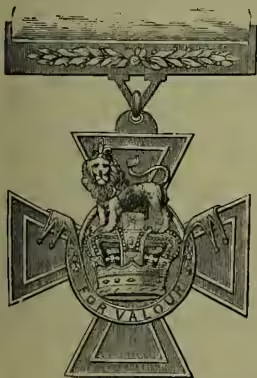
Victoria Cross, a decoration instituted at the end of the Crimean war in 1856, and conferred on members of the British naval and military services who have performed, in presence of the enemy, some signal act of valour or devotion to their country. Non-military persons who have served as volunteers against an enemy are also eligible. The general distribution of the crosses earned in the Crimean war (to 62 personally) took place in 1857; and the distinction has since been conferred from time to time. The Victoria Cross is in the form of a Maltese cross, and is made of bronze. In the centre is the royal crown, surrounded by the lion, and below, on a scroll, the words 'For Valour.' The ribbon is blue for the navy, and red for the army. On the clasp are two branches of laurel, and from it the cross hangs, supported by the initial 'V.' An additional act of exceptional bravery may be marked by a bar on the ribbon. The decoration is accompanied, in the case of non-commissioned officers and men, by a pension of £10 a year, and £5 is added for each bar. See works by R. W. O'Byrne (1880), W. Richards (1891), and M. Gerard (1891).