Viper (Vipera), a genus of venomous snakes, representative of the family Viperidae. This family includes many important forms—e.g. the Common Adder (Vipera or Pelias berus); the Asp (V. aspis), extending as far north as Sweden; the African Horned Viper (V. cerastes) and Puff-adder (Clotho or Echidna arictans); the Indian Daboia or Russell's Viper (Daboia russelii); and the Indian Echis carinata. The head is relatively broad, somewhat triangular, and generally covered with scales; the eye has a vertical pupil, and there is no pit between it and the nostril; the maxilla bears on each side one functional fang, usually with several reserve-fangs beside it; the poison is virulent. The vipers are widely distributed through the Old World and in Australia; the majority are African. As far as is known they are viviparous.
The common viper or adder is the only poisonous snake indigenous to Britain. It lives especially on dry heaths and waste places, often among stones and brushwood; it is commoner in Scotland than in England, and does not occur in Ireland. It is widely distributed throughout Europe. Often confused with the innocent Grass-snake (Tropidonotus natrix), it may be distinguished by its markings. It has two diverging marks between and rather behind the eyes, a spot on each side of the hinder part of the head, a row of confluent rhomboidal spots running zigzag along the upper surface the whole length of the body and tail, and a row of small irregular, almost black, triangular spots on each side. The under parts are of a lead colour. The characteristic markings are almost invariable; but the ground colour varies considerably, from nearly olive, rich deep brown, or brownish yellow, to almost black. Thus in some parts of England a 'Black Viper' is occasionally met with; its ground colour a rich black, and the markings of a more intense black than the rest.
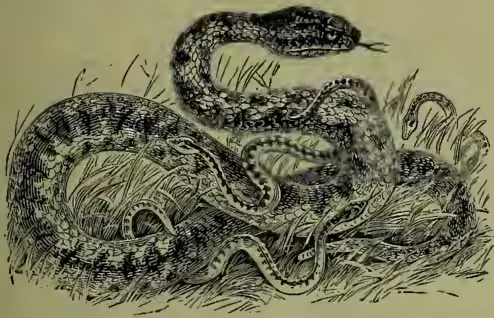
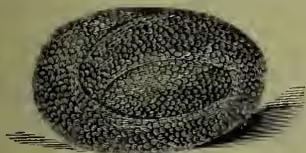
There is also the 'red' and the 'blue-bellied,' and an almost white viper, with black markings. The viper seldom exceeds two feet in length. It feeds on mice, frogs, small birds, and other small animals, which are killed by its poison-fangs, and swallowed entire. It hibernates during several months of the year, and several may then be found twined together in a torpid state. It is a good swimmer, and may occasionally be seen on lakes such as Loch Lomond, crossing from one island to another. The young are produced in early summer, from ten to fifteen or more at a birth. The eggs have soft, thin envelopes, and are hatched within the oviduct. The young viper is coiled up so closely in the egg as to appear almost a solid mass, but the moment it is set free it is active, and ready to throw itself into an attitude of defence.
It has often been alleged that in times of danger the young of the viper seek refuge in their mother's open mouth, and find temporary protection in her œsophagus; but, although this unlikely habit is not impossible, the fact is not supported by sufficient evidence. The viper is naturally shy of man, but when trod on or provoked is of course ready to defend itself by biting. The bite is painful, and, though not dangerous to healthy adults, is apt to be attended with more serious consequences in the case of children or those of weak constitution. Fatal cases are exceedingly rare. For remedies, see SNAKES, p. 532; and for the proverbial deafness of the adder, see SNAKES, p. 529.
The name Viper (Lat. Vipera) is manifestly a contraction of Vivipera for Vivipara. The name Adder arose from writing an adder, for a nadder. The A.S. is nædre, Old Eng. naddere, neddere, or addere, Scot. nether. Pliny, Galen, and other ancient writers ascribe great medicinal virtues to broth made of vipers, and to the flesh of the animal. Viper twined together in hibernation were supposed to produce the Övum Anguinum, to which virtues were attributed; and snakestones as charms were at one time common in Britain. They were either marbles or glass beads of various forms, supposed to cure vipers' bites, and to be otherwise useful.