Volcanoes. A volcano is a more or less conical hill or mountain, usually truncated, and communicating with the interior of the earth by a pipe or funnel, through which issue hot vapours and gases, and frequently loose fragmentary materials and streams of molten rock. The pipe or funnel may be a vertical hole blown out by the subterranean forces through otherwise continuous and undisturbed rock-masses, or it may be an aperture upon a line of fracture or rent in the earth's crust. In the former case the volcano will usually be small; and should several such volcanoes occur in the same neighbourhood they will generally be irregularly distributed. There is reason to believe that all the larger volcanoes occur upon lines of fracture, and their linear arrangement or grouping along more or less well-defined belts harmonises with this view. All modern volcanic eruptions appear to take place from isolated points or foci, but in earlier ages molten matter seems frequently to have welled up and overflowed from long lines of fissure. These last are termed fissure-eruptions.
During successive eruptions the heavier portions of the loose fragmental materials—blocks, cinders, &c.—fall back within and around the vent, while lava streams from the crater, now in one direction, now in another. Thus in time a cone is built up, consisting of rudely alternate sheets of fragmental materials and lenticular flows of lava, which are all inclined outwards from the orifice of eruption. Some volcanoes are made up entirely of loose ejectamenta, but such cones are generally small, varying in size from mere monticules up to hills nearly 1000 feet in height. The stones composing volcanoes of this kind occasionally consist in large measure of the debris of the underlying rocks, such as sandstone, shale, limestone, &c., which have been ruptured, shattered, and blown into the air by exploding vapours. More usually, however, the loose materials are slags and cinders discharged from a mass of lava occupying the throat of the volcano. After a more or less prolonged ejection of slags and cinders torn from the upper surface of the lava, the latter sometimes rises into the crater and makes its escape by breaching the cone. Many of these cinder-cones are the products of only one eruption. Just as we have cinder-cones composed wholly or chiefly of fragmental materials, so we have volcanoes built up almost exclusively of lava. Some of these are of insignificant size, others are among the largest volcanoes of the world. The form assumed by a lava-cone depends chiefly upon the character of the molten rock. If the lavas be extremely viscous and tenacious they usually cool and consolidate immediately round the vent, and thus tend to form a more or less abrupt cone. Some cones of this kind have no craters—the tenacious mass having welled up and stiffened around and over the orifice so as to form a dome-shaped hill. Good examples occur in Auvergne, Bohemia, Hungary, and the Isle of Bourbon. The more liquid lavas give rise to flattened or depressed cones. The great volcanoes of Hawaii are built up almost entirely of sheets of lava which are extremely liquid at the moment of eruption, and hence readily flow away and spread themselves as they go. By far the great majority of volcanoes, however, are composite in character—i.e. they are built up partly of lava and partly of fragmental materials—sometimes the one and sometimes the other predominating. Etna and Vesuvius are excellent examples of composite cones.
While some volcanoes occur upon the ridges of vast mountain-ranges, others are met with at much lower levels. Many have commenced their eruptions upon the bed of the sea, such as Etna and Vesuvius, which were in their younger days submarine volcanoes, and the same is the case with the vast cones of the Sandwich Islands. Submarine volcanoes have even come into existence in modern times. In 1796 a column of vapour was seen to rise from the North Pacific Ocean about 30 miles to the north of Unalaska. The ejected materials eventually raised the crater above the sea-level, the fiery crest of the islet thus formed illuminating the region for 10 miles around. Six years afterwards, when a few hunters landed on the new island, they found the ground in places too hot to walk upon. Repeated eruptions have since increased the dimensions of the island, until now it is several thousand feet in height, and between two and three miles in circumference.
Some volcanoes are much more active than others. A few may be said to be in a state of permanent eruption, such for example as Stromboli, which has been constantly active since the time of Homer; Izalco (in Salvador, Central America), which had no existence before 1770, has continued active ever since, and is now some 2500 feet in height. Other examples of constantly active volcanoes are those of Masaya and Amatitlan in Nicaragua, Sangay in the Andes of Quito, Cotopaxi, Sion in the Moluccas, and Tofoa in the Friendly Islands. Many volcanoes, such for example as Vesuvius, continue in a state of moderate activity for longer or shorter periods, and then become quiescent or dormant for months or, as the case may be, for centuries, when they wake up to renew their labours. The eruption that succeeds prolonged repose is usually correspondingly violent or paroxysmal. Such was the famous eruption of Vesuvius that destroyed Herculaneum and Pompeii. Similarly in our own day the terrible outburst of Krakatoa in the Straits of Sunda took place after a repose of 200 years.
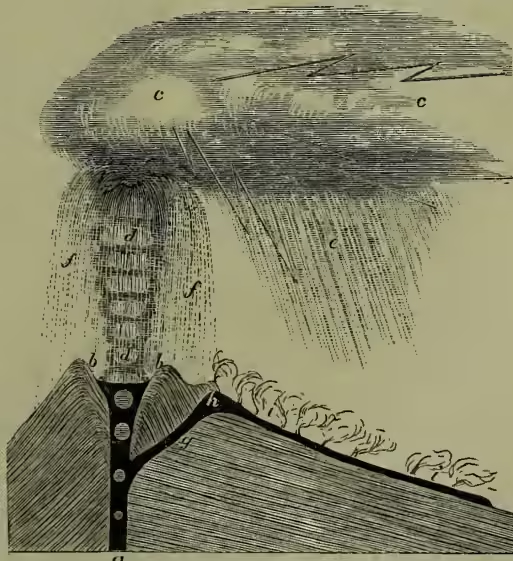
The general phenomena of a paroxysmal eruption are illustrated by the accompanying diagram. The neck or funnel of the volcano is shown at a, and the crater at b. Lava (represented as occupying the funnel) is highly charged with steam or water-gas and other vapours, and these, as the molten matter surges up, continually escape from its surface with violent explosions and rise in globular clouds, d, d, to a certain height, after which they dilate into a dark turbid cloud, e. From this cloud showers of rain, e, are frequently discharged. Large and small portions of the lava are shot upwards as the imprisoned vapours explode and make their escape, forming a fiery fountain of incandescent drops and fragments (bombs, slags, cinders), and, along with these, pieces of the rocks forming the walls of the funnel and crater are also violently discharged; the cooled bombs, slags, cinders, angular blocks, and smaller stones (lapilli) falling back in showers, f, upon the external slopes of the cone or into the crater, from which they are again and again ejected. Lightning, probably induced by the intense friction of the escaping steam, often plays round the borders of the dark cloud. The lava at last bubbles over and flows away in torrents, either from the lip of the crater or from a rent or fissure in the side of the cone. In the diagram it is represented as escaping by a lateral fissure, g, h, and streaming down the slope, while jets of steam and other vapours, i, escape from its surface. The outflow of lava marks the crisis of the eruption, and after a final ejection of stones and dust the volcano relapses into a quiescent state. In some paroxysmal eruptions of great violence the liquid lava is entirely blown out in the form of hot dust by one or more tremendous explosions. This appears to be the case when a considerable body of water is suddenly introduced to the heated reservoir. Such paroxysmal eruptions often result in great changes in the appearance of a volcano. The upper part of the cone disappears, and a vast yawning cauldron takes its place. This is no doubt due to the shattering of the walls of the crater by gaseous explosions, and to the undermining action of the surging lava. Much of the broken material is blown outwards, but the chief portion of the missing rock-masses has often given way and fallen into the eviscerated volcano. The cones of Etna and Vesuvius have frequently been modified in this way. Thus in 1822 the summit of the latter was reduced by 800 feet. Again, the entire summit of Papandayang in Java was blown off during a great eruption in 1772. The same appears to have been the case with Bandaisan in Japan—one of the principal peaks of which (Kobandai) was greatly reduced in height by the terrible eruption of 1888. It is estimated that 1,587,000,000 cubic yards of rock were blown from the top of the mountain and scattered over an area of 27 sq. m. The great eruption of Tarawera in New Zealand (1886) showed that both ejection and engulfment accompany paroxysmal action. Enormous quantities of material were scattered over the surrounding regions, and after the eruption there appeared in the south-western slope of Tarawera a sunken area 2000 feet long, 600 feet wide, and 250 to 800 feet deep. Many volcanoes after such prodigious action have become apparently extinct. One of the most remarkable eviscerated volcanoes of the kind is the island of Palma, one of the Canaries, from 3 to 4 geographical miles in diameter. The caldera or depressed interior is surrounded by precipices from 1500 to 2000 feet in height. These form an unbroken wall, except at the south-western end, where a deep gorge permits the passage of the torrent which drains the caldera. In not a few cases the calderas of eviscerated volcanoes are occupied by deep lakes. Examples in Europe are the Laacher See and other maars of the Eifel country; Albano, Nemi, Braeciano, Bolsena, Avernus, and others in Italy; Lac Paven in
Auvergne; the beautiful lakes of San Miguel (Azores), &c. Similar crater-lakes are met with in many other parts of the world, such as the lake of Gustavila in Mexico, and Crater Lake in Oregon, which has a circumference of 20 miles, and is surrounded by precipitous walls rising from 1500 to 3000 feet in height. Occasionally eviscerated volcanoes are entered by the sea, when their craters appear as nearly land-locked lagoons or natural harbours. Such is the Lago del Bagno in Ischia.
Although actual extinction appears in many cases to have followed a paroxysmal eruption, yet it is well known that this is by no means a general rule. The structure of numerous volcanoes makes this sufficiently evident. Thus Vesuvius is a cone standing in the caldera of a much larger cone, which is known as Monte Somma. The latter had evidently been eviscerated at some distant prehistoric period, and the younger cone of Vesuvius dates its origin from the time of the Plinian eruption. Since that time it has continued to increase—its growth, however, having ever and anon been interrupted by paroxysmal action. Should the volcano maintain a condition of moderate activity, the time must come when it will occupy the whole of the caldera of Monte Somma, and the latter will then become obliterated under newer ejections of lava and fragmental materials. This cone-in-cone structure is conspicuous in many other volcanoes. It is seen, for example, in Tenerife, the peak rising as a great cone from a vast caldera which is surrounded by the abrupt wall-like precipices of the older cone. The volcano of Bourbon rises in like manner in the midst of an old crater-ring, 4 miles in diameter; and the Pico de Fogo, one of the Cape de Verde Islands, is another example of the same structure. The craters of volcanoes which are situated in or upon the margin of the sea are occasionally, as we have seen, converted into harbours, the water finding access by a breach in the cone. When such volcanoes wake up, a new cone or cones by-and-by appear as islets in the centre. This type of half-submerged cone-in-cone is exemplified by the Santorin Islands (Greek Archipelago), where Aspronisi and Thera are remains of a great crater-ring, in the centre of which we see the Kaimeni Islets—the product of recent eruptions. A still more perfect example of the same structure is afforded by Barren Island in the Bay of Bengal.
A volcano, as we have seen, is composed of successive sheets of erupted material, inclined outwards in all directions from the focus of eruption. This structure is eminently weak, and, subject as an active volcano is to constant vibration and frequent earthquake movements, the cone is often modified by the displacement and collapse of large rock-masses. Indirectly, however, the fracturing of the mountain is the means of strengthening the structure—for lava frequently rises in the rents and crevices that radiate outwards from the funnel, and thus forms veins and dykes which serve to brace and bind together the various parts of the volcano. In the case of volcanoes which have attained a great height it not infrequently happens that lava ceases to rise to the central crater, and is ejected through such rents and fissures lower down on the flanks of the cone or even near its base. Sometimes this seems to indicate approaching repose or even extinction. A time comes in the life of all volcanoes when they cease to erupt either lava or fragmental materials. But for a long period they continue to give out acid gases and vapour. This is called the solfatara stage. Eventually the last traces of volcanic heat disappear, and springs of cold water may issue from the mountain and the ground in its vicinity. Such springs are often highly impregnated with mineral matter, and frequently effervescent with carbonic acid. Many of the natural effervescent mineral waters of commerce come (or used to come) from regions of extinct volcanoes. Such waters, however, are now imitated—the artificial production, owing to its greater sparkle, being in more demand than the natural.
The amount of materials discharged during a volcanic eruption varies considerably, not only in different volcanoes, but in one and the same. A prodigious quantity of lava issued from Skaptar Jokul (Iceland) in 1783. It formed two main streams which flowed for distances of 40 and 50 miles respectively, and varied in thickness or depth from 600 to 1000 feet. Enormous lava-floods have likewise issued from the volcanoes of the Sandwich Islands. In prehistoric times lava seems in many cases to have issued from long vertical fissures, and deluged wide regions. Some of these inundations of lava are well seen in western North America, as in the great basalt plain of Snake River, Idaho. The basaltic plateaus of Autrim and the Inner Hebrides, of the Faroe Islands, and of Iceland are believed to be the denuded remains of successive massive-eruptions like those of Idaho. The volcanic plateaus of Abyssinia and the Deccan (Hindustan) have had a similar origin. As a rule the volcanoes which emit lava in greatest volume are comparatively quiet in their action. The lava simply rises and is poured out, the crater is depleted of its liquid contents, and the eruption ceases. This is the case with the volcanoes of Hawaii. While the lava is bubbling and boiling in the crater jets of the incandescent liquid are shot up more or less continuously, forming the so-called 'fire-fountains,' but the terrible explosions which accompany the paroxysmal eruptions of such volcanoes as Etna and Vesuvius are unknown in Hawaii. Hence in that region the cones are built up chiefly of lavas. The Javanese volcanoes are examples of the explosive type of volcano. In these loose ejectamenta predominate, and frequently no lava flows out. In Vesuvius and similar volcanoes we seem to have, as it were, a mean between the quiet and explosive types. The enormous energy displayed during an explosive eruption is shown by the heights to which stones and ashes are projected. According to Sir W. Hamilton, jets of lava mixed with stones and scoriæ were in 1779 thrown from Vesuvius to a height of 10,000 feet, giving the appearance of a column of fire. The fine ashes of Krakatoa are said to have been carried by the uprush of gas and vapours to the amazing height of 17 miles. Remarkable solar phenomena, seen in Ceylon, South Africa, and Brazil, were attributed to the presence in the upper atmosphere of this fine dust; while in Britain gloriously coloured skies before sunrise and after sunset, months after the eruption, were attributed to the same cause. In 1845 the dust from Hecla was in ten hours lying thick on Orkney and Shetland. Ashes from Consequina fell, in 1835, in Jamaica, 700 miles off; and fine dust covered the ground 30 miles south of the volcano to a depth of 10 feet. During the great eruption of Tomboro ashes and einders were ejected sufficient to make three mountains, each equal in size to Mont Blanc, or to cover all Germany 2 feet deep. Owing to the heavy rains which so frequently accompany eruptions, destructive torrents are formed. In many cases this water is increased by that derived from melting snows, or from the bursting open of subterranean reservoirs, or the sudden emptying of crater-lakes. Sweeping down the slopes of the mountain, the water carries along coarse and fine debris, and, reaching lower levels, often flows onward for many miles, not as a mere torrent of muddy water, but as a great inundation of soft pasty mud. Such muds are termed mud-lavas. Mention has already been made of the acid gases, &c. which are given off during eruptions. Occasionally hydrogen and other combustible gases are present and burst into flame. But the 'flames' that seem to issue from a crater are usually the reflection of the glowing lava illuminating the clouds of vapour, scoriæ, and ashes.
Even during its period of activity a volcano is subject to excessive denudation, and becomes seamed and scored with ravines, radiating outwards from the upper part of the cone, and deepening as they proceed towards the low grounds. Long after the volcano has become quite extinct the process of denudation is continued, until the mountain has become so reduced in size and altered in form that its volcanic character is apparent only to geologists. Extinct volcanoes, showing every stage in this process of decay, are met with abundantly in many parts of the world which are no longer disturbed by volcanic action. Often all that has been left is the choked-up pipe or funnel, with, it may be, some of the loose ejectamenta surrounding it, and a few portions of the old lava-flows. As examples in Scotland may be cited Arthur Seat, Largo Law, the Eildon Hills, Ruberslaw, &c. These are the mere stumps or roots of what must have been volcanoes of moderate dimensions. Now and again all that remains of a volcano is the plugged neck or funnel, such as North Berwick Law, Edinburgh Castle Rock, Loudoun Hill, the Dunian, &c.
Active volcanoes are fortunately limited to particular regions of the earth, where they are distributed at intervals, and are generally arranged in a linear direction. The Pacific Ocean is bounded by an almost unbroken line of active volcanoes—the 'belt of fire.' The coast-lands of the Atlantic, on the other hand, show hardly any, and only a few appear in adjacent islands. But the Caribbean Sea and the Mediterranean—those great transmeridional depressions—wash the shores of lands which show active and recently extinct volcanoes in considerable numbers. The volcanoes of western Asia are probably closely related to the Mediterranean depression, as those of north-east Africa appear to be to that of the Red Sea. Note also must be made of the several volcanoes and volcanic islets that rise from the depths of the great ocean basins.
The causes of volcanic action have formed a fruitful theme for chemists, geologists, and physicists, but none of the conclusions arrived at is wholly satisfactory. Sir H. Davy suggested that if immense quantities of the metallic bases of the earths and alkalies were present in the interior of the earth all the phenomena of volcanic action would be produced by their oxidation from contact with air and water. This view he subsequently abandoned, but it was again taken up and advocated by Daubeny and others. Some writers, again, have maintained that the chief cause of volcanic action is the introduction of water to the highly heated interior of the earth. In some cases—those of quiet eruptions—the water or steam is supposed to be absorbed by the lava in a gradual manner; in other cases—those of explosive eruptions—the water is believed to be suddenly introduced in considerable volume. Both these actions doubtless take place, but steam, however much it may intensify an eruption, can hardly be its ultimate cause. Some lavas, it is true, emit immense quantities, but others again appear to contain a much smaller supply; and we cannot believe that the enormous volumes of lava which flow quietly away from such lofty volcanoes as those of Hawaii have been forced up from below by the mere pressure of the moderate amount of steam which they contain. The most probable view is that volcanoes are closely related to those earth-movements which have resulted in the flexing and fracturing of strata. All the greater wrinkles of the earth's surface—its ocean-basins, continental plateaus, and mountains of elevation—owe their origin to the sinking-in of the crust upon the cooling and contracting nucleus. The crust yields to the enormous tangential pressure by cracking across and wrinkling up, in various linear directions, and it is along these lines of fracture and flexure that molten matter and heated vapours and gases are enabled to make their escape to the surface. So far, then, geologists are generally agreed as to the close relation that obtains between fracturing, folding, and volcanic action. But beyond this agreement ceases. By some it is believed that the earth is a practically solid globe—that, notwithstanding its high temperature, the interior is kept in a solid state by pressure. But as the earth parts with its heat it contracts and the crust is fractured and wrinkled up, and the pressure being relieved in this way the solid matter becomes liquefied and is forced upwards through fissures, partly by pressure and partly by the action of imprisoned steam. Others, again, think it is more probable that a liquid or viscous substratum separates the cooled crust from the solid nucleus, while some still favour the old hypothesis of a comparatively thin crust enclosing a liquid or viscous interior. According to these two latter views lava is extruded through rents and fissures formed by the yielding of the crust to tangential pressure—the lava being forced to the surface by the weight of the subsiding crust in adjacent regions. Great mountain-chains adjoin areas of dominant depression, and it is conceived that the viscous-liquid matter of the interior is displaced underneath the sinking regions while an equivalent weight is forced up through fissures in the mountain-chains, and continues to be discharged until equilibrium is restored. In this view the interstitial steam or water-gas which plays so important a part in volcanic eruptions is not the inciting cause of activity. Its presence renders the viscous matter more liquid, and its expansion doubtless increases the force of volcanic eruptions; but the extrusion of lava from the fluid or viscous interior would take place even if no steam were present. But as steam is invariably present in volcanic discharges, and as it could hardly have been derived from the supposed liquid or viscous interior, it is possible that the lava in its upward progress absorbs water from the supplies always circulating through the rocks of the crust. It is certainly remarkable that all the great volcanoes are situated within or along the margins of what are believed to be sinking areas; and the same would appear to have been the case in earlier stages of the world's history. As the continents have increased by successive ridging up of their borders, and the shore-lines of the globe have advanced seawards, the lines of chief volcanic action appear to have advanced with them. Even the few volcanoes that occur in inland regions seem to be situated within or in close proximity to subsiding areas, so that they really form no exception to the general rule. Once more, there is reason to believe that all the notable volcanoes and volcanic islets of the great ocean basins rise from the backs of ridges and swellings of the crust.
See the articles EARTH, EARTHQUAKES, GEOLOGY (with books there cited), LAVA, ETNA, HAWAII, ICELAND, VESUVIUS, &c.; works on volcanoes by Scrope, Daubeny, Judd, Hull (1892), Dana on those of Hawaii (1892), A. Geikie on The Ancient Volcanoes of Great Britain (1897), T. G. Bonney (1899). And see IGNEOUS ROCKS.