Water-dropwort (Enanthe), a genus of plants of the natural order Umbelliferae; having ovato-cylindrical fruit, not prickly nor beaked, each carpel with five blunt convex ribs, and single vittae in the interstices; the calyx teeth lanceolate; the petals orbicordate and radiant, with an inflected point; the partial involucre of many rays; the flowers of the circumference on long stalks and sterile, those of the centre subsessile and fertile. A number of species are natives of
Britain, large perennial plants, with a strong and generally disagreeable aromatic smell, and compound or decomposed leaves. The Common Water-dropwort (E. fistulosa) and the Hemlock Water-dropwort, or Water Hemlock (E. crocata), are both common in wet places in Britain and throughout Europe, and both are narcotic acrid poisons. The roots of the latter have some resemblance to small parsnips, and hence fatal accidents have frequently occurred. The Fine-leaved Water-dropwort, called Water Fennel by the Germans (E. phellandrium, formerly known as Phellandrium aquaticum), is also common in ditches and ponds both in Britain and on the Continent. It has a jointed root-stock (rhizome), with tufted whorled fibres, and a strong zigzag stem dilated at the base. It is not so poisonous as the other species just named. It was at one time erroneously regarded as a specific against pulmonary consumption; but it has been advantageously employed in pulmonary complaints.
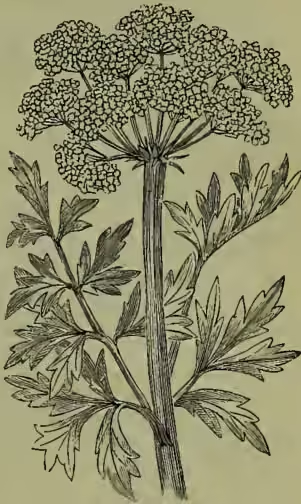
(Enanthe crocata).