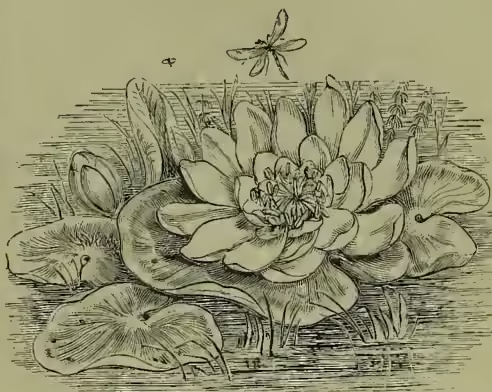
Water-lily, a name commonly given to the different species of Nymphaea and Nuphar, and also of Nelumbin, all genera of the natural order Nymphaeaceae (q.v.), and indeed often extended to all the plants of that order. Britain produces three species—Nymphaea alba, the White Water-lily, and Nuphar luteum and Nuphar pumilum, called Yellow Water-lilies. The two former are frequent in still waters in most parts of the island; Nuphar pumilum is more rare, and chiefly found in Scotland. All have heart-shaped leaves, floating on the water. The beautiful and fragrant white flowers of Nymphaea alba float upon the water during the day, but collapse and droop upon or sink below its surface during the night, rising and expanding again in the morning. The flowers of the yellow water-lily, which are of comparatively little beauty, are raised by their stalks a little above it. The seeds of these, as well as of the Water-lily of the Nile (Nymphaea lotus; see LOTUS), are farinaceous, and are sometimes used for food. The root-stocks of Nymphaea alba contain a large amount of gallic acid, and have been used in dyeing. Numerous species of tropical and subtropical Nymphaea are cultivated in British aquaria for their beautiful and fragrant flowers. The Sweet-scented Water-lily of North America (Nymphaea odorata) has a large white flower of great beauty, and of very sweet smell. Not only N. lotus, but also N. rubra and N. pubescens, are sacred plants to the Hindus. N. cærulea was held sacred by the ancient Egyptians.