Waterloo, a village or small town (pop. 3600), 11 miles S. of Brussels, which has given its name to the decisive battle fought near it on Sunday, 18th June 1815. On that day Wellington had collected 50,000 infantry, 12,400 cavalry, and 156 guns on the low ridge, some 3 miles long, which bestrides the Charleroi road near Mont St Jean. Of these troops only one-third were British, and many raw recruits; of the others a large proportion being Dutch-Belgians were disaffected and sympathised with the French. Along the main ridge, which was not entrenched, twenty battalions, some 15,000 men, were deployed in front line, and twenty battalions stood in second line under cover of its reverse slope. Some 14,000 men were in reserve in two groups, and 6000 in advance occupying the important posts of Hougmont (1200), La Haye Sainte, Papelotte, La Haye, and Smohain. The cavalry brigades were posted on the left flank and behind the centre and right, two at each place; 4000 horsemen being held in reserve. One-third of the guns were in action in front of the deployed line, one-third in support behind the right and centre, and the remainder in reserve. The right was strong so long as Hougmont held out; the left was weak in comparison, but the Prussians were approaching that flank from Wavre. On the right of the ridge was a steep ravine, whilst its left merged into a plateau. The front slope was gentle, continuous, and unobstructed, except by the farm enclosures, rising to an opposite ridge of the same character on which was deployed the French army, some 61,000 of all arms, under Napoleon. Its disposition was as follows : in front were 31,000 infantry, in two lines of battalion columns at deploying intervals. On each flank was a brigade of cavalry (1700 sabres); close in rear of the centre a reserve of the three arms, 10,000 strong; and behind it the main reserve, 11,000 strong, composed of the Imperial Guard. Two large bodies of cavalry, each about 2600 sabres, were also posted behind the main infantry line. Of the 246 guns 84 were pushed down the slope in front of the infantry, 96 were held in reserve, and the remainder formed local reserves with the cavalry behind the right and left centre.
The quality of the French troops was excellent; there were none that had not already made one or more campaigns, they were all of the same nation, mont, and after a severe struggle gained the road south of the château, but were brought to a standstill by the loopholed garden-wall. The orchard east of the garden was temporarily occupied, but attempts to get into the farm-buildings failed, and reinforcements from the British right then drove them beyond the southern garden-wall with heavy loss. The struggle was constantly renewed throughout the day, but the defenders held the farm and out-buildings to the last.
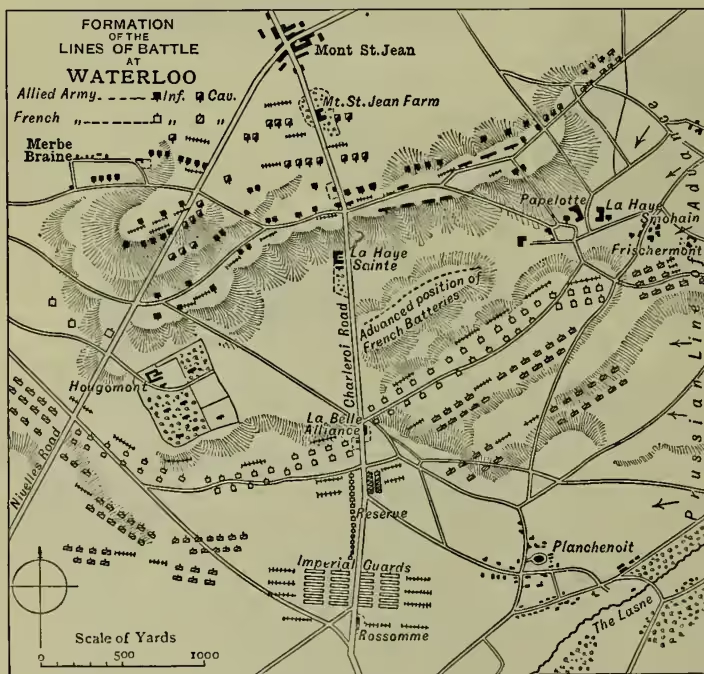
Meanwhile the guns on both sides kept up a continuous fire, and to prepare for an attack against the British centre Napoleon advanced seventy-four to a lower ridge only some 600 yards from it. The movement was delayed owing to the presence of troops to the eastward being signalled, and cavalry were sent to ascertain who they were. But at 1.30 the French infantry on the east of the Charleroi road advanced in dense columns flanked by cavalry—in all about 25,000 men, chiefly from D'Erlon's corps. The flank brigades first came into contact, and at 2 o'clock the British were expelled from the orchard of La Haye Sainte, but not from the buildings, while an indecisive action raged at Papelotte and Smohain. Simultaneously a charge of French cuirassiers swept down parallel to and west of the Charleroi road, scattered some Hanoverian troops, and passed between the hastily formed British squares, within which the gunners of the advanced batteries took refuge. A Belgian brigade taking to flight left Picton's weak division to withstand, unsupported, the attack of the heavy French columns. The moment was critical, as no infantry reserves were at hand, and the two brigades of heavy cavalry were therefore ordered to charge. One, the Household brigade, overthrew the French cuirassiers, cleared the space in rear of La Haye, and pursued to the west of the Charleroi road for some distance; the other, Ponsonby's, attacked the French infantry columns, and drove them back in disorder. Sweeping on- wards, these three regiments reached the advanced French batteries, but were then taken in flank by French cavalry, and retreated with great loss under cover of the charge of their own light cavalry from the left wing. It was now nearly 4 o'clock, and determined but unsuccessful efforts had been unceasingly made by the French to gain possession of Hougomont and La Haye. Between that hour and 6 P.M. four great cavalry attacks were then delivered against the British right centre. Some 4400 horsemen rode in the first, and nearly twice that number in the third. The British squares stood firm against these attacks, but suffered great loss from the enemy's artillery and skirmishers whilst in this dense formation.
The heavy rain that had been falling for many hours ceased at 4 A.M. on the 18th, but Napoleon did not attack until 11.30, owing, as he asserts, to the statement of his artillery officers that guns could not move until the ground had dried a little—a very inadequate reason for such a fatal loss of time. He occupied the interval with an ostentatious review of his army. The battle commenced with a violent cannonade all along the line. Then three divisions of Reille's infantry, on the west of the Charleroi road, preceded by clouds of skirmishers, attacked the homestead of Hougo- mont, and after a severe struggle gained the road south of the château, but were brought to a standstill by the loopholed garden-wall. The orchard east of the garden was temporarily occupied, but attempts to get into the farm-buildings failed, and reinforcements from the British right then drove them beyond the southern garden-wall with heavy loss. The struggle was constantly renewed throughout the day, but the defenders held the farm and out-buildings to the last.
Meanwhile the guns on both sides kept up a continuous fire, and to prepare for an attack against the British centre Napoleon advanced seventy-four to a lower ridge only some 600 yards from it. The movement was delayed owing to the presence of troops to the eastward being signalled, and cavalry were sent to ascertain who they were. But at 1.30 the French infantry on the east of the Charleroi road advanced in dense columns flanked by cavalry—in all about 25,000 men, chiefly from D'Erlon's corps. The flank brigades first came into contact, and at 2 o'clock the British were expelled from the orchard of La Haye Sainte, but not from the buildings, while an indecisive action raged at Papelotte and Smohain. Simultaneously a charge of French cuirassiers swept down parallel to and west of the Charleroi road, scattered some Hanoverian troops, and passed between the hastily formed British squares, within which the gunners of the advanced batteries took refuge. A Belgian brigade taking to flight left Picton's weak division to withstand, unsupported, the attack of the heavy French columns. The moment was critical, as no infantry reserves were at hand, and the two brigades of heavy cavalry were therefore ordered to charge. One, the Household brigade, overthrew the French cuirassiers, cleared the space in rear of La Haye, and pursued to the west of the Charleroi road for some distance; the other, Ponsonby's, attacked the French infantry columns, and drove them back in disorder. Sweeping on- retiring towards his base. His leading troops were indeed within 8 miles of Wellington's left at the time when Napoleon assumed them to be retiring before Grouchy towards Namur. The country separating the allies was little suited to the rapid march of large bodies of men. The deep and miry cross-roads had become almost impassable owing to the heavy rain. The men had been drenched and tired out on the 17th. A fire in Wavre hindered their passage through that town, and defective arrangements, causing two columns to cross on their march, still further delayed the general advance. A start could not be made until 7 A.M., and the rate of marching did not exceed 1 mile an hour. Grouchy, too, having ascertained the true direction of their march, was now pressing on their rear, and had to be held back. The rain, which Napoleon says prevented him attacking in the early morning, was therefore also responsible for many of the long hours during which Wellington had to bear unaided the full brunt of his attacks, and, but for Blücher's dogged resolution and his influence upon his men, might have prevented altogether that junction of the allies which they had designed on the night of the 17th, and to achieve which Wellington stood fast at Mont St Jean.
The Prussian corps advanced on a wide front, their left being directed on Planchenoit. To oppose them Napoleon (when assured of their approach by the capture of an orderly carrying despatches from Bülow at 1 P.M.) had detached 10,000 of the Young Guard under Lobau, as well as the cavalry (2400 sabres) already reconnoitring in that direction. He also wrote to Grouchy hoping that he was near enough to take Bülow in flank, but that officer was thoroughly committed to a severe action at Wavre, where Napoleon's letter reached him at 6 or 7 P.M.
Trusting that he could thus hold Bülow in check, Napoleon then continued his efforts against the British, whose front line had been somewhat altered by bringing forward two batteries and two brigades from the reserve. The latter deployed in a four-deep line extending from the north-east corner of the Hougomont enclosure to the main ridge. Soon after 6 P.M. Ney was entrusted with a fourth attack upon La Haye Sainte, and succeeded in gaining possession of the farm-buildings. At the same time and up to 7.30 the attack was pressed near the Charleroi road. Clouds of skirmishers and artillery fire repeatedly caused the allied battalions to deploy and advance down the ridge, when masses of French cavalry suddenly attacked and obliged them to form squares and so present vulnerable targets to the guns and sharpshooters.
But severe fighting was now going on for the possession of Planchenoit, and over 50,000 Prussians were engaged. At 7.30 Napoleon determined on one more attempt to crush the adversary in his front. The Imperial Guard advanced in two columns between Hougomont and La Haye Sainte. That on the right, consisting of four battalions, moved first, and, unchecked by artillery fire, gained the summit of the ridge. The British Guards, who were there lying down in a line four-deep, sprang to their feet at Wellington's command, fired a volley and charged. Shattered by this enveloping fire, the heavy French column fell back in confusion. Ten minutes later the left column, six battalions, followed from the south-east corner of Hougomont against the same part of the British line. Adam's light brigade, on the right of the Guards, thereupon wheeled forward its right one-eighth of a circle, fired into their flanks and then charged. The Guards crushed with their fire the head of the column, and its rout was complete. A general advance of the whole British line then took place, and the battle was won.
In the meantime the Prussians drove the French in confusion from Papelotte, which they had won, on La Belle Alliance, thus exposing Lobau's left. His troops, assailed at the same time in front, then gave way, and after an obstinate resistance Planchenoit was wrested from them. This success laid open the main line of retreat to the fire of the Prussian guns, which now almost crossed the British front and turned the defeat into the most disastrous rout of a great army which history records. The allied cavalry pressed on in their eagerness so hastily as to exchange sabre cuts in the coming darkness. The losses were great in proportion to the numbers engaged: allies, 22,500, of whom 7000 were Prussians; and French (including prisoners), 32,000. The result was the deposition of Napoleon and his exile to St Helena.
The best and fullest book on the subject is unquestionably The Campaign of Waterloo: a Military History (1893), by the American author John Codman Ropes, where references to the rather extensive literature of the subject will be found; a recent popular work is that by Horsburgh (1895). Before entering upon a study of the campaign the Waterloo Lectures, by Lieutenant-colonel C. C. Chesney, R.E., should certainly be read, referring as they do to all the best sources of information, such as the works of Charras, Thiers, Briamont, Siborne, Shaw-Kennedy, Gurwood, Dorsey Gardner, Hooper, &c., and critically examining the many discrepancies which they present. See also the article NAPOLEON. It should be added that the French named the battle from Mont St Jean, and the Prussians from Belle Alliance; but the name Waterloo is now commonly used in France and Germany as well as in Britain. The mound surmounted by the Belgian lion is conspicuous on the field.