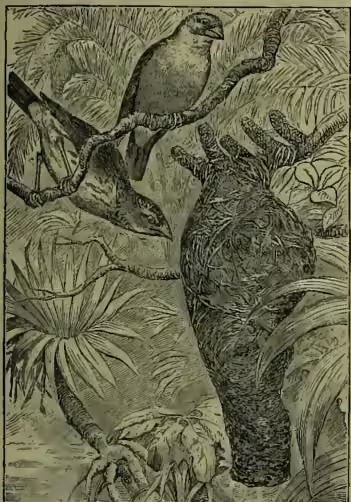
(Ploceus baya).
Weaver-bird (Ploccidae), a family of passerine birds numbering between 200 and 300 species, which bear considerable resemblance to the finches, and are, indeed, often spoken of as such. The name has reference to the remarkable structure of the nests of many of these birds, which are woven in a very wonderful manner of various vegetable substances, and are objects of great interest. The Ploccidae are natives of the warmer parts of Asia, of Africa, and of Australia; none being found in Europe nor in America. They are small birds, with a strong conical bill, the ridge of which is slightly curved, the tip entire. The wings are pointed or rounded, the first quill remarkably short, and the males of many species have a distinct summer and winter plumage, the former acquired by moulting some of the feathers. This is the case in the genus Pyromelana, for example, in which the males in full plumage are adorned with the most brilliant yellow, orange, or scarlet, set off by velvety black. They are often called 'bishops;' and the species represented is yellow above and black below, with brownish wings and tail, when 'in colour' as shown. There is great diversity in the form and appearance of the nests constructed by different species. One of the best-known species is the Baya (q.v.) of India. Many of the other weaver-birds construct nests pretty much on the same plan with this—pouches elongated into tubes, entering from below; those of some are kidney-shaped, and the entrance is in the side. They very generally suspend their nests in the same way from the extremities of branches, and often prefer branches which hang over water, probably as affording further security against monkeys, squirrels, snakes, and other enemies. Social habits are very prevalent among them, and many nests of the same species are often found close together. Some of them attach the nest of one year to that of the year preceding, as the Neliconvixes neliconvixi of Madagascar, which sometimes thus makes five nests in succession, one hanging to another. Some of the African species build their nests in company, the whole forming one structure. Thus the Social or Republican Weaver-bird of South Africa (Philhcterus socius), often called Social Grosbeak, constructs a kind of umbrella-like roof, under which 100 to 200 nests have been found, the nests like the cells of a honeycomb, and arranged with wonderful regularity. An acacia with straight smooth stem, such as predaceous animals cannot easily climb, is often selected by the bird-community. When the situation is chosen, the birds begin by constructing the roof, which is made of coarse grass, each pair afterwards building their own nest, which is attached to the roof. As new nests are built every year, the weight of the structure often becomes so great as to break down its support. The Red-billed Weaver (Textor panicivorus) is a large species of the weaver-bird group, which is commonly seen in South Africa accompanying herds of buffaloes, and feeding on the bots and other insects which infest them, alighting on their backs to pick them out of the hide. The bird is often of great use to the buffalo in another way, by giving warning of the approach of an enemy. The Whydah Birds (q.v.) likewise belong to the group of Ploceidae; and a large number of (usually) small seed-eating birds, commonly imported as pets, are referred to this family, such as Avadavats or Amadavats (Estrilda amandava), Waxbills (Pyelia), Mannikins (Munia)—not to be confused with the Manakins, i.e. Pipridæ, and the well-known 'Java Sparrow' (Munia oryzivora), of which there is a white domestic variety. The 'Bengalese' of bird-dealers are white and pied varieties of a Mannikin (Munia striata) domesticated for centuries in Japan; and many other Ploceidae will breed, more or less freely, in captivity.