Weaving is the art of forming a web or cloth by the intersecting of two distinct sets of fibres, threads, or yarns. The one set of yarns which pass in a longitudinal direction from end to end of the web is called the warp; the yarn which crosses and intersects the warp at right angles is called the weft. Textures made by knotting, twisting, and knitting are distinguished from woven fabrics by the fact that the yarns in these proceed in the same direction or have similar functions, while in knitting one continuous thread alone is used. The art of weaving, even in its simplest form, demands a certain amount of manual dexterity combined with some mechanical skill; and therefore, although one of the most ancient and fundamental of human industries, its practice implies some amount of knowledge and civilisation. It is, however, a universal art, and the textile skill of any people has in all ages been a measure of their culture and advancement. Indisputably, also, next to the industries connected with the production of food, those related to the manufacture of cloth are the most important of all arts, and the inventive genius, patient skill, knowledge, and taste which have been lavished on cloth-making have been, beyond all measure, greater than have been devoted to any other range of industries.
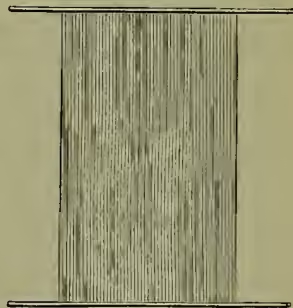
Weaving in general implies the preparation of yarns by spinning; but in making haircloth, woven wire, and some kinds of matting yarns are not employed. The simplest form of weaving is that employed in making the mats of uncivilised nations. These consist of single untwisted fibres, arranged side by side to the width required, and of the length of the fibres themselves, which are tied at each end to a stick, which is so fixed as to keep the fibres straight, and on the same plane, as in fig. 1. Then the weaver lifts up every other of these longitudinal threads, and passes under it a transverse one, which he first attaches by tying or twisting to the outermost fibre of the side he commences with, and afterwards in the same way to that on the other side, when it has passed through the whole series.
Hand-loom.—But all weaving proper is done in a loom, which may be a very simple and primitive apparatus, or it may range upwards in complexity of mechanical contrivance and delicacy of adjustment to one of the greatest triumphs of human ingenuity. In the simplest operation of weaving it is necessary to pass one set of threads transversely through another set, divided into two series, working alternately up and down, so as to receive the transverse threads in passing, and interlock them, forming thereby a united surface out of the threads. The loom is made to assist the weaver in this operation after the manner shown in fig. 2: A, A, A, A is the frame of the loom, and is of no other use than to hold the working-parts in their proper position. At each end of the frame a roller is placed, B, C, so that they will readily turn on their axes; and from one to the other the threads of the warp are attached, and kept tight by the weights b, b. The warp-threads are wound round the roller B, the beam or yarn-roll, only as much of each thread being left unwound as will reach to the other roller C, the cloth-beam, to which the ends are fastened, and upon which the cloth is wound as it is woven.
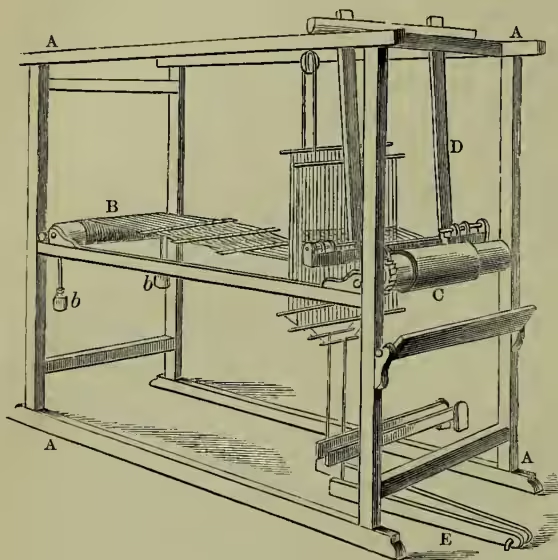
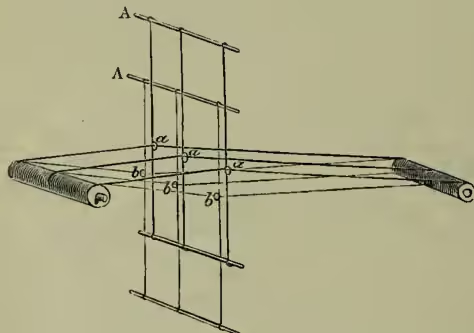
The next step is to divide the warp-thread into two equal sets by raising up every alternate one, and inserting between them a smooth rod of wood, to prevent them entangling or returning to their former position. This separation takes place before the final fixing of the ends of the threads to the cloth-beam, because, previous to that, each thread must be passed through a small eye or mail in a perpendicular thread called the heald, which hangs down from the rod A in fig. 3 (in which only six heald-threads and six warp-threads are shown, for the sake of rendering the action clearer). There are always two sets of healds in the simplest form of loom, and the threads of the warp are divided alternately by the mails of each heald, so that if one heald is raised it lifts every alternate thread of the warp, and if the other is depressed it pulls down the opposite set of threads; thus, in fig. 3, the three threads of the warp are seen to pass through the three upraised threads of one heald by the loops a, a, a, and the three remaining threads of the warp pass through the depressed healds by their loops b, b, b; the united action of the two healds opens a space between the two sets of warp-threads. This space is called the shed, and through it is thrown the shuttle which carries the thread of the weft; when the weft has passed through, the healds are reversed, and the lower warp-threads now become the upper ones. The threads, after each intersection, are driven up tight by the reed, which is a narrow frame with transverse wires set sufficiently far apart for two or more threads of warp to pass through each; it hangs to the frame called the batten (fig. 1, D). The movement of the batten is produced by the hand of the weaver, whilst that of the healds is readily effected by the treadles E.

At each end of the batten is a shuttle-box, in either of which the shuttle rests when the loom is not in operation. The shuttle of the form seen in fig. 4 is usually made of boxwood, its ends shod with iron. The middle part is hollowed out into a small box, open on the upper side. In this box the bobbin, on which the yarn or thread is wound, is placed, with its two ends on pivots, admitting of its being turned by the slightest strain on the yarn; the end of the yarn passes through a hole in the side of the shuttle, as seen in fig. 4. Between each shed the shuttle is projected by the agency of the picker, moved by the picking-stick held in the right hand of the weaver, along the shuttle-race between the shed-warp from shuttle-box to shuttle-box, and the beating up of the thread left by the shuttle completes one pick of the loom. When coloured patterns are being produced, or when for any reason more than one kind of weft must be frequently interchanged, a number of shuttles corresponding to the varieties of weft must be used. In such case a compound shuttle-box containing as many compartments as there are kinds of weft is required, and a mechanism is applied to the loom for bringing any particular shuttle into line at the time it is needed.
Power-loom.—But into the manifold devices by which the loom has been brought to the perfect condition it has attained it would be impossible here to enter. The ordinary hand-loom, while fully exemplifying all the principles of weaving, is now, for nearly all purposes, superseded by the power-loom. Automatic weaving was substantially the invention of the Rev. Edmund Cartwright (q.v.), who himself thus graphically narrates the course of his experiments:
‘It struck me that as in plain weaving, according to the conception I then had of the business, there could be only three movements which were to follow each other in succession, there would be little difficulty in producing and repeating them. Full of these ideas, I immediately employed a carpenter and smith to carry them into effect. As soon as the machine was finished I got a weaver to put in the warp, which was of such material as sail-cloth is usually made of. To my great delight a piece of cloth, such as it was, was the produce. As I had never before turned my thoughts to anything mechanical, either in theory or practice, nor had ever seen a loom at work, or knew anything of its construction, you will readily suppose that my first loom must have been a most rude piece of machinery. The warp was placed perpendicularly, the reed fell with a force of at least half a cwt., and the springs which threw the shuttle were strong enough to throw a Congreve rocket. In short, it required the strength of two powerful men to work the machine at a slow rate, and only for a short time. Conceiving in my great simplicity that I had accomplished all that was required, I then secured what I then thought a most valuable property by a patent, 4th April 1785. This being done, I then condescended to see how other people wove, and you will guess my astonishment when I compared their easy mode of operation with mine.
Availing myself, however, of what I then saw, I made a loom in its general principles nearly as they are now made, and it was not till the year 1787 that I completed my invention, when I took out my last weaving patent, August 1 of that year.'
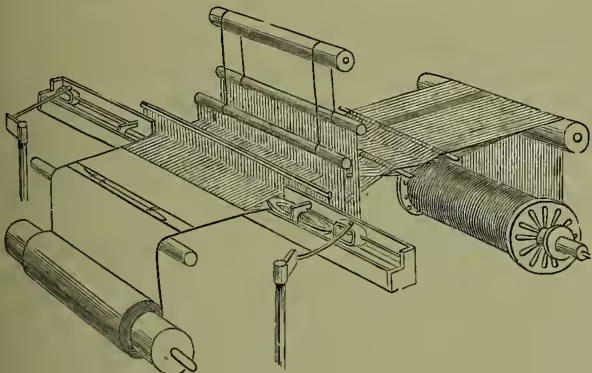
As first put on the market, the power-loom was a cumbrous and clumsy machine, which competed with much difficulty against the hand-loom. But by degrees various adaptations and accessories were added to the loom, which enormously increased its efficiency, until it attained that swiftness and certainty of action, and that power of producing all variety and quality of work, which now characterise it, and go to make it the most marvellous of all mechanical combinations. In fig. 5 is seen the skeleton of a power-loom divested of its working- parts, in which there is necessarily great variety. The whole of the complicated series of motions is invariably derived through the crank-shaft which revolves under the web.
Loom-mounting.—Before the weaver is in a position to proceed with the formation of the simplest of webs, a number of most important preliminary operations are necessary. These are embraced under the general name of loom-mounting, and include, in the case of warps, the warping, sizing, beaming, healding, and sleying of the yarn. Warping consists in bringing together and arranging in parallel order and in uniform length the number of threads which are required for the breadth of web to be formed. Sizing or dressing is an operation in which the warp yarn so assembled is treated with a glutinous or pasty compound to give the threads increased compactness and tenacity. Beaming consists in spreading the warp uniformly over the warp-beam, the width of the web to be made, and in rolling it around the beam in a regular manner, keeping the threads parallel and in straight order. Healding or drawing-in is the most important of all operations in loom-mounting, or indeed in weaving, for on it the whole nature of the weave depends. In the case of the simplest of all weaves, the making of plain or tabby cloth, only two heddles or heald-shafts are required in the loom, and the warp is drafted in alternate threads through the mails or loops in each shaft. Thus the odd threads, 1, 3, 5, 7, &c., are passed in orderly succession through No. 1 shaft, and the alternate 2, 4, 6, 8, &c. go through shaft No. 2. In this way the warp is divided into two equal quantities. After being drafted through the healds, the warp is passed between the splits or dents of the reed, two, three, or four threads being carried in each split, according to the size of reed and width of web. It then only remains to carry the warp over the breast-beam, attach the ends to the piece-beam, and the operation of weaving may be begun.
Weaves.—With two shafts of healds in the loom it is possible only to produce a plain web, and no variation of pattern can arise except from the introduction of stripes by the use of coloured warps or of checks by using also different coloured wefts. A section of plain cloth is seen in fig. 6.


When more than two shafts of healds are mounted in the loom, therewith begins the possibility of variation. With three shafts a simple twill can be produced, in which the weft flushes or passes over one and under two warp-threads alternately, thereby producing a kind of diagonal furrow, which runs from edge to edge of the cloth. In this simple weave the warp-threads are equally divided among the three shafts, and in regular succession two are raised while one is depressed to form the shed. Viewed transversely, this twill is shown in fig. 7. From this point upwards the possibility of combination and variation with the use of additional shafts of healds increases enormously. Thus with four shafts many combinations, regular and irregular, may be formed, the simplest and most common of which is known as the Cassimere twill, in which two weft-threads flush over and under two warp-threads alternately in a diagonal direction. When the number of shafts exceeds four it becomes possible to obtain a sateen weave such as is the basis of figured damasks and similar textures. In weaving a sateen only one shaft of healds, whatever number there may be in the loom, is depressed at each pick; consequently the warp flushes smoothly over the weft, giving the cloth a smooth feel and lustrous appearance, especially in fine linens and silks. The production of figured damasks depends on the combination of plain and sateen weaves, the effect in silks being heightened by the use of different colours also. But for the production of a complete pattern of any considerable dimensions a large number of picks or shots of the shuttle are needed, and for each pick there is a different combination of warp-threads in the shed. Now the number of heald-shafts it is possible to mount in a loom is limited, and besides it is impossible for a hand-loom weaver to operate more than twelve or sixteen treadles, and each shaft of healds requires a separate treadle. It is only very small and simple figured designs which can be completed in that number of picks; and when the separate sheds of warp number hundreds and even thousands it is obvious that some other means must be devised for obtaining the sheds than can be secured by healding. By means of a mechanical attachment called a witch or dobble-frane, it becomes possible to actuate up to about forty-eight sets of healds by a single pair of treadles, but beyond that number of combinations healds are not used. For all complicated patterns each warp-thread is passed through an independent suspended loop or mail, and thus it becomes capable of entering into an endless variety of combinations of sheds. Before the invention of the Jacquard apparatus the weaver had the difficult and tedious task of tying together the combinations in each separate shed of his pattern, an operation called 'tying the harness,' and these sheds were attached to a 'draw-boy' apparatus, by which they were mechanically operated in their proper sequence.
Jacquard Loom.—The great invention of Jacquard entirely obviated the tedious task of harness-tying, and so simply effected what was formerly a difficult, complex, and tedious operation that now the most varied and extensive pattern can be woven with as much ease and rapidity as a piece of plain cloth. The apparatus was invented in 1801 by Joseph Marie Jacquard (1752-1834), a native of Lyons, who, stimulated by reading an account in an English newspaper of the offer of a premium for any person who should invent a machine for weaving nets, set his wits to work to improve the existing machinery for weaving. The reception of his great invention by the public was most dispiriting, for, though Napoleon rewarded him with a small pension, the silk-weavers themselves offered such violent opposition to its introduction that on one occasion he narrowly escaped with his life, and his machine was broken up by the body of men who, under the title of Conseil des Prud'hommes, were appointed to watch over the interests of the Lyonnese traders. But on the spot where the machine was publicly destroyed a statue now stands, to show the gratitude of a more enlightened generation.
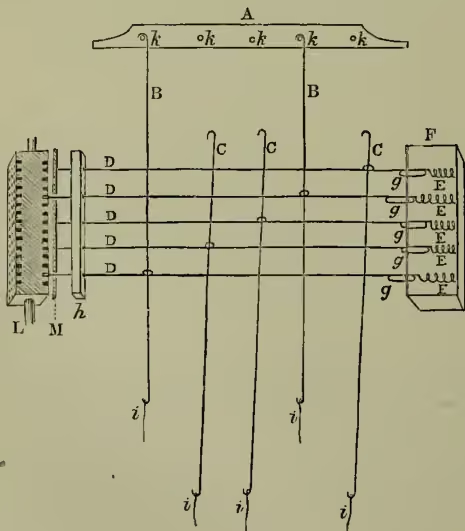

The merit of the invention was too great to admit of its being long suppressed, and when its value was once fairly recognised it effected a complete revolution in the art of weaving, especially in the finer kinds of figured silk fabrics. The Jacquard apparatus can be adjusted to almost every kind of loom, its office being merely to direct those movements of the warp-threads which are required to produce the pattern, and which previously were effected by the weaver's fingers. The warp-threads are each (as in the common weaving process) passed through a small loop in the lifting-thread, so as to be raised by means of the treadles, which act directly upon the lifting-bars; these lifting-threads (fig. 8, i, i, i, i, i) are attached to certain wires in the Jacquard apparatus, which form a rigid continuation ending in a hook, which, when nothing interferes, is caught and raised by each upward motion of the lifting-bar; thus, A is the lifting-bar, and it has five projections (k, k, k, k, k), upon which the hooks of the wires catch when in a straight position, as at B, B, but which miss them if they be thrown out of the perpendicular, as at C, C, C. There are only five of these wires given, to prevent confusion, but practically there must be one for every thread of the warp—i.e. one for every thread in the width of the cloth to be woven. Each of the lifting-wires passes through a horizontal needle placed at right angles, D, D, D, D, D, which has a loop formed for the purpose, thus, at f (fig. 9). This needle passes freely through an opening in the frame at h, and is so looped on to another rod, g, on the spring-box F, that it moves freely without fear of displacement, and if pushed back into the spring-box is made to press upon one of the spiral springs, E, which restores it to its place as soon as it is freed from pressure. In the diagram (fig. 1) this pressure is supposed to be exerted upon three of the lifting-wires, C, C, C; consequently, if the lifting-bar A is simultaneously raised, those three wires are missed, whilst the other two, B, B, being in position, catch the projections k, k, on the bar, are drawn up with it, and thus raise the threads of the warp to which they are attached. Now, the regulation of this pressure upon the horizontal needles is effected by a revolving square drum, which has each of its four sides perforated with rows of holes, which, like the needles and lifting-wires, correspond in number to the threads of the warp. This drum, when in its place, receives into one row of perforations the whole row of needles where they project through the frame at h, and it has a motion given by the machinery which brings each row on its four surfaces in regular order into the same position; and if no impediment is offered all the needles are undisturbed, and the upright wires lift the entire set of warp-threads to which they are attached. But in order to produce the necessary variations of motion required by the pattern, a set of cards are made each of the width of the square face of the drum; these also are so perforated that when placed on the surface of the drum their perforations correspond exactly with those on the face immediately beneath them; but the cards are perforated in exact accordance with the pattern, so that intervals occur in which there are no perforations to correspond with those on the drum face; hence, when the drum L (fig. 8) is brought up to the frame h, some of the needles will find entrance into the holes of the drum through the corresponding perforations in the covering card, seen in section M, fig. 8; but others will be prevented entering by the absence of such perforations, and the card, by the resistance it offers, will force the needles thus opposed back upon the springs E, E, E, removing thereby the hooks of the lifting-wires from the action of the lifting-bar. The cards are looped together at the corners, and move as an endless chain on the drum faces, and the entire set of perforations on the whole chain of cards exactly represents the pattern to be produced; the same as the notes represent the air in a piece of music.
Into the numerous varieties of weaving and the modifications both of looms and cloth it is quite impossible here to enter. The ribbon-loom is a most distinctive structure, in which many small webs are simultaneously woven; and the apparatus in which tubular fabrics, such as seamless sacks, is woven is an ingeniously modified loom. Of the leading varieties of weaving it must suffice simply to mention double-cloth, in which two warps are simultaneously woven and combined into one fabric; looped textures, like Brussels carpeting, which with the loops cut become pile fabrics, as, for example, velvet; and gauze or leno, in which the contiguous warp-threads make a half-twist around each other between each throw of the shuttle.
See Darlow, History and Principles of Weaving (1878); Ashenhurst, Treatise on Weaving and Designing Textile Fabrics (1888); Beaumont, Woollen and Worsted Cloth Manufacture (1888); Brown, Practical Treatise on the Power-loom (1887); The Textile Manufacturer, and other technical periodicals and journals; also the articles CARPETS, COTTON, LINEN, RIBBON, SILK, SPINNING, THREAD, VELVET, WOOL, &c.