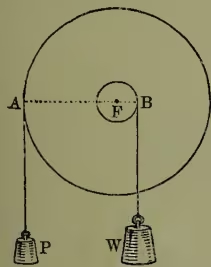
Wheel and Axle is a modification of the Lever (q.v.). Its most primitive form is a cylindrical axle, on which a wheel, concentric with the axle, is firmly fastened. When employed for raising heavy weights, the weight is attached to a rope which is wound round the axle, and the power is applied either to a rope wound round the grooved rim of the wheel, or to a handle fixed at right angles to the wheel's rim, or to its practical equivalent, an ordinary winch. The accompanying figure exhibits a transverse section of one of the commoner forms, and shows that the machine is neither more nor less than a lever, whose extremities are the points at which the power and weight act. These do not act at invariable points in the circumferences of the circles whose radii are FA and FB. They act along the cords wound round the circles and therefore at the points A and B at which for the moment the cords are tangents to the circles. Thus the imaginary simple lever, AB, is preserved unaltered in position and magnitude. The conditions of equilibrium are that , or, since the circumferences of circles are proportional to their radii, that . The capstan and windlass are simple and common examples of this mechanical power, and combinations of toothed-wheels, or of wheels from one to another of which motion is communicated by an endless band, are compound illustrations of the same.—For wheels and wheel work generally, see works on mechanical engineering, like Rankine's Applied Mechanics. There are treatises on toothed wheels by Camus (1806; new ed. 1868) and Robinson (1876). For water-wheels, see WATER (section on Water-power); for the potter's wheel, see POTTERY.