Willow (Salix), a genus of trees and shrubs of the natural order Salicaceæ, otherwise regarded as a sub-order of Amentaceæ. This order or sub-order, to which the Poplar (q.v.) also belongs, is distinguished by having the flowers naked or with a cup-like perianth; numerous ovules; a naked, leathery, one-celled, two-valved fruit; seeds with long hairs; leaves with stipules. In the willows the flowers are absolutely naked, the stamens from one to five in number, the leaves simple and deciduous. There are many species and very numerous varieties. So widely do British botanists differ as to the number of species indigenous to Britain that Bentham recognises only fifteen, while Babington places them at fifty-eight. They are mostly natives of the colder temperate regions of the northern hemisphere, although some are found in warm countries, as Salix tetrasperma in the hottest parts of India, and another species abundantly on the banks of the Senegal. Most of them are shrubs, and some are of very humble growth, particularly those of arctic and alpine regions. Thus, S. herbacea, which occurs on the mountains of Scotland, seldom rises more than an inch from the ground. S. arctica and S. polaris are the most northern woody plants. Other small species are also found to the very limits of perpetual snow in different countries, as S. lindleyana on the Himalaya. Some of those which more generally receive the popular name willow are trees of large size and remarkably rapid growth. The
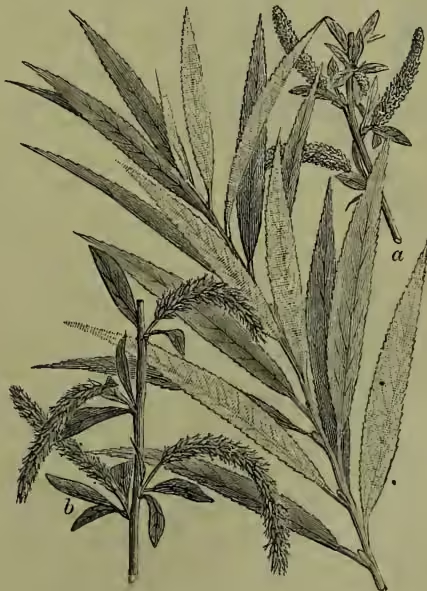
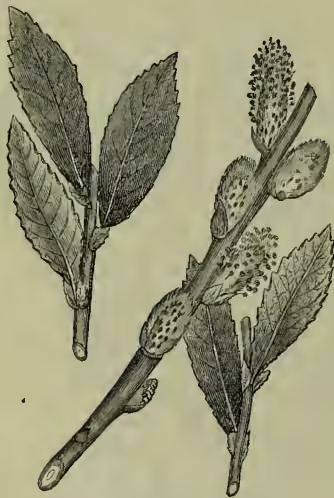
White Willow, or Huntingdon Willow, is by far the largest species known in Britain. It attains a height of 80 feet, and grows so rapidly that a cutting has been known to become a tree of 30 feet in ten years. Its head is much branched and spreading, its leaves narrow elliptical-lanceolate, silky beneath, and sometimes also above. The wood of some willows is used for many purposes, being remarkably tough and durable, although light and soft. It was anciently used for shields, and for building sloops of war. Cork-cutters and others employ it for whetting sharp-edged implements, and it is largely used in the manufacture of cricket-bats and for making paddles of steamboats. The leaves and young shoots are in some places used as fodder, and even dried and stacked; and in times of scarcity the bark has been kiln-dried and ground, to mix with meal. Willows are often planted as ornamental trees, especially near streams and in moist grounds. Many kinds are also planted on the banks of rivers, to retain the soil in its place, and restrain the encroachments of the river. They are the better adapted for this purpose that they grow readily by cuttings; and willow-stakes driven into a moist soil strike root, and soon become luxuriant. The twigs of most of the willows are very tough and flexible, and are used by coopers for making hoops, and by gardeners for tying espalier trees, and for many similar purposes. They are much used for basket-making and other kinds of wickerwork (see OSIER); willow withes were probably amongst the first ropes used by man. But the young shoots of many of the kinds with ovate or little elongated leaves are comparatively brittle and ill adapted for wickerwork. tree. The Long-leaved Sallow (S. acuminata) has lanceolate leaves. Willow-trees are sometimes treated as pollards, and the lop used for fuel and other purposes. They are also often grown as coppice-wood, yielding a great bulk of hoops, poles, fuel, &c. The Crack Willow (S. fragilis), the Goat Willow (S. caprea), and others with brittle stems and branches, which are unsuitable for basket-making, are often planted to furnish wood for charcoal for the manufacture of gunpowder, for which purpose it is greatly esteemed. A valuable medicinal principle called Salicin (q.v.) exists in the bark of willows; it is more abundant in the Bedford Willow (S. russelliana) than in any other species. This species is also remarkable in containing a larger proportion of tannin in its bark than even the oak itself. S. pentandra, a British species, besides being tonic is also possessed of aromatic properties. The flowers of the willow, which in many species appear before the leaves, are much sought after by bees. The male catkins (see figure at CATKIN) of many species are very beautiful, the prominent anthers being of a fine yellow colour, or, as in S. purpurea, of a rich purple. The sweet-scented male catkins of S. egyptiaca are used in the preparation of a stimulant and carminative liquid much favoured in some parts of the East. The Weeping Willow (S. babylonica) is a very ornamental species, a native of the East, now much planted in Britain and on the continent of Europe, on account of its beautiful pendent twigs. Perhaps the most complete collection of willows in cultivation in Britain is that at Woburn, the seat of the Duke of Bedford.