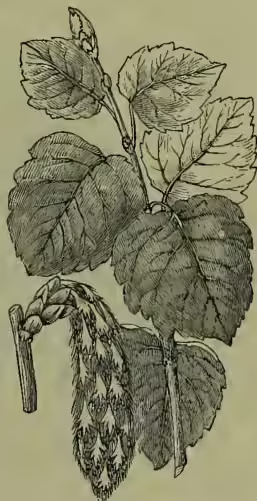
Poplar (Populus), a genus of trees, forming along with willows the whole of the natural order Salicaceæ or Salicineæ (by some regarded as a sub-order of Amentaceæ), and having dioecious flowers arranged in catkins, both male and female flowers with an oblique cup-shaped perianth. The seeds have silky hairs, as in willows, and are readily wafted about by the wind. The species are numerous, chiefly natives of the temperate and cold regions of the northern hemisphere. They are large trees of rapid growth, with soft wood, and broad, heart-shaped, ovate, triangular, or lozenge-shaped, deciduous leaves, on rather long stalks. Many of them are very beautiful trees. The catkins appear long before the leaves, and proceed from distinct lateral buds. Few of the poplars are of much value for their timber, which is generally white, soft, and light; but from their rapid growth they are useful as yielding firewood, where the scarcity of other fuel renders it necessary to plant trees for this purpose, and they are often planted as ornamental trees, producing an immediate effect of embellishment in a bare situation more readily than almost any other kind of tree. Besides the species known by the name Aspen (q.v.), or Tremulous Poplar, the following seem the most worthy of notice. The White Poplar, or Abele (P. alba), a native of the southern parts of Europe, and reckoned among British trees, but probably not indigenous in Britain, is a tree of 80 feet or upwards, with a fine spreading head, and roundish, heart-shaped, lobed, and toothed leaves, which are smooth, shining, and dark-green above, downy and silvery-white beneath. The wood is used by cabinet-makers, turners, and toy-makers. It is little liable to swell or shrink, and this fact adapts it for various purposes. The tree loves low situations and clay soils. This tree has of late years suffered in Britain from some unknown cause, like the potato, dying where it previously flourished; whilst other poplars, the most nearly allied, continue to flourish in the same localities. The Gray Poplar (P. canescens) is very similar to the white poplar, but of more vigorous growth, a large spreading tree, the leaves similar to those of the white poplar, but not so dark green above or so white beneath. It is not of so rapid growth as the white poplar; and its wood is harder and better, makes good flooring, and is preferable to pine-deal for the neighbourhood of fireplaces, being less apt to take fire; it is also used for coarse doors, carts, barrows, &c., and, not being liable to warp, is esteemed by woodcarvers. The tree generally begins to rot in the heart when forty or fifty years old. Like most of the other poplars, it fills the ground around it with suckers. Like the white poplar, it is a very doubtful native of Britain, and belongs to the centre and south of Europe. The Black Poplar (P. nigra), a native of most parts of Europe, and perhaps of England, is a tree 50 to 80 feet high, with an ample spreading head, viscous leaf-buds, and deltoid or unequally quadrangular, perfectly smooth leaves. The wood is used for the same purposes as that of the white and gray poplars. The 'cotton' from the seeds has been used in France and Germany for making cloth hats and paper, but these uses of it were not found profitable. The Lombardy Poplar (P. fastigiata or dilatata) is a mere variety of the black poplar, with erect instead of spreading branches. It appears to have been introduced into Europe from the East. It is very common in the Punjab and in Persia, and now also in Lombardy and other parts of Italy. It attains a height of 100, or even 150 feet, and is remarkable for its erect form, contracted head, and very rapid growth. It is often planted as an ornamental tree, although not so generally as in the end of the 18th century, when it was thought preferable for ornamental purposes to every other tree. It is common in the streets and squares of towns in Britain, and is particularly adapted to situations where a long horizontal line of any kind fatigues the eye, or where it is seen starting up from a mass of lower wood or shrubbery. The wood is almost of no value. It is generally propagated by layers. The species commonly known as Black Italian Poplar (P. monilifera or acladesca), although it is really a native not of Italy, but of North America, and is sometimes more correctly called Canadian Poplar, the female catkins of which resemble a string of pearls, is frequently planted both as an ornamental tree and for the sake of its timber, which is useful for flooring, &c. The leaves are deltoid. It is of very rapid growth, and attains a height of 100 to 120 feet. The Balsam Poplar, or Tacamahae (P. balsamifera), a very common ornamental tree in Britain, is a native both of North America and of Siberia, and has ovate-oblong leaves, which in spring are of a delicate yellow tint, and have an agreeable fragrance. The leaf-buds are viscid. The resinous exudation of the buds (Tacamahac, q.v.) is said to be diuretic and anti-spasmodic; and an ointment made from the buds is used for tumours, wounds, and burns. The resinous exudation of the buds of other species, as the black poplar, possesses similar properties. The Cottonwood (P. canadensis) of North America, particularly abundant on the upper parts of the Mississippi and Missouri, is valued as a timber-tree, and has been pretty extensively planted in Britain; as has also the Ontario Poplar (P. candicans), a species with the same balsamic character as P. balsamifera, and chiefly distinguished from it by its larger leaves. In size of leaf no other species equals P. heterophylla, a native of the southern states of North America, the leaves of which are often 6 inches long. See ASPEN.