Windmill is a mill for performing any class of work in which fixed machinery can be employed, and in which the motive-power is the force of the wind acting on a set of sails in a manner similar to that of a current of water impinging obliquely on the float-boards of a water-wheel. The origin of windmills is altogether lost in the oblivion of the past, though their introduction into Europe is generally ascribed to the Saracens through the Crusaders. Early writers record the employment of windmills in Europe in the 12th century, mention being found of disputes in reference to tithes in connection with them. Windmills are specially adapted for use in those new countries where fuel is scarce and work may be intermittent. Economy in working forms a special feature of the utilisation of wind-power. In good situations, and under ordinary conditions, a windmill will average about eight hours' operation out of the twenty-four. At the commencement of the 19th century the whole of the grinding, stamping, sawing, and draining of the eastern counties of Great Britain was performed by wind-power; since then the steam-engine has replaced the windmill to a considerable extent, though the latter is still found extensively in the low countries on both sides of the North Sea; whilst both in France and the United States the economical if intermittent power of wind is largely utilised. The latest development of wind-power, and one for which it would appear eminently adapted, is for charging electrical accumulators, and its employment in this capacity, as advocated by Lord Kelvin of Largs, seems destined to largely increase. Windmills may be employed for supplying economical auxiliary power to steam-engines, the latter working only in periods of calm. In illustration of this an arrangement at Faversham may be quoted where a 15 horse-power windmill auxiliary to the steam-engine raised 21,000,000 gallons of water in ten months from a depth of 109 feet, thereby saving a consumption of 100 tons of coal.
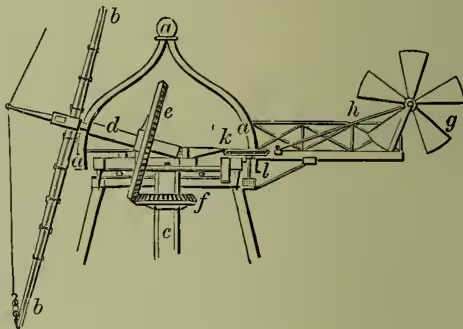
The energy of the wind in actuating a windmill is exerted upon four or more vanes known as 'sails' (fig. 1, b, b), radiating from the 'wind-shaft,' d. The obliquity of a windmill sail, or the angle which it makes with its plane of revolution, is called its 'weather.' In the oldest or 'post' mills the entire structure was carried on a post, a long lever being provided to turn it and enable the sails to face the wind. In the 'tower,' 'smock,' or 'frock' mill (fig. 1) there is a fixed tower with a rotating cap, a, a, a. This cap carries the wind-shaft, d, and is turned by hand in the older, and automatically in the later mills, so that the sails at all times face the wind. The motion which the sails communicate to the axis is transferred by the bevelled wheels, e and f, to the upright shaft, c, which actuates the machinery below. The axis d of the sails is inclined at an angle of from 5° to 15° to the horizon to enable the sails to revolve clear of the base of the tower. The transference of the plane of rotation of the sails to right angles with the wind was formerly effected by manual labour applied by a winch at the bottom of the tower, actuating an endless band and rotating the dome above through a rack.
About the year 1750 Andrew Meikle devised a successful automatic appliance for moving the sails so as to catch every wind. He placed a supplementary set of revolving vanes of about 10 feet diameter at the back of the rotating cap and at right angles to the cardinal sails; by reducing the motion of the new set of vanes about 5000 times by means of worms, he caused the cap to veer round to the wind. This apparatus consists of a revolving 'flyer' or fan (fig. 1, g) projecting from a gallery fastened to the dome on the side opposite to the sails; h, a long shaft of small diameter with a spur wheel at the end furthest from the mill, geared into a corresponding wheel on the axis of the flyer (these wheels are not seen in fig. 1, being behind the flyer); and a pinion at the other end of the shaft acting upon cog-wheel k, which carries on the lower extremity of its axis a pinion, l, which can at pleasure be geared into the rack on the lower edge of the dome. The construction of the sails, generally four in number, is shown in fig. 2.
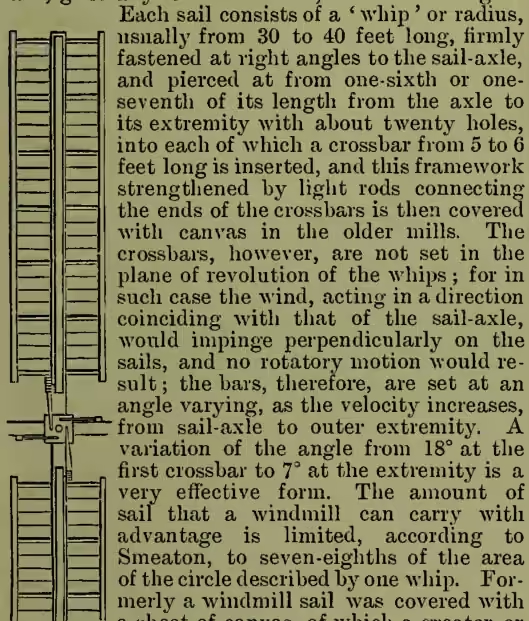
Each sail consists of a 'whip' or radius, usually from 30 to 40 feet long, firmly fastened at right angles to the sail-axle, and pierced at from one-sixth or one-seventh of its length from the axle to its extremity with about twenty holes, into each of which a crossbar from 5 to 6 feet long is inserted, and this framework strengthened by light rods connecting the ends of the crossbars is then covered with canvas in the older mills. The crossbars, however, are not set in the plane of revolution of the whips; for in such case the wind, acting in a direction coinciding with that of the sail-axle, would impinge perpendicularly on the sails, and no rotatory motion would result; the bars, therefore, are set at an angle varying, as the velocity increases, from sail-axle to outer extremity. A variation of the angle from 18° at the first crossbar to 7° at the extremity is a very effective form. The amount of sail that a windmill can carry with advantage is limited, according to Smeaton, to seven-eighths of the area of the circle described by one whip. Formerly a windmill sail was covered with a sheet of canvas, of which a greater or less extent could be spread according to the strength of the wind. Since then various methods have been devised for reefing the sails—i.e. for varying the surface exposed to the wind while the mill is in motion; in some arrangements rollers are employed on which the canvas can be rolled up, in others boards are furled by sliding behind each other, as in a fan, or turn on axes into different positions, as in a Venetian blind. Sir William Cubitt's automatic reefing arrangement, introduced at the commencement of the 19th century, was of the last-named type, the sails being of thin boards held up to the wind by a weight. As the force of the wind increased the 'valves' were pressed back and exposed less surface. According to Smeaton, the best speed for the tips of the sails, weathered as above stated, is about 2.6 times the velocity of the wind, whilst the same authority gives the effective power of a windmill with sails of best form, and about 15½ feet radius, with a breeze of 13 feet per second, at about one horse-power.
The horse-power of windmills may be derived from the following formula due to experiments by Coulomb: = the number of sails; = area of each sail in square feet; = velocity of wind in feet per second; then horse-power = , assuming the speed of the tips of the sails to be about two and a half to three times the wind velocity.
The largest windmills in Great Britain are to be found in Norfolk, where the wings describe a circuit of 100 feet diameter, and with a moderate breeze drive six pairs of millstones 4 feet 6 inches in diameter, grinding collectively 30 bushels of flour per hour. In American windmills the sails are not unfrequently arranged in an annulus or disc, and consist of narrow boards or slats arranged radially, each board being inclined at a constant angle of weather. An ingenious form of horizontal windmill was patented by Mr Giraudat of New York in 1861. The peculiarity is in the sails, which are hinged in such a way that the force of the wind acting on one face of them preserves their perpendicularity to it, and secures thereby a maximum effect; but when after a further semi-revolution the other side is presented to the wind the sails are raised to a horizontal position.