Wood, or XYLEM of the botanists, has a wider significance than that in popular use. Nearly all plants, from ferns to flowering plants, have veins or ribs in their leaves. These ribs consist of tubes or vessels (sap-carriers) supported by strong skeleton-work of fibres; hence they are called fibro-vascular bundles. Usually throughout the length of these bundles there are two groups of elements in close connection; the upper is the wood whose vessels carry sap from the roots by way of the stems to the leaves, and the lower is the bast whose sieve-tubes convey the elaborated sap (see VEGETABLE PHYSIOLOGY) down to the stem and to all growing parts of the plant. The bundles pass from the leaves into the stem, where they form a network having all the wood elements in Phanerogams (q.v.) turned towards the heart of the stem and the bast elements to the outside. It is only in the stems of phanerogams that wood in the sense of Timber (q.v.) is formed. Further, wood is formed only in those plants in which the bundles arrange themselves
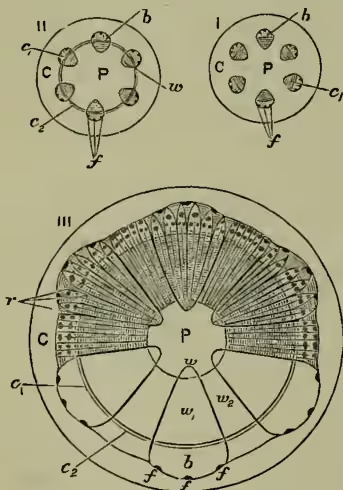
Everywhere, C, cortex; P, pith; b, bast; w, wood of the vascular bundles; f, f, f, three groups of fibres of bast; c1, cambium of the original bundle; c2, cambium formed between the bundles; w1, wood formed from the cambium of the bundle; w2, wood formed from the cambium between the bundles; r, medullary rays. (After Sachs.) dicotyledonous (obsolete exogenous) type—i.e. close together in cylinders around a common centre called the pith or medulla, while a removable Bark (q.v.) is always formed outside after the first or second year's growth. Stems of Gymnosperms (q.v.) and Dicotyledons (q.v.) have this arrangement, and it is from these two groups of plants that all true timbers are got. Stems of Monocotyledons (q.v.), including such as palms, have not got this concentric arrangement of bundles and removable bark, consequently in them no close wood is formed. If a one year old stem of the
Gymnosperm or Dicotyledon—be broken across, the fibres or bundles will be seen protruding. If the stem be cut across with a sharp knife the arrangement represented in fig. I, I. will be easily seen with the help of a simple lens. Between the wood and bast of each bundle is a layer of living cells, called the cambium or growing layer, from which all the new wood and new bast are developed. In monocotyledonous (obsolete endogenous) stems the cambium layer is wanting. At the beginning of the second year's growth, and sometimes during the first year, the cambium layer stretches across from bundle to bundle until a hollow cylinder of cambium is formed within the stem (fig. I, II.). During the second year this cambium cylinder forms a continuous cylinder of wood to the inside and a thinner cylinder of bast to the outside (see fig. I, II. and III.). The result of this is to push the bast towards the outside of the stem, while the wood forms round the original pith as its centre. (For further development of all the tissues outside of the cambium, see articles BAST and BARK.) In tropical regions where the growth of the cambium is almost continuous the wood is of almost uniform structure or grain, but where the leaves wither or fall during the hot dry season growth ceases, and this stoppage of growth is marked in the wood by an annual ring. Annual rings are best seen in woods grown in temperate regions, and are explained as follows: The cambium is active only from the opening of the bud in spring to the fall of the leaf in autumn; then growth stops and the cambium remains inactive during the winter. The result of this alternate growth and rest is the formation of the well-known rings of wood, seen when a tree is cut across, and by which we can approximately calculate the age of the tree.
In spring, when growth begins, the bark clothes the stem somewhat loosely; the cambium grows rapidly and forms vessels and cells of large bore and thin walls; but as the new wood grows outwards, and new bast is formed on the inner surface of the bark, the two layers of wood and bast press upon one another; and the pressure often becomes so great that during the summer the outer bark of many young trees may be seen splitting into longitudinal cracks which darken and widen with age. As the summer gives way to autumn the increasing pressure of the wood within the bark forces the cambium to form the vessels and cells of the wood with thicker walls and narrower bores, and the result is a dense close-grained or autumn wood, so valuable in carpentry; while the open ends of the large vessels in the loose-grained spring wood can be seen with the naked eye in a cross section of an oak stem. In the same section light-coloured lines of cells may be seen running from the pith—others from the different rings—outwards to the bast; these are the medullary or pith rays—the silver grain of carpenters.
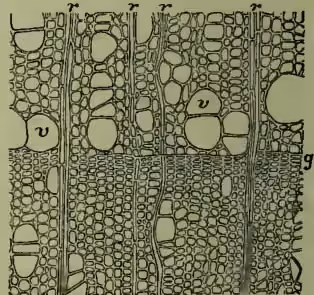
It is through these that the food-sap of the bast soaks to the wood and the pith in the younger stages of the stem, and they also store up food for the stem during winter. When wood is dried too rapidly it often cracks along the medullary rays, which are made up of cells with thinner walls than the neighbouring wood cells and vessels; consequently the medullary rays are lines of least resistance. If a tree is deprived of its leaves by insects or other agencies during the summer, the formation of wood ceases; but if the tree recovers from the injury and forms new leaves, then new wood resembling spring wood is formed, and this is followed by the usual autumn wood. In such a case a double ring will thus be formed in one year; hence the necessity of accepting with caution the number of rings as the exact age of the tree. The effects of a cold season will be seen in the narrow ring of wood produced, while a warm season will cause the formation of a broad ring. The general breadth of the annual rings increases with the age of the tree up to a certain period, and then begins to decrease. It is seldom that the rings are of uniform breadth round the stem; they are usually broader on the side exposed to the greater light and air; while the lateral branches of most dicotyledons have thicker annual rings on their upper than on their under surfaces, and the branches of conifers have the greater thickness on the under surface. (For explanation of heart-wood—Duramen—and sap-wood—Alburnum—see TIMBER.) The hardness of wood is due to lignin, a substance of unknown composition related to Cellulose (q.v.); hence woody tissues are said to be lignified. See The Oak (Modern Science, 1892), and Timber and some of its Diseases (1889), by Marshall Ward.—For the preservation of wood from decay, see TIMBER, DRY-ROT; for wood-pulp in paper-making, see PAPER; see also PAVEMENT, SILK.