Writing. In the article ALPHABET an account has been given of the various systems of writing, ideographic, syllabic, or alphabetic, and all existing alphabets have been traced to their origin in the Egyptian hieroglyphic picture-writing. In the articles PALÆOGRAPHY and INSCRIPTIONS the standard records, documents, and manuscripts have been catalogued, and the various 'hands' or styles of penmanship have been described, so that it is now only necessary to give an account of the materials used for writing, and of the influence of these materials in modifying or transforming the character of the several scripts.
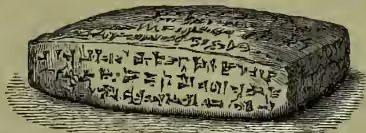
The chief materials on which writings have come down to us are stone, clay, metal, potsherds, wood, papyrus, leather, parchment, wax-tablets, palm-leaves, and paper. The oldest documents which we possess come from the earliest seats of civilisation, Babylonia and Egypt, and the Babylonian and Egyptian scripts begin with inscriptions on stone. The style of the cuneiform inscriptions is due to their having been written on tablets of soft clay, which have then been dried in the sun or kiln-baked. But this cuneiform writing was itself developed out of an earlier lapidary script, the linear Babylonian, so called because it is formed of lines, not wedges, as shown in the undated lapidary inscriptions from Tel-lo (Tellah), or the inscription of Sargon of Agade, who reigned about 3800 B.C. (see BABYLONIA, Vol. I. p. 633). But when the linear Babylonian had been modified owing to the use of clay, the lapidary inscriptions follow the wedge-shaped forms which arose out of the clay script. The wedge-shaped forms are believed to have been impressed on the soft clay by means of a square-headed implement, a corner of which was dented into the clay. The great library of Nineveh consisted of clay-tablets containing Assyrian copies of older Babylonian documents, and from Babylon we have on similar tablets the records of the Egibi banking firm, consisting of innumerable deeds relating to financial transactions, such as loans, sales, and marriage settlements. The contract tablets go back to the 24th century B.C., and come down to the time of Domitian.
The oldest inscriptions of Egypt, which may be earlier by a thousand years than any from Babylonia, are also engraved on stone; but papyrus was also used at an extremely remote period. Hence two styles arose, the hieratic for papyrus and the hieroglyphic for inscriptions. The oldest book in existence is the Papyrus Prisse, now at Paris. It was found in 1847, in a Theban tomb of the 11th dynasty (2500-3000 B.C.), and purports to be a copy of a much earlier treatise, composed in the time of the 5th dynasty. It is written in a bold hieratic hand, bearing little resemblance to the hieroglyphic picture-writing from which it was derived. Such remains of the literature of ancient Egypt as we possess have chiefly come to us on papyrus rolls found in Egyptian tombs. From
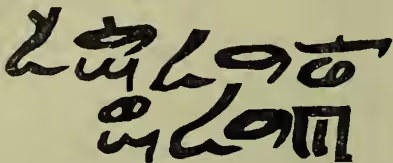
Egypt the use of papyrus spread to Europe. The oldest Greek records are inscriptions on stone or metal, but we possess Greek papyri found in Egypt which date from the 2d century B.C. At Herculaneum a library consisting of some 2000 carbonised rolls of papyrus has been discovered. It consists mainly of Greek treatises on the Epicurean philosophy, but comprises a few Latin works, among them a poem on the battle of Actium. In the 5th century the rescripts of the Imperial Chancery at Constantinople were written on papyrus; we have papyrus deeds from Ravenna dating from the 5th to the 10th century; and in the 7th century papyrus was used for the charters of the Merovingian kings in Gaul. In the 8th century, owing to the Moslem conquest of Egypt, papyrus became more difficult to procure, but it continued to be used in the Papal Chancery till the middle of the 11th century. Concurrently with the use of papyrus for deeds and rescripts, parchment, a more costly material, was largely used for books. As to the date of its invention, Pliny records the legend that Ptolemy V. (205-185 B.C.) prohibited the exportation of papyrus from Egypt, and that in consequence the books in the great library at Pergamus were written on skins specially prepared, called from the place of their origin pergamena, from which the word parchment is derived. Leather had previously been used, and is still employed by the Jews for the sacred rolls of the law. Parchment is leather so prepared that both sides can be used to write on. From the 4th to the 16th centuries parchment, made from the skins of sheep, goats, and calves, was the usual material for books. Vellum is merely a finer kind of parchment made from the skins of younger animals.
Paper (q.v.), made of vegetable fibre or of rags, was probably invented by the Chinese, and introduced into Europe by the Arabs in the 9th century; in the 13th century it was used in France for deeds, and in the 15th century for books. But for the invention of paper, the printing-press would have been an invention of comparatively little importance, papyrus being too frail and parchment too costly for the multiplication of printed books.
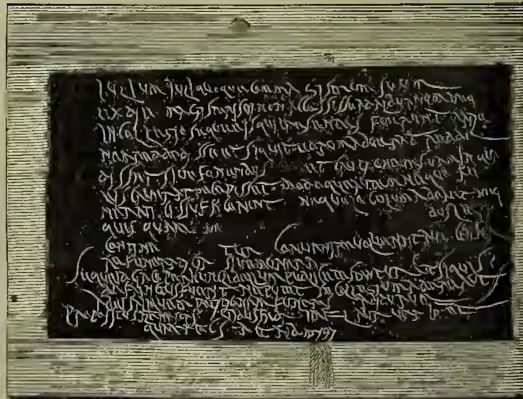
For ordinary purposes, such as letters, accounts, and the first drafts of books, the Greeks and Romans made use of wooden slabs covered with a thin coating of wax, on which the writing was scratched with a hard point of metal, wood, or ivory, which was called the graphium or stilus. The other end of the stilus was flattened into a palette, which served to efface the writing or to smooth the wax. These tablets were called deltoi by the Greeks, and tabulae by the Romans. They were connected by rings, serving as hinges, and two or more slabs thus connected were called a candex or codex. A codex of two leaves or slabs was called a diptych, and one of three leaves a tritych. The peculiarities of the Roman cursive hand are largely due to the employment of these wax-tablets. They were used in France till the 13th century, and then superseded by paper.
Papyrus MSS. are, as a rule, written only on one side, and are usually found in the form of cylindrical rolls. Our word 'volume' is derived from the Latin name volumen, which was given to these rolls. When parchment came into use, we have also the word rotulus, whence the name of the Master of the Rolls, who was custos rotulorum, the keeper of the rolls or legal documents of the Chancery. The Greeks called these rolls biblia, whence the name of the Bible, and the word bibliotheca for a library. When the work was in several rolls the rolls were called tomoi (Gr., 'slices,' 'sections'), whence the word 'tome.' The Latin word liber, 'a book,' whence our 'library,' points to the use of the bark of trees as the material for writing, while 'book,' from the A.S. bóc, 'a beech tree,' points to the fact that the runes were cut on slabs of beech-wood. The book form was adopted for literary works written on parchment, and the name codex, originally given to the hinged sets of wax-tablets, was transferred to such MSS., distinguishing them from the volumina and rotuli. Codices written on papyrus are rare, the material being so fragile that it was liable to tear in turning over the leaves. There is, however, at Paris a papyrus codex of the 6th century, containing the sermons of St Avitus, Bishop of Vienne, and another of nearly the same date, containing some of the works of St Augustine. At Milan there is a papyrus codex of the 7th or 8th century, containing a Latin translation of Josephus by Rufinus. Before the 15th century MSS. are not paged, but only foliated—i.e. only the leaves or quires, and not the pages, are numbered. Till the 11th century the lines for the writing are scratched with a dry-point, in the 13th they are ruled with a plummet or lead point, or with red ink.
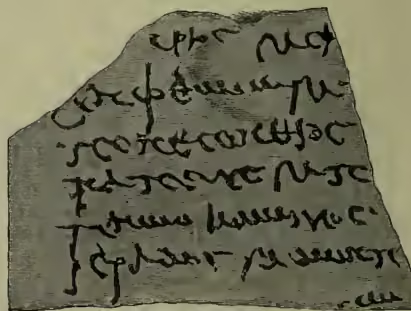
In Egypt great numbers of graffiti or inscribed potsherds, called ostraca (lit. oyster shells), have been found. Sometimes the writing is scratched with a sharp point, but is more commonly written in ink with a reed. Some of these ostraca are letters or orders to officials, but most usually they are receipts for taxes. The tax-collectors must have gone round with donkeys laden with pot-sherds in order to give these receipts. We have also Graffiti (q.v.) rudely scribbled on the plaster of Pompeian and Roman walls, which are valuable as disclosing the popular spelling and the cursive hand of the period.
Documents intended for preservation, if not inscribed on stone, were usually engraved on metal. The questions addressed to oracles were scratched on leaden plates, of which great numbers have been found, and leaden plates, containing the name of the deceased, were used as scrolls for loculi in tombs. Treaties between Greek states were frequently engraved on bronze plates and affixed to the walls of temples.
The oldest specimens of Indian writing are the rock inscriptions of Asoka (q.v.), which date from the 3d century B.C. These are succeeded by numerous inscriptions from Buddhist caves. The grants of land to temples were commonly engraved on copper plates. But the characteristic Indian material was the palm-leaf, the use of which has profoundly modified the scripts of Southern India, Orissa, Ceylon, and Burma. The palm-leaves were strung together something in the manner of a rosary, by a cord passing through holes bored in the leaves. The Devanagari, or Sanskrit Book-hand (fig. 5), was written on palm-leaves with a was derived. Hebrew, Syriac, and Arabic, and the scripts derived from the Arabic, such as Turkish, Afghan, and Hindustani, retain this direction. The oldest of the Greek inscriptions follow the Phœnician direction, but at an early period they are occasionally written in a snake-like form, following the margin of the stone. In the 6th century, or even earlier, we find them written boustrophedon or 'plough-wise,' the lines running alternately from right to left, and from left to right, just as oxen, when ploughing, draw the alternate furrows in opposite directions. Finally all the lines were written from left to right. The same happened in Italy. The older inscriptions are retrograde, a direction long retained by the Etruscans, while from Cuneæ we have boustrophedon inscriptions, until finally the direction from left to right was adopted. The same was the case with the runic writing, which was obtained from the Greeks before the direction of the writing had been changed. The earliest runic inscriptions are retrograde, then they become serpentine or boustrophedon, and finally they are written from left to right. The Himyaritic inscriptions from Arabia Felix are retrograde, boustrophedon, or from left to right, a direction which was adopted when the Himyaritic writing penetrated to India. Hence the Devanagari, the Pali, and all the derived Indian scripts are written from left to right. Chinese is written in vertical columns, beginning
ईश्वर इत्थं जगददयत यत् स्वमद्वितीयं
तनयं प्राददात यतो यः कश्चित् तस्मिन्
विश्वसिष्यति सोऽविनाश्यः सन् अनन्तायुः
प्राप्स्यति ।
Fig. 5.—St John, iii. 16, in Sanskrit (the Devanagari character), as printed by the British and Foreign Bible Society.
reed and ink, but exhibits characteristic forms due to the earlier employment of a dry point, the connecting line from which the letters depend being in this case necessarily absent.
The reed, called calamus, fistula, arundo, or canna, and cut like our quill-pens, was used for writing with ink on papyrus or parchment. It is still employed in the East, and in the West continued to be used till the 12th century. Isidore of Seville, who wrote in the 7th century, is the first to mention the quill—penna, 'a feather,' whence our word 'pen.' In the 13th century the quill had replaced the reed, and the result of the change is seen in the adoption of finer up-strokes. The general use of steel pens has had considerable effect on modern scripts, but metal pens, or calami made of bronze, were not unknown to the ancients. The last innovation is the stylographic pen, the use of which is modifying modern hands.
Ink was usually black. The oldest inks were thick and glutinous, necessitating the use of a brush, as in the earlier hieratic writing, and in Chinese or square Pali. A thinner ink, suited for the reed, was made from gall-nuts and sulphate of iron (see INK). Red and blue ink were used for titles or initials. From the 6th to the 11th century coloured inks are rare, but in the 12th they become more common. For an account of gold and silver writing on purple parchment, see ILLUMINATION.
Among Aryan nations the writing is horizontal, and the normal direction from left to right. The Semitic scripts, on the other hand, are written from right to left, this being the direction of the early hieratic, from which the Phœnician alphabet with a column on the right-hand side of the paper. The Manchu and Mongolian scripts are also written in vertical columns, but, unlike the Chinese, they begin on the left-hand side of the paper. The Mongolian, from which the Manchu was derived, was obtained from the Syriac script of the Nestorian missionaries, who at first wrote from right to left, and then for convenience wrote vertically, the paper being turned round through 90° to enable it to be read. Finally it was both written and read vertically.
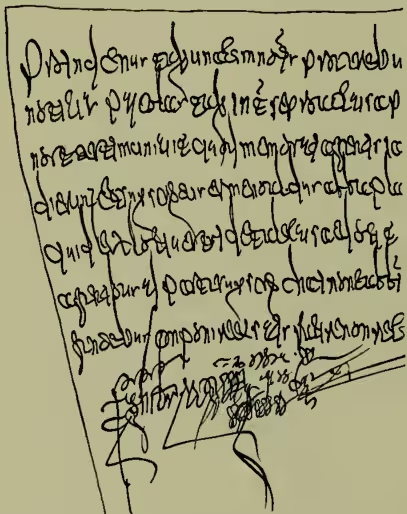
The character and general appearance of scripts has been greatly influenced by the nature of the materials employed, whether stone, clay, metal, wood, papyrus, wax, palm-leaves, parchment, or paper, and also by the implement, whether chisel, brush, reed, stile, or quill, as well as by the quality of the ink. Scripts of wholly different origin, if written with the same materials, acquire a general external resemblance. If a brush, with thick ghtinous ink be employed, the writing tends to become upright, thick, and bold, as in Chinese, Siamese, Square Pali, and the hieratic of the old Egyptian empire. If a reed be used the writing often slopes to the left, the up-strokes and down-strokes being of the same thickness, as with a stylographic pen. On the other hand, with a quill or a steel pen the writing slopes to the right, and the up-strokes are fine. Thus it is manifest that our printed capitals, such as W, M, N, or V, are imitations of quill-written letters, the down-strokes being thicker than the up-strokes. With a lapidary script the strokes are all of the same thickness, the letters are square, angular, upright, and regularly formed, eschewing oval loops or sweeping tails. Thus lapidary Greek and lapidary Himyaritic have a superficial resemblance, though their pedigrees are different. A xylographic script, such as the runic writing, is rectilinear and regular, like a lapidary script, but triangles are preferred to squares, complicated forms disappear, curves and horizontal lines are avoided, diagonals running obliquely across the grain of the wood being preferred. Hence in the runic writing H becomes N, the bars of F slope upwards, and those of E slope downwards (see RUNES). A palm-leaf script, if scratched with a point, and not written with a reed, prefers arcs of circles and vertical lines, lending itself readily to intricate convolutions, but like a xylographic script it rigorously eschews horizontal lines, which would cause the leaf to split. Palm-leaf scripts, such as those of Orissa, Ceylon, and Burma, have a superficial resemblance, though their pedigrees may differ. On metal, if the writing be punched, it partakes of lapidary forms; if written with a point it becomes scratchy, and we get intersecting lines, the angles are not joined with precision, and circles become irregular ovals. On clay the loops are opened, all the forms are rectilinear, and the strokes become parallel and detached. Books written on parchment, a costly material, exhibit an elaborate calligraphic style, the letters being upright, separately formed, regular in size, with symmetrical curves, elliptical rather than circular curves being preferred. The up-strokes are fine, and the down-strokes of uniform thickness. But if a rough and cheap material, such as papyrus or paper, be employed, the writing tends to become careless and cursive, easily degenerating into an almost illegible scrawl, as in the Merovingian charters, exhibiting blotted loops and elongated tails, the letters being joined by ligatures which have a tendency to modify the forms of the letters. Thus A is a lapidary form, a is a parchment form, while a is a paper form. The same characteristics are exhibited by M, m, and m; G, g, and g; B, b, and b; and by most of the other letters.
Assimilation also produces superficial resemblances, especially between contiguous letters, such as E and F, M and N, m and n, p and q. The effects of dissimilation have also to be reckoned with. Thus when r took the form z the resemblance to the written z became a source of confusion, and the latter letter acquired a tail and became z. So the oldest forms of the letters b, d, and r, which consisted of a triangle with a tail, were almost undistinguishable, and the triangle having become a loop, from a common form resembling P three differentiated forms arose, the letter B acquiring a lower loop, the letter D losing its tail, and the letter R acquiring a second tail, so that B, D, and R are now perfectly distinct.
The history of writing exhibits a constant process of decay and regeneration. Careful book- hands degenerate into illegible cursive scripts, and then new book-hands are gradually developed, which again degenerate. There is a constant struggle between two principles—the principle of least effort, which tends to render writing illegible, and the need of being legible, which tends to regeneration. Thus the beautiful uncial book-hands gave place to the illegible Greek and Roman cursive, and out of these cursive the new minuscules were evolved, which again degenerated into almost illegible cursive. Fashions in writing vary with time and place. Some distinctive national hands are described at PALEOGRAPHY.
See books cited at ALPHABET, INSCRIPTIONS, and PALEOGRAPHY; the articles CUNEIFORM, HIEROGLYPHICS, QUIPU, RUNES, SHORTHAND; the articles on A, B, C, and the other letters; and specimens at ARABIA, ARMENIA, BURMA, CHINA, ETHIOPIC, HEBREW, IRELAND (p. 208), MOABITE STONE, &c.