Paper. The earliest paper was doubtless that made from Egyptian Papyrus (q.v.), whence all similar writing material is named. The papyrus paper used to be described as being made of the thin pellicles lying between the rind and the pith: now it is known to have been made of slices of the cellular pith laid lengthwise side by side, whereon other layers were laid crosswise, the whole moistened with Nile water, pressed and dried, and smoothed by being rubbed with ivory or a smooth shell. The papyrus paper was superseded in Europe by paper of other fibrous matter gradually between the 10th and 11th centuries (see PALÆOGRAPHY). At a remote antiquity the Chinese made paper of the bast of a special mulberry-tree, of sprouts of bamboo, and of Chinese grass (see BEHMERIA). According to Fang Mi-Chih, author of the Encyclopædia Tung-ya, the Chinese at first wrote on bamboo-boards; but for 300 years before and after Christ the usual writing material was paper made of silk-waste, solidified in some way not described. The inventor of paper made of vegetable fibre was the statesman Ts'ai Lun, born in Kwei-yang, in the province of Hu-nan, who in 89 A.D. was in charge of the imperial arsenals. In 105 A.D. it is expressly testified that he had succeeded in making paper of bark, of hemp, of rags, and of old fishing-nets. The governor of Samarkand, returning from a victorious expedition into China in 751 A.D., brought back amongst his prisoners of war artisans who enabled him to estab- lish a paper manufactory at Samarkand. Here Persians learned the mystery, and soon were making paper of old linen cloths. The demand rapidly increased, and new paper-works were at work in 795 at Bagdad, where the manufacture was carried on till the 15th century. Soon paper-making was practised in Damascus, Egypt, and along the north coast of Africa; and ere long this paper, to which the names of papyrus and charta were transferred, was imported into Europe, where it was generally known as Charta Damascena, bombycina, cuttunæa, and gossypina. From the latter adjectives it has currently been held that the earliest paper was made of the pulp of crude cotton-wool, and that this was only gradually superseded by rag pulp. But the researches of Wiesner and Karabacek on 12,500 MSS. brought to Vienna from the Fayûm in 1884 by Archduke Rainier have proved that this is an error. There never was any paper made by Arabs from cotton-wool; the charta cuttunæa was all made of rags, and called 'cottony,' probably only from its resemblance to fine cotton cloth. The first manufacture of rag paper in Europe was in Spain under the Moors; in 1154 there was a mill at Jativa. But soon after traces of paper-making are found in Italy, France, and Germany. In England there is said to have been a paper-mill at Stevenage in Hertford in 1460, but little is known of the history of paper-making in England till about 1558, when there was a well-known mill at Dartford. Rag paper had, however, been commonly in use since the 14th century.
The art of paper-making is one of the most useful that has been invented, and paper has acquired a degree of importance with which it would not have been credited in the 18th century. It has been well observed that paper has contributed more to the advancement of the human race than any other material employed in the arts, and its manufacture constitutes an industry depending more closely than any other on the march of civilisation. Its uses are now beyond number; the demand for it is so general that it has become an article of prime necessity, and one that is daily entering more and more largely into the ordinary wants and ordinary life of all classes. Large as the make of paper is in the United Kingdom, it is not applied to so many and general uses as paper and paper-pulp is in the United States, Japan, and some of the European countries. In the paper trade, as in other mechanical industries, there has been great progress made in the last half-century. Chemists and mechanics have each contributed their part. The former have furnished improved methods for washing, bleaching, and colouring the paper stock, which must yield a different product from what was made by the ancients; while the mechanical improvements also have been many, both for boiling, running out, drying, and finishing the pulp.
The vegetable substances from which paper can be made are innumerable, but the difficulties are to obtain them at a sufficiently low price to be used profitably and to secure a continuous supply. Many books and newspapers have been printed entirely of one material, such as bamboo, straw, jute, Phormium tenax, maize leaves, esparto, &c.: at the Paris Exhibition of 1889 a paper-maker showed more than sixty webs or rolls of paper, each made from a different vegetable fibre. Books, again, have been published which were composed of several hundred leaves, all of a different fibre. In Japan a species of mulberry osier is grown specially for its bark for paper-making. But the substances available in Europe are few that can be had in quantity at a low price.
The multitude of vegetable fibres that have been suggested for the use of the paper-maker is bewildering, but of the number only two have come into use to any general extent; these are esparto and wood-pulp. The best sources of fibre for the paper-maker's use are linen and cotton rags for white paper, and hempen cordage for brown; but the modern uses of paper have become so numerous that rags are no longer available in sufficient quantities for paper-making. Having regard to the composition of paper, the supply would at first seem to be illimitable, inasmuch as woody fibre is amongst the most common of vegetable things. Practice, however, soon teaches the important lessons (1) that not all woody fibre is equally well adapted for the production of paper, and (2) that many vegetable growths are built up of admirable cellulose for the paper-maker's use, but yield it with such trouble and at such cost as to be wholly unre remunerative. Much caustic soda or soda-ash is required in the preparation of many fibres.
Raw fibre may be divided into four classes: (1) that which is easily reduced and easily bleached; (2) that which is difficult to bleach; (3) that which is difficult to reduce, but easily bleached; and (4) that wherein perfect bleaching affects the integrity of the fibre. The longer the fibres and the more intricate the mixture of them when wet, the stronger will be the sheet of paper when dry. The shorter the fibres, the less pliable will they become with water, as in the case of ground wood, and the less will be the pressure which individual fibres exert on each other, and the more brittle will the paper sheet turn out.
Various early attempts to employ Esparto (q.v.) for paper-making are recorded. One patent dates back to 1839, and paper made of it was shown at the London Exhibition in 1851. But to the late Mr T. Routledge is mainly due its extensive employment by the trade. He commenced with a few tons at the Eynsham Mills in 1856, and the paper for the number of the Society of Arts weekly journal for November 28 of that year was made of it. For several years the makers looked very coldly on this new material, but gradually by the aid of Mr Pirie, Mr E. Lloyd, and others it became universally adopted. From an import of 891 tons in 1861 it has gradually increased as follows: in 1870, 89,156 tons; 1880, 191,229 tons; and 1890, 217,048 tons. The United Kingdom has hitherto monopolised the supply. Esparto is treated much like straw, but does not require as much soda-ash and chlorine to bleach it. The fibres are easily dissolved and bleached by chemicals. They felt readily and yield an excellent pulp, which is employed alone, or mixed with rags, wood-pulp, or straw. It furnishes a paper pliant, resistant, transparent, and of great purity, thicker than other papers of the same weight, and forming a good printing and writing substance.
The culms of various cereal grasses are employed where obtainable; rice-straw in Asia, wheat, oat, and other kinds of straw in Europe. Straw was used a century ago for paper-making, but its extensive use is of comparatively recent date. For low papers it commands a market, but as a mixer it is inferior to esparto, the internodes or knots being exceedingly troublesome and difficult to get rid of. The deficiency in the supply of rags and the absence of any cheap substance to supplement esparto have led to a great run upon wood-pulp in the last few years for the paper-mills in Great Britain and most other countries. Its manufacture and use dates practically back only to about 1870; indeed its general adoption may be referred to the ten years later. Although not all that could be wished for as an adjunct or filler, its introduction and employment have proved eminently useful. The conifers giving the strongest and toughest fibre seem to be best adapted for conversion into pulp, although many other species are used. The production has centred chiefly in the two Scandinavian countries of Norway and Sweden. From these Britain yearly receives about 140,000 tons of wood-pulp, besides what they ship to other countries. They also make a large quantity of paper and pasteboard for export. The quantity and value of the paper materials received by Britain in 1889 were:
| Tons. | value | ||
|---|---|---|---|
| Rags..... | 42,443 | " | £426,322 |
| Esparto, &c..... | 217,256 | " | 1,090,266 |
| Wood-pulp..... | 122,179 | " | 690,692 |
| Total..... | 381,878 | £2,207,280 |
The idea of making a paper-pulp of wood was repeatedly mooted in the early part of the 19th century. A patent was granted to some paper-makers in Italy in 1826. Some years later the idea was revived in improvements in Great Britain by Desgrand, Johnson, Newton, and others. Mr Houghton took out a patent in 1857. But the mechanical process of Volter of Heidenheim was that which gave the principal impetus to the use of wood-pulp. At first the wood was simply rubbed down into pulp against the periphery of a wheel with a rough surface; but now by improved chemical appliances a better pulp is produced, and the manufacture has become generally adopted in Europe and America, adding largely to the value of their forests. Wood-pulp is admirably adapted as a principal ingredient in the manufacture of cheap paper. It is deficient in fibre, but a moderate admixture of rags, esparto, or other fibrous material strengthens it. It was about 1873 that wood-pulp began to be introduced in England as a paper material. At first only 12,000 tons could be got rid of yearly, but in 1890 as much as 137,837 tons was received, chiefly from Sweden and Norway. Much of the paper made is used up a second time. Koop's patent for reworking old waste-paper was carried on in the earlier years of the 19th century at the Neckinger Mills, Bermondsey. The process of manufacture then would seem to have been faulty, the paper made being found unfit for use, and the mill was sold. The process has, however, been brought extensively into use of late years, old newspapers and books forming much of the material for repulping. Cotton and linen rags are one of the mainstays of the paper-maker, and all countries are drawing largely on this waste substance. In Great Britain, unlike sunny climes, woollen clothing is more generally worn than cotton and linen, hence these used vegetable fibres are not so plentiful with us as in Asia and southern Europe.
British imports of foreign rags were 29,642 tons, valued at £451,762, in 1880; 34,889 tons, valued at £354,306, in 1890; and 21,055 tons, valued at £206,772, in 1896. Much of this is re-slipped, and British rags are also exported. Of 'esparto and other materials' for paper-making 538,464 tons, valued at £2,630,964, were imported in 1896. The British export of paper in 1896 had a value of £1,304,483. In 1897 the imports of paper-making materials had a value of £3,150,240; the value of paper and stationery exported was £2,472,429.
The prices of all paper-making materials have fallen greatly since 1875; nevertheless a great impetus has been given to the use of straw and wood-pulp. The demand for paper continues great. Some of the London daily journals consume 100 tons weekly; but as they sell at low prices the paper they use must be cheap. In order to reduce the price many makers introduce into their pulp sawdust and various mineral matters, such as kaolin or china clay. Very often 25 to 30 per cent. of such substances is introduced into these loaded papers, which do for cheap journals, the sheets of which have hence no solidity. But if such papers are used for book-work they have no durability, and are also injurious to the type. Another cause which contributes quite as much to the bad quality of many modern papers is the too rapid desiccation which the sheets undergo in the preparation of machine-sized paper. Admitting that many of the papers now made are infinitely finer, more beautiful, and above all whiter than those made in former times, it is equally true that in general machine-made papers possess less strength than the old hand-made papers. Paper of pure and good quality ought not to leave after burning more than 2 per cent. of ash.
The question for consideration as to the future is whether raw material enough can be obtained in quantity to keep our mills going, since esparto must gradually fail, and wood-pulp and rags will alone remain to us, unless some new, cheap, and abundant vegetable fibre can be met with. About 90,000 tons of rags are collected in Britain, but they are chiefly of cotton fabrics, and even these are now much drawn upon for other purposes. How much longer will Belgium, France, and Germany be disposed to part with their rags? and without rags wood-pulp is useless, however plentiful it may be.
The varieties of paper made are chiefly the following four classes: (1) news and printing papers; (2) writing-papers of various kinds, blue, cream, and yellow laid, and wove and tinted, and for account-books, &c.; (3) wrapping or packing papers, brown and purple, heavy manilla for cartridge and bags; (4) miscellaneous, such as light copying, tissue, and pottery papers, blotting and filtering, cigarette, &c. Lastly, there are all kinds of cardboards and millboards made. The following enumeration shows the principal kinds of papers, &c. made in the British mills; but the list might be extended to one or two thousand names of various kinds and qualities. Account-book, backing, bag-papers, bank-note and bill, blottings, boards, bowl-papers, browns (heavy and cutting), butter, caps (brown for bags), cards for looms, carpet-felt, cartridge, casings, chart-papers, cheques, cigarette, collar, coloured, copyings, drawings, drying royals, duplex, enamelled, engine-boards (glazed and milled, paste and portmanteau), envelope-paper, filtering, fly-papers, foil or tin-foil, grocery, gun-wadding, hosiery, lithographic, loans, long elephants, manifold, manillas, marbled, middles (browns), mill wrappers, music, news or printings, parchment, pin and needle, plate, railway-ticket, royal hands (gray, brown, blue, and white), sampling, skips, small hands (browns), tea-paper, tissues, tobacco, tracings, tube-paper, water-proof, wrapping, writing. It is on record that in 1772 there were sixty varieties of paper made from as many different materials, and ten or twelve years later the number had been extended to 103. In those days all paper was manufactured by hand, each sheet separately. The rags were pulped in mortars by trip-hammers, and several days were required to turn out a sample of dry finished paper. The workman dipped a rectangular sieve or mould into the vat and deposited the sheet of fluid pulp on a piece of felt to dry.
This simple mode of manufacture, which is still largely practised in Holland and Italy, has been superseded very generally by continuous machines, and only a small quantity of paper for special books, éditions-de-luxe, and the like, besides a superior writing, bank-note, and drawing paper is now made by hand in England. Millboards (q.v.) and pasteboard or cardboard were formerly chiefly made for bookbinding; but now they are much in demand for box-making, machine, packing, and other purposes. Over 50,000 tons of straw and wood board are imported from Germany, Holland, Belgium, and other countries, besides what is made in Britain.
The various machines for making paper in continuous lengths are wonderful productions of mechanical skill, being almost automatic in their action, and they work with marvellous exactness. These machines consist of contrivances for causing an equal supply of pulp to flow upon an endless wire-gauze apron, which revolves and carries on the paper until it is received on an endless sheet of felt, passing around and between large couching-cylinders. These machines have now been brought to such perfection that paper can be made in one continuous roll or web of any length, and before leaving the machine is sized, dried, calendered, hot-pressed, and cut into sheets.
At the Edinburgh Exhibition in 1886 a web of paper was shown five miles long, and at the Pitts-burgh Exhibition there was a roll 14 miles long, 18 inches wide, which weighed 2658 lb. Some of the machines are 75 to 100 feet long and 126 inches wide, requiring a building to themselves, and making a sheet of paper 7 feet in width.
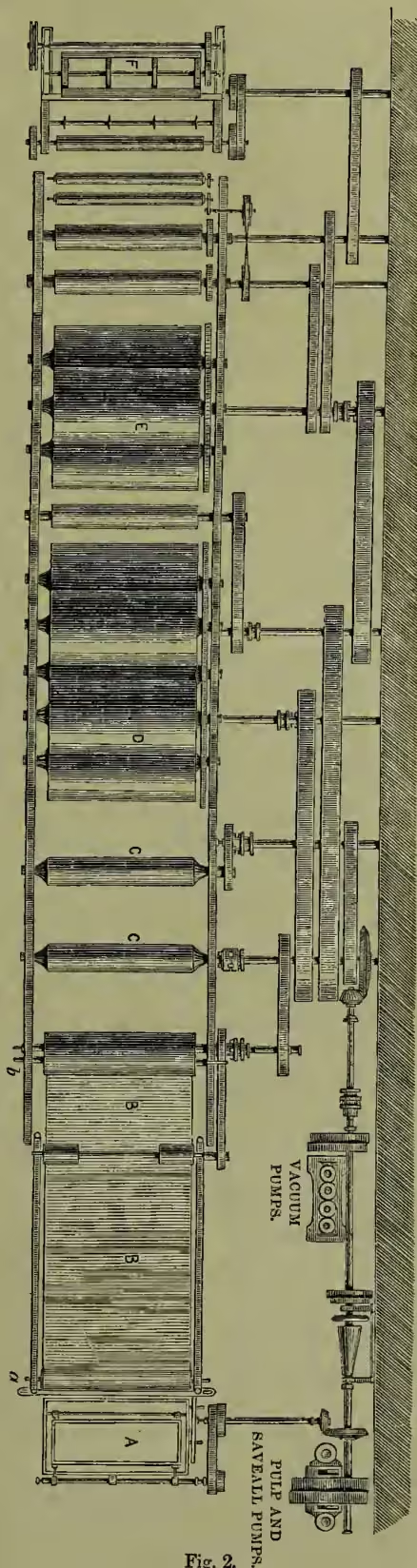
Fig. 1 is a side-view of a continuous paper-making machine, and fig. 2 a vertical one. The principle of the machine is very simple: it contains a pulp-vat, A, with a hog or wheel inside to agitate the pulp, and an arrangement for pouring the pulp over the wire-gauze mould, B, B, B, B, which, instead of being in single squares, as in the hand-process, is an endless sheet moving round two rollers, a, b, which keep it stretched out and revolving when in operation. Under the part which receives the pulp there is a series of small brass rollers, d (fig. 1); these, being nearly close together, keep it perfectly level—a most necessary condition; besides which there is a shallow trough, ce (fig. 1), called the save all, which catches and retains the water that always escapes with some pulp in suspension; and an arrangement of suction boxes and tubes, f, f, f (fig. 1), worked by air-pumps, which draw much of the water out as the pulp passes over them. The pulp is kept from running over the sides by straps called deckles, which are also endless bands, usually of vulcanised india-rubber, carried round moving rollers so that they travel with the wire-gauze, and therefore offer no resistance to it. In addition to all this the framework on which the surface of the wire-gauze rests has a shoggling motion, or side-shake, which has an important effect in working the fibres together before the pulp finally settles down. When it reaches the couching-rolls, which press out most of the remaining moisture, and carry it forward to the first and second series of press-rolls by means of an endless web of felt which passes round them, the speed of these rollers and the travelling sheet of felt, CC (figs 1 and 2), is nicely calculated, so as to prevent a strain upon the still very tender web of paper. Sometimes the upper rollers of these two series are filled with steam in order to commence drying the web. The paper is now trusted to itself, and passes on, as indicated by the arrows, from the second press-rolls to the first set of drying cylinders, DD (figs. 1 and 2), where it again meets with a felt sheet, which keeps it in close contact with the drying cylinders, which are of large size, and filled with steam. Around these it passes, drying as it goes, and is then received between the two smoothing-rolls, or damp calenders, which press both surfaces, and remove the marks of the wire and felt, which are until then visible on the paper. This necessarily is done before the drying is quite completed; and from the smoothing-rolls it passes to the second series of drying cylinders, E (figs. 1 and 2), where the drying is finished, and thence to the calenders, which are polished rollers of hard cast-iron, so adjusted as to give a considerable pressure to the paper, and produce a glossiness of surface. For writing-papers the paper passes through a shallow trough of size after leaving the drying cylinders, and then passes over another series of skeleton cylinders, with fans moving inside, by which it is again dried without heat, and afterwards passes through the calenders. Printing and other papers are usually sized by mixing the size in the pulp, in which stage the colouring materials—such as ultramarine for the blue tint of foolscap—are also introduced. Still following the paper web in the drawing (fig. 1), it is seen to pass from the calenders to another machine, F; this slits the web into widths, which are again cross-cut into sheets, the size of which is regulated at will. In the United States, for fine book-work, the paper receives a white coating after it has been made; it is the finish thus given to the surface that renders the illustrations seen in the best American magazines possible. The water-mark is impressed on machine-made paper by means of a fine light-wire cylinder with a wire-woven pattern; this is placed over the wire-gauze sheet upon which the pulp is spread, but near the other end of it, so that the light impression of the marker may act upon the paper just when it ceases to be pulp, and this remains all through its course. There are many other interesting points about the paper-machine, but their introduction here would rather tend to confuse the reader. Its productive power is very great; it moves at a rate of from 20 to 200 feet per minute, spreading, pulp, couching, drying, and calendering as it goes, so that the stream of pulp flowing in at one end is in two minutes passing out finished paper at the

other. It has been computed that an ordinary machine, making webs of paper 54 inches wide, will turn out four miles a day.
Paper Production of the World.—The following is a tolerably accurate return of the paper-mills of Europe in 1890, and their annual production :
| Mills. | Tons. | |
|---|---|---|
| United Kingdom..... | 300 | 400,000 |
| France..... | 491 | 240,000 |
| Germany..... | 1083 | 180,000 |
| Austro-Hungary..... | 741 | 72,000 |
| Italy..... | 230 | 45,000 |
| Spain..... | 95 | 13,000 |
| Sweden and Norway..... | 131 | 14,000 |
| Netherlands..... | 65 | 7,200 |
| Russia..... | 46 | 33,500 |
| Belgium..... | 37 | 22,500 |
| Switzerland..... | 34 | 10,000 |
| Portugal..... | 16 | 6,000 |
| Denmark..... | 13 | 3,600 |
| Roumania and Greece..... | 4 | .... |
| Total..... | 3286 | 1,049,800 |
Many of the mills may not be working, some produce pulp only, and the vat-made paper is included in the estimate of production. Assuming 1 million tons are made annually, this may be valued at £30,000,000, of which half is the prime cost of the raw material.
It is difficult to determine with any precision the quantity of paper now made in the United Kingdom, as the manufacture is free from tax; but we may form a fair estimate by looking at the progress under the duty rate, and judging of the advance since from the increased exports and the stimulus now given to production. The following are official figures of the quantity of paper charged with duty before the abolition of the tax, which brought in £1,500,000. In 1842, 43,166 tons; 1852, 70,000 tons; 1861, 102,456 tons. In 1851 Mr Poole, in his Statistics of British Commerce, stated that there were then 437 paper-mills at work in the United Kingdom; 349 in England, 48 in Scotland, and 40 in Ireland. The weight of paper made amounted to 62,000 tons; the estimated value of which was £3,000,000. The number of mills in 1860 was 397; in 1870, 369. Mr W. Arnot, in his course of lectures on the 'Technology of the Paper Trade' before the Society of Arts in 1877, stated the number of paper-mills working in the United Kingdom at 385; of which 300 were in England, 65 in Scotland, and 20 in Ireland. The number of machines employed he gave at about 526, producing 350,000 tons of paper, which, with 10,000 tons of hand-made, gave a total production of 360,000 tons. This quantity he estimated to be worth £16,000,000 sterling. This is, however, far too high an estimate, having regard to the depreciated prices resulting from the fall in value since 1880. The 400,000 tons made at the present time cannot be valued at more than £12,000,000. Assuming the annual production of paper in the United Kingdom at present to be 400,000 tons, the home consumption is evidently large and progressive, for we only export in books and paper about 57,000 tons, while we import of writing and printing papers, &c., 60,000 tons. Newspapers, books, and periodical literature use up fully one-half of our total make. Schools and public offices and correspondence consume much of the remainder, leaving but little for wrapping, packing, and other purposes. Judging from the data adduced, the British paper-manufacture has more than quadrupled since the abolition of the paper-duty.
The export trade of the United Kingdom in paper has been rapidly progressive, as the figures in the following table will show; the first of its two columns comprising writing-paper, printing-paper, and envelopes; and the second all other kinds of paper.
| Cwt. | Cwt. | |
|---|---|---|
| 1870..... | 130,650 | 38,465 |
| 1880..... | 336,118 | 134,450 |
| 1890..... | 708,502 | 236,093 |
The average price of paper, which in 1874 was as high as £3, 2s. per cwt., has fallen as low as 30s. per cwt. The superiority of the British over the continental manufacture has obtained for Britain a steadily increasing business in the markets of Asia, South America, and her Colonies. In 1879 the value of the British paper of all kinds exported was £915,925; in 1889 it was £1,602,075, even at the much lower prices ruling. In 1889 was imported of paper and pasteboard of all kinds 2,110,000 cwt., an increase of 1 million cwt. over 1882.
In the United States equal progress has been made in the paper-manufacture as in Great Britain. The first mill was established in 1690, on ground now included within Philadelphia. In 1770 there were forty paper-mills in Pennsylvania, New Jersey, and Delaware, and only three or four in New England. In 1840 there were in the United States but 426 paper-mills; in 1850, 443; and in 1860, 500, producing 60,000 tons; in 1872 there were 812 mills, owned by 705 firms, making 200,000 tons. At present, with over 1000 paper-mills having 3000 machines, the quantity made greatly exceeds that of the United Kingdom; the amount in some of the last years of the decade 1880-90 amounting to over 1,200,000 tons. In the other parts of America there are 85 paper-mills. In Asia there are 19 paper-mills, besides numerous vats; in Africa, 4; and in Australasia, 7; making a total of nearly 4500 mills in the world. The production of hand-made papers in China and Japan it is impossible to estimate. China has made great strides in her exports of paper of all kinds. From about 75,000 cwt. a few years ago the export advanced to 237,000 cwt. in 1890, valued at £350,000. The greater part of the paper now made in the world—at least three-fourths—is believed to be used for printing on, since the correspondence carried on in many countries out of Europe is comparatively small.
There are works on paper and paper-making by Hofmann (New York, 1873), Munsell (New York, 1876), Archer (1876), Dunbar (1881), Parkinson (1886), C. T. Davis (1886), and Cross and Bevan (1887). For old water-marks dating from 1473, see Archæologia, vol. xii. For ancient paper-making, see Hirth, Chinesische Studien (1890), and Karabacek, Das Arabische Papier. WALL-PAPER is the subject of a separate article.