Beaver (Castor), a familiar rodent mammal, allied to squirrels and marmots, and represented by a single widely distributed species (Castor fiber or canadensis). It is widely known for its aquatic habit, its sagacious architectural devices, its glossy fur, and its fatty castoreum glands.
Form and Structure.—The beaver is usually about 2½ feet in length, and is thus hardly surpassed by any other rodent except the Capybara (q.v.). It stands rather under a foot in height, and the broad, flat, scaly tail is about 10 inches long. The body is plump, the back arched, the neck thick, the hind-feet webbed, and all the digits clawed. The strong wrist has an accessory bone. The fur varies considerably in colour, but is usually reddish-brown above, and lighter or grayish below. The short head runs out into a naked muzzle; the external ears are short and scaly, and admit of being folded, so as almost to shut the opening; the eyes are small; and the nostrils closable. The skull is massive, with marked ridges for fixing the muscles which work the jaws, and both size and ridges increase throughout life. The two front teeth on either jaw are like those of other rodents, wearing away more rapidly behind so as to leave a sharp enamelled chisel edge. They have a bright orange colour. They grow as usual from persisting pulps, so that what is worn away in gnawing is continually being replaced at the root. The four grinding teeth on each side of each jaw are nearly equal to one another, and exhibit two or three infoldings of the enamel coating. The stomach has near its commencement a peculiar glandular structure; the external relations of anal and urinogenital apertures resemble those of marsupials; and the male bears on its groin a pair of glands which secrete a substance known as Castoreum.
Distribution.—The beaver, though represented only by a single species, is widely distributed in the northern parts of both eastern and western hemispheres. It is rapidly disappearing from countries where it previously flourished, being now, for instance, extinct in Britain, and apparently also in Scandinavia. An attempt has been made to reintroduce it in Bute. Isolated colonies of beavers are still to be seen where they have been protected from molestation on the Elbe and a few other rivers in Germany and Austria; but they can hardly be said to be really at home in Europe except in Russia and Poland, and 'especially on the streams of the Ural Mountains, and those emptying into the Caspian Sea.' They are also abundant in Siberia. The American beaver, which is probably only a variety, and not a distinct species, is found to the west of the Mississippi, between Alaska and Mexico, and more sparsely to the east of the same river, to the south of the Great Lakes, in the Maine and Adirondack wildernesses, and yet more sparsely southward to Alabama and Mississippi. They are also frequent in some parts of Virginia and Pennsylvania (see Heilprin, Distribution of Animals, International Science Series). Several extinct species of beaver have been dug up from Miocene and Pliocene strata. Castoroides ohioensis was an allied giant rodent about as big as a black bear. Another large extinct rodent, which Owen described under the title 'Trogontherium,' is regarded by some as a giant beaver.
Habits.—Beavers are well known to be aquatic animals, and are never found far away from river or lake. Their webbed hind-feet make them capital swimmers. They also dive well though noisily, and can remain two minutes under water. They feed mainly on the bark of trees, such as willows, magnolias, poplars, and birches, but also on the roots of the water-lily and other plants, and on their inland excursions during the warm season on fruits, corn, and the like. They often sit on their hind-feet and tail, eating with their fore-paws like squirrels. They are, however, pre-eminently bark-eaters, and large quantities of wood are stored up in the autumn for winter use. When the streams are frozen, they may remain for as long as a fortnight comfortably provided with supplies within their burrows. Most of the beavers' active life is during the night, except when floods force them to abandon their homes. They may be readily tamed, but cannot of course be kept in wooden houses. They may be seen in the London Zoological Gardens, and occasionally in aquariums.
Family-life.—Beavers are social animals; a family of about half a dozen is frequently found within a single house, and where food is abundant and the locality secluded, a large number of families occur congregated in a community. The young beavers leave the parent house in the summer of their third year, find mates for themselves, and establish new homesteads. When increase of population brings about difficulties of subsistence, a migration takes place, some going up and others down the stream. The old houses are never left vacant, however, but are simply transferred by the emigrants to some related new couple. Isolated males or terriers, apparently expelled from a colony for laziness or misbehaviour, are often found living alone.
Homes.—The simplest beaver home is merely a burrow, and when their tenure seems insecure, as in populous countries, the beavers may remain contented with this mode of life. These burrows open outwards under the water, and are thus effectively concealed. Mr L. H. Morgan, in his work on the American beaver, regards the burrow as the primitive and normal residence from which 'in the progress of experience, by a process of natural suggestion,' the more elaborate homes have been gradually evolved. Beaver architecture, as well as human, has had its history. Above the burrow a surface-pile of sticks is often found, perhaps to keep the snow loose enough overhead to admit air, and from these ventilating piles 'it is but a step to a lodge with its chamber above ground, and the previous burrow as an entrance from the water.' 'A burrow accidentally broken through at its upper end, and repaired with a covering of sticks and earth, would lead to a lodge above ground, and thus inaugurate a beaver-lodge out of a broken burrow.'
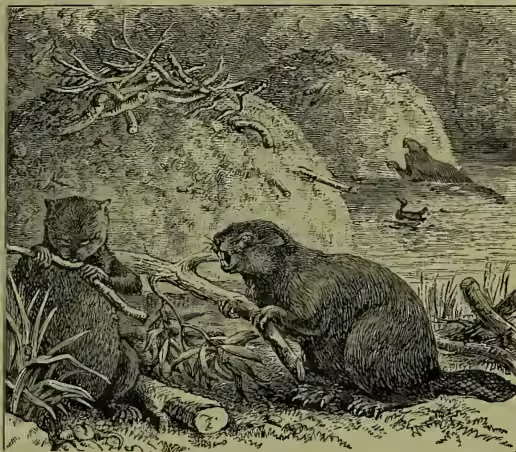
The Lodge.—However it may have arisen, the so-called beaver-lodge is a marvellous structure. Three distinct kinds can be distinguished in adaptation to different localities. The island-lodge is constructed on a small island in the pond or dam. It consists of a central chamber, with its floor a little above the level of the water, and with two entrances. One of these—the 'wood entrance'—is a straight incline rising from the water, and opening neatly into the floor of the hut. Up this the pieces of wood used for winter food are passed. The other approach—the 'beaver entrance'—is more abrupt in its descent to the water, and often tortuous in its course. Both approaches, which are often many feet in length, are neatly lined and finished off, especially where they open into the central chamber. The lodge itself is an oven-shaped house of sticks, grass, and moss, woven together and plastered with mud, increasing gradually in size with year after year of repair and elaboration. They are not only comfortable, but efficiently protective against beasts of prey. The room inside may measure 8 feet in diameter, and 2 or 3 feet in height. The floor is very comfortably carpeted with bark, grass, and wood-chips, and there are sometimes special store-rooms adjoining. The entrances open into a specially deep moat surrounding the home, and as this is too deep to freeze readily, the inmates are not apt to be imprisoned even by very keen frost. Another kind of lodge is built on the bank of a stream or pond, either a short way back from the edge, or partly hanging over, with its front wall built up from the bottom of the pond. A third type—the so-called 'lake-lodges'—are built on the shelving shores of lakes, with a large part of the hut built out upon the water. The various forms of house, all apparently modifications of the primitive burrow, are of much interest, as illustrating the beaver's power of adapting its constructive powers to different local conditions. Mr Morgan also directs attention to the 'beaver-slides' or cuttings seen on the Upper Missouri, where the banks are too vertical to admit of the ordinary construction without some previous surface-work. In certain localities—for instance, in California—the animals have either relapsed from their ordinary architectural labours, or have never fully developed the constructive habit. Hunters often break into the lodges so as to drive the beavers into the holes or burrows.
Wood-cutting.—Some of the most interesting habits of beavers are connected with the way in which they procure and store their food-material. That they are bark-eaters has been already noticed, and it is an equally familiar fact that in order to procure this they cut down trees by gnawing a ring round the base. This they cut all round, but more towards the side nearest the water, so that the tree may fall as conveniently as possible. They can cut down a tree 10 inches or so in diameter. The smaller branches with more palatable bark are cut off in the same way, and cut into lengths convenient for transport and storage. The heavier pieces are ingeniously rolled along, often for a considerable distance, to the water-edge. Sometimes the tree is near enough to fall at once into the water, and is simply left till required, but such a convenient supply is soon exhausted. When a block has been rolled to the water-edge it is floated out to the lodge, and either anchored by means of brushwood stuck into the bottom of the pond, or sunk to the mouth of the 'wood entrance,' and conveyed up into the lodge. Barked branches from which the nutritive portion has been eaten away, may be further used, as already indicated, for building the lodges.
Beaver-dams.—Yet more marvellous are the dams by which beavers widen the area and increase the depth of water round about their homes. These vary in structure according to the nature of the locality. They are either made of sticks and poles, with a slight embankment of earth, not enough to prevent the surplus water flowing freely through, or they are constructed more firmly and solidly of mud, brushwood, and stones, with a special outlet on the ridge for the discharge of the overflow. Though beavers do not hammer in poles, nor use their tails as trowels, they exhibit marvellous ingenuity in the construction of their dams. The stones and mud are cleverly carried by the fore-paws, the burden being pressed against the chest; the curvature of the dam is adjusted to the direction of the current; a constant level of water is secured by modification of the outlet sluice; the wear is continually remedied by fresh building; auxiliary dams are constructed to all appearance simply for the purpose of breaking the flow of water in the main dam, and so on. Some of these dams have prodigious dimensions. Mr Morgan describes one structure 1530 feet in length, of which 530 feet in two sections is artificial, and the remainder natural bank, but worked here and there where depressions on the ground required raising by artificial means.
Canals.—Mr Morgan has also discovered and described the construction of waterways or canals, which the beavers dig between their ponds and the sources of timber-supply. When the trees near the water are exhausted, and when the uneven character of the ground makes the rolling of the logs a difficult task, canals are cut for convenience of transport. In certain cases the construction of a big dam may bring the water-edge quite near enough the trees, but this is not always so. The construction of canals becomes as necessary as it is marvellous. They may be hundreds of feet long, increasing in length as the trees are gradually cut away, and are usually about a yard or more in breadth, and 3 feet or so deep. Sometimes, however, the ground rises suddenly at a certain distance from the pond, so that a continuous canal becomes impossible. In such a case an engineer constructing a canal would make a 'lock.' This is exactly the solution of the difficulty which has been arrived at by beavers. Mr Morgan describes a case where three water-collecting crescent-shaped dams have been made, at three successive sudden ascents of the ground, and the principle of locks ingeniously combined with that of collecting reservoirs. In another case the canal bifurcates at the foot of the woodland slope, and thus presents a maximum water-edge. Or again, these acute engineers have been observed to make a short-cut waterway across the ground enclosed in a loop of the river, so as to lessen considerably the distance of transport.
Geological Interest.—All this work of burrowing, timber-felling, dam-building, canal-cutting, carried on continuously by generation after generation of beavers, must in no inconsiderable way have affected the minuter features of a landscape. Agassiz has estimated the age of one of these beaver dams at a thousand years. As the result of beaver work, large tracts once covered with trees have become bare, and what was once dry meadow has been flooded with water. Acres of what once was forest land are represented now by peaty clearings, and still remain as 'beaver meadows' in countries from which the busy foresters have long since disappeared.
Practical Uses.—The beaver has for long been hunted for the sake of its fur, from which both hats and gloves were made. Chaucer speaks of a 'Flaundrish bever hat' about 1386, and we have 'brown beaver gloves' in Dickens' Sketches by Boz (1836). An act of the English parliament, in 1638, prohibiting the use of any other material for hat-making, contributed to the rapid diminution of the number of beavers in the parts of North America from which their skins were then obtained (see HAT). During a great part of the 18th and the earlier part of the 19th century, the number of beaver skins annually exported from America appears to have been not less than 200,000. It is now greatly diminished, but is still large. From very ancient times the secretion of the gland, on the groin of male beavers, has been valued on account of its curative properties. So far as the beavers are concerned, the strong-smelling substance is apparently subsidiary to sexual attraction. Hunters are said to utilise it as bait for their traps. The so-called castoreum contains oily and resinous substances, along with a crystallisable component known as castorine, once largely employed in medicine as a nervous stimulant. Mythical stories are told of the way in which beavers throw themselves on their backs when pursued by hunters, so as to expose the wished-for glands, with a hint that their lives might be spared; according to the credulous they may even bite off the glands and leave them as a ransom. The oily flesh is said also to be esteemed by the trappers. The fat tail is a special delicacy, and the animal being popularly regarded as a fish, may be eaten during Lent.
Intelligence.—Enough has been said to show that the habits and labours of beavers exhibit more marks of sagacity than can possibly be the result of hereditary habit. They do much more than follow a hard and fast path of orderly and purposeful action—they can adapt their actions to varying conditions in a manner which can only be described as rationally intelligent. The Indians go further, and invest the beaver with immortality. The reader should consult Lewis H. Morgan on The American Beaver and his Works (1868), or Romanes on Animal Intelligence (1886), and on Mental Evolution in Animals (1886), and Horace T. Martin's Castorologia (1892).
Beaver Dam.—A city at the outlet of Beaver Lake, Wisconsin, U.S., 61 miles NW. of Milwaukee, on the Chicago, Milwaukee, and St Paul Railway. It is the centre of a fertile district, and has a university, various factories, and flour-mills. Pop. (1880) 3441; (1890) 4222.
Beaver Falls.—A village of Pennsylvania, U.S., near the junction of the Beaver River with the Ohio, 34 miles NW. of Pittsburg. The 'Harmony' Society of Economy controls most of the manufactures here. Pop. (1880) 5104; (1890) 9735.
Beaver Wood.—See MAGNOLIA.
Bebeerine.—or BEBERINE, is an alkaloid obtained from the greenheart bark or bebeeru of British Guiana, first separated and described in 1843 by Sir Douglas MacLagan of Edinburgh. Recent investigations seem to show that this alkaloid is identical with Buxine, which is obtained from the bark and leaves of the common box, and it is probable that it is also present in some other plants. It was hoped that bebeerine, in the form of sulphate, would become a substitute for quinine; but it is not so powerful in its action as a tonic and febrifuge, and has not therefore come into popular use. Bebeerine is always prescribed in the form of sulphate, a dark amorphous substance, obtained in thin translucent laminae by spreading the sirup solution on sheets of glass, and allowing it to dry. See GREENHEART.
Bebek.—A lovely bay on the European side of the Bosphorus, with a palace of the sultan, known as the Humayunabad, and built in 1725. Here also are the establishments for baking biscuits for the fleet, an American school, and a college of the French order of Lazarists.
Rebel, FERDINAND AUGUST, social democrat, born at Cologne in 1840, in 1860 came to Leipzig, where four years later he established himself as a master turner. Since 1862 engaging fanatically in the labour movement, he was elected in 1867 to the North German Diet, in 1871 to the Reichstag. In 1872 he was sentenced to two years' imprisonment. Among his writings are Der Deutsche Bauernkrieg (1876), and a work on the status of women (1883).