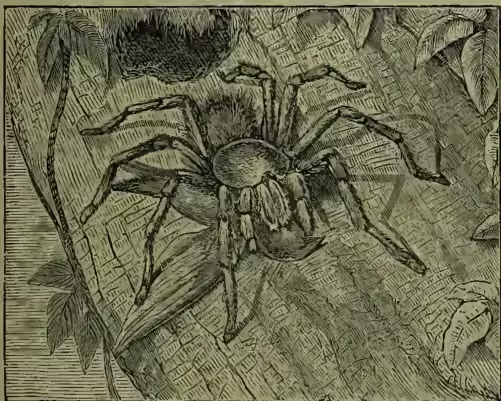
Bird of Paradise, the common name of a family of birds (Paradiseidae), found chiefly in New harks in the wide porch of its house, but issues forth at night to hunt for its prey, which, according to Bates and others, really includes small birds. They are large enough to be led about by children as playthings. It is probably a species of this genus that Dampier mentions as found in Campeachy, the fangs of which, 'black as jet, smooth as glass, and at their small end as sharp as a thorn,' are said by him to be worn by some persons in their tobacco-pouches to pick their pipes with; and to be by others used as toothpicks, in the
Guinea and neighbouring islands, and remarkable for splendour of plumage. In all other respects, however, they are very closely allied to the crow family, Corvidæ (q.v.), to which they exhibit a great similarity, not only in the characters of the bill, feet, &c., and in general form, but also in their habits, and even in their voice. They have been the subject of many fables. The state in which their skins are usually exported from their native islands, gave rise to the notion that they were destitute of feet; and free scope being allowed to fancy, it became the prevalent belief that they spent their whole lives floating in the air, except when perhaps they suspended themselves for a little by their long tail-filaments from the uppermost branches of trees. They were supposed to feed on dew and vapour, or more substantially on the nectar of flowers. Some of them do, indeed, feed partly on the latter. Antony Pigafetta, who accompanied Magellan in his voyage round the world, described them as having legs, and stated that these were cut off as useless in the preparation of the skins; but his statement was not credited, and Aldrovandus went the length of accusing him of an audacious falsehood. Most of the characters ascribed to birds of paradise are simply to be regarded as imaginative revelling in the absence of facts; but it is also possible that some of the fables are in part due to the desire of the inhabitants of those islands in which they are found to increase the value of their skins as an article of merchandise. A sort of sacred character being attached to them, they were employed not merely for ornament, but as a charm to secure the life of the wearer against the dangers of battle. Mr A. R. Wallace also points out that the Malayan traders, from whom the birds were usually bought, never saw them alive, knowing them indeed by the name Burong mati, or 'dead birds.' The people of Ternate call them Manuk dewata, or 'birds of God,' which name Buffon modified into Manucode. In different languages they are known by names signifying birds of the air, birds of the sun, &c. In 1760 Linnaeus described the largest species, Paradisea apoda, and also referred to the King Bird of Paradise. The list was gradually increased, but our real knowledge of the group dates from Mr Wallace's visit to New Guinea in 1857-58. Since then the quest has been followed up with enthusiasm.
The Paradiseidæ are comparatively small birds, but their spreading feathers are often of great length. Though allied to crows and starlings, the adult males are in beauty unsurpassed even by humming-birds. Tufts of bright feathers spring from beneath the wings, from the tail, or from the head, back, or shoulders. Trains, fans, and exquisitely delicate tress-like decorations occur abundantly, and the gracefulness of the plumage is enhanced by the brilliant colour and metallic lustre. The females are plain, sober-coloured birds, and it is only with maturity, and after successive moult, that the males acquire that brilliancy of plumage which they exhibit to such advantage in their courtships. The true birds of paradise feed on fruits and insects, and are practically omnivorous. Their mode of life is more or less gregarious. They are intensely active, flitting about the whole day long. There is still lack of information in regard to nests and eggs. Some of them may be readily kept in confinement.
The birds of paradise are usually grouped in two divisions—the Paradiseidæ proper and the long-beaked Epimachidæ—but Wallace unites these in one family. The former appear more nearly related to the crows, the latter to the hoopoes. Among the Paradiseidæ proper, the following species deserve special record. The Great Bird of Paradise
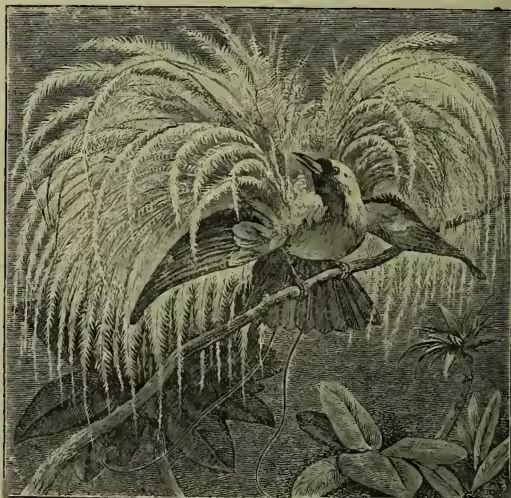
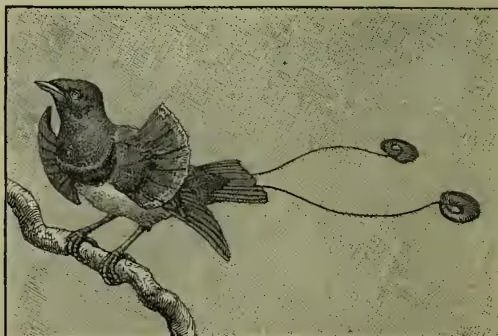
(Paradisea apoda) is the largest species, measuring about a foot and a half in length. From beneath the wings of the male there springs on each side a rich tuft of long plumes, sometimes 2 feet in length. The gorgeous colours, from golden orange to blackish violet, baffle brief description. 'The loud, shrill note is the most prominent and characteristic animal sound in the Aru Islands.' The natives shoot the males with blunt arrows when they are displaying themselves in courtship. So preoccupied are they that many may be shot before the thronging rivals take alarm.—The Lesser Bird of Paradise (P. papuana) is smaller and predominantly yellow, except on the breast, which is purplish. The females are white below, and so are the young males. They gradually become more brown and more handsome. This species is very frequently used for ladies' head-dresses. Its home is in New Guinea and adjacent islands. Wallace brought two live specimens to Britain, and they lived for one and two years in the Zoological Gardens in London.—Among closely related species is the Red Bird of Paradise (P. rubra), restricted to the island of Waigou, near New Guinea. It is about 14 inches long, and the side plumes are rich crimson. The two middle tail-feathers form stiff black ribands, about 22 inches long. Wallace notes this bird as one of the most vivid instances of the development of colour and plumage through the selective action of the females. The natives catch them by an ingenious snaring contrivance.—The King Bird of Paradise (Paradisea regia, also called Cicinnurus regius) is much smaller, only about 6 inches long, but is even more brilliant in plumage. The two middle feathers of this living gem are wire-like shafts, about 6 inches long, bearing at their extremities a spiral emerald disc. The females and young males are, as usual, very plain.—The Magnificent Bird of Paradise (Diphyllodes speciosa) has a curious double mantle on its back.—The Superb Bird of Paradise (Lophorina atra) is yet rarer and more brilliant, and bears a most extraordinary shield (like another pair of outspread wings) on the back of its neck.—The Six-shafted Bird of Paradise (Parotia sexpennis) is adorned in many ways, but especially by six slender feathers springing from the back of the head and ending in oval webs. Wallace discovered a beautiful bird, which he called the Standard-wing (Semioptera wallacei), especially distinguished by a pair of long narrow white feathers, which spring from the bend of the wing, and are capable of being erected at pleasure.
Among the Epimachidæ, or Long-billed Birds of Paradise, one of the most remarkable is the Twelve-wired Paradise Bird (Seleucides alba). About twelve posterior plumes have the midrib elongated into black wires, which curve backwards for about 10 inches. The female is not so plain as in most other species. The males are solitary in habit. These birds frequent flowering trees, are almost ceaselessly in motion, and feed to a large extent on the nectar of flowers. The great Epimaque, or Long-tailed Paradise Bird (Epimachus magnus), 'has a magnificent tail, more than 2 feet long, glossed on the upper surface with the most intense opalescent blue.' Broad brightly coloured plumes spring from the sides of the breast. The rife-birds of North Australia (Ptilorhis), and the paradise oriole are not distinctly related to the birds of paradise.
These marvellously beautiful birds have some commercial importance. 'They are the monopoly of the chiefs of the coast villagers, who obtain them at a low rate from the mountaineers, and sell them to the Bugis 'traders.' The skull and feet are usually removed, the skin is wrapped up in palm leaves, and dried in a smoky hut. The colour is often half-spoiled in the process. That the feathers are used for head-dress decoration has been already noticed.
The scientific interest of these birds is centred in the relation of the beauty of the males to their highly developed art of courtship. Wallace gives a vivid description of the excitement and display at pairing time. They meet in what the people call 'sàcaleli,' or 'dancing parties,' on wide-spreading forest trees, with large but scattered leaves. A dozen or twenty fully-plumaged males then display their beauty in every variety of attitude and motion. It is believed that the males were originally like the females, as they generally are when young. Changes in colour and form gave certain males a preference in the eyes of the selecting females. The more attractive became the more successful breeders, and thus the development of their beauty is laid to the credit of their courtship. The real origin of the colour in the mature males still requires elucidation; the theory of sexual selection only shows how changes once started might be gradually accumulated and enhanced.
The birds of paradise are restricted in distribution as above noticed. Their home (New Guinea) is rugged and mountainous, and in its recesses almost inaccessible. The people are savages. 'In such a country,' says Wallace, 'and among such a people, are found these wonderful productions of nature, the birds of paradise, whose exquisite beauty of form and colour, and strange development of plumage, are calculated to excite the wonder and admiration of the most civilised and the most intellectual of mankind, and to furnish inexhaustible materials for study to the naturalist, and for speculation to the philosopher.' See A. R. Wallace, Malay Archipelago (vol. ii. 1869); Elliot, Monograph of Paradiseidæ (1873).