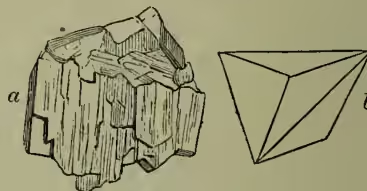
Bismuth (sym. Bi, eq. 210) is a brittle metal, white with a faint red tinge. It is found native in Cornwall, France, Peru, Siberia, &c., but is mostly obtained from Saxony. It exists also in combination with oxygen, carbonic acid, lead, tellurium, &c., but the native (impure) metal is preferred. The ore is placed in inclined iron tubes, and heat applied, when the metal melting and partly volatilising, runs down to the receivers, and when transferred to moulds, solidifies with a crystalline texture. When pure, it crystallises more readily than any other metal; and it exhibits the singular anomaly, that when it has been exposed to great pressure its density becomes less. It may be distilled at a high temperature, and repels a magnet more than any other metal. Heated in the air, it burns with a blue flame, forming yellow fumes of oxide. Bismuth unites readily with other metals, forming Alloys (q.v.). The most remarkable of these is called fusible metal, consisting of 2 of bismuth, 1 of lead, and 1 of tin, the melting-point of which is 200.75° F. (93.75° C.), or 12° below the boiling-point of water. Spoons made of this alloy, therefore, readily melt when placed in boiling water; a favourite trick with amateur conjurers. A still more fusible metal is obtained by the addition of mercury, and this is used in forming moulds for toilet-soaps or in taking casts. Bismuth has a specific gravity of 9.83, and melts at 507° F. (264° C.).
Bismuth forms several compounds of service in the arts and in medicine; it combines with oxygen to form several oxides, of which the trioxide, , is the most important. It may be prepared by boiling together a solution of the subnitrate of bismuth, , and caustic soda, , when the oxide, in combination with water, is thrown down, and nitrate of soda remains in solution. It is employed in the porcelain manufacture as an agent for fixing the gilding, and for increasing the fusibility of fluxes, at the same time neutralising the colours which are often communicated by them. The ternitrate of bismuth is prepared by acting upon the metal bismuth with a mixture of one part of commercial nitric acid and one part of water, and applying heat. The sub-nitrate or basic nitrate of bismuth receives the names of Pearl White, Pearl Powder, Blanc de Fard, and Blanc d'Espagne. It is used as a cosmetic, but is apt to become gray in tint, and even brown or black, when sulphuretted hydrogen, often evolved from sewers, cesspools, and drains, comes in contact with it. The subnitrate and subcarbonate of bismuth are used in medicine as very soothing, feebly astringent sedatives when applied to irritated mucous membranes, and are of great value in various forms of stomachic disease; while externally they are used as an application to scrofulous sores. The citrate of bismuth in combination with ammonia being very soluble, is more rapid and irritant in its action than the soluble salts last mentioned, but is of special use in cases of relaxation with excessive discharge. Bismuth salts sometimes contain arsenic, and must be used with caution. The 'bismuth breath' is a peculiar garlicky odour often felt in the breath of those who have taken bismuth preparations for some time. The cause of this is not clearly known, although at various times the presence of arsenic or tellurium as impurities has been blamed for it; but it would seem that it may be produced even when these are absent.