Bison (Lat.; Old High Ger. Wisund), a genus of wild cattle, represented by two rapidly disappearing species in Europe and America. The European Bison (Bos europæus or Bonassus), wrongly confounded with the Aurochs (Urus), was common in Europe in Roman times, but has gradually been all but exterminated. It only persists in a dwindling herd 'in the imperial preserves of Lithuania, and in the wilds of the Ural and Caucasus.' The bison measures about 10 feet in length, stands about 6 feet high, and is extremely strong, especially in its fore-parts. Old bulls can knock down trees 5 or 6 inches in diameter, and can readily cope with wolf or bear. The most striking differences between a bison and an ox are the hump just behind the neck, the broader convex forehead, the longer limbs, the shaggier head and shoulders. There are also internal differences, such as the presence of an additional rib. The hump is due to the long spines of the backbone bodies in that region, and to the enormous muscles working the head. The horns are short and very far apart, a little curved inwards at the point, and fixed not at the ends of the top-most ridge of the head, but considerably in front of it. The long shaggy hair on head and breast is of a dusky brown colour, and is cast in summer. The females are not so large as the males, nor do they exhibit the same shagginess of the fore-parts. The bison is the largest quadruped now existing in Europe, although within the historic period there existed along with it an even larger ox (B. primigenius), the Urus of the ancients, abundant in the time of the early Roman emperors. The ancient Bonassus was apparently the still extant bison. The food of the bison consists of grass and brushwood, and the leaves and bark of young trees. Its cry is peculiar, 'resembling a groan or a grunt, more than the lowing of an ox.' It does not attain its full stature till after its sixth year, and lives for about thirty or forty years. The period of gestation appears to be the same as that of the ox. The bison has never been reduced to subjection by man, and the domestication even of individuals taken young, has been very partial. It generally shows a great aversion to the domestic ox. The bison is generally very shy, and can only be approached from the leeward, its smell being very acute. It is easily provoked, and is not approached without danger. It runs very swiftly, although it cannot long continue its flight, galloping with its head very low, so that the hoofs are raised higher than the head. Few authorities derive any of the domestic breeds of cattle from the bison, but this theory has been recently proposed by Wilckens. It is usually supposed, however, that all have descended from B. primigenius.
There is no historical record that the bison ever existed in Britain; but remains of this, or of a very closely allied species, are found in pliocene freshwater beds in several parts of England, as well as on the continent of Europe. The most abundant fossil species is B. priscus, but other closely related forms are also known (B. sivalensis, latifrons, antiquus).
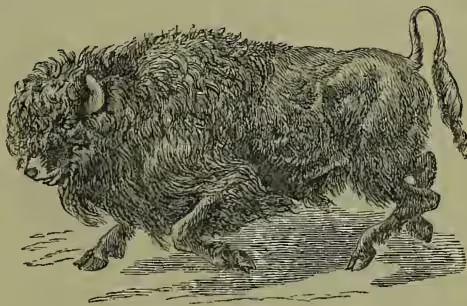
The American Bison (B. Americanus) is interesting as the only living species of the ox family indigenous to America, except the Musk Ox (q.v.) of the subarctic regions. It is commonly called Buffalo by the Anglo-Americans, but must be distinguished from the true Buffalo (q.v.). The bison was within recent times very abundant in America, especially in the prairies beyond the Mississippi, and from 63° N. lat. to New Mexico. Even in the 19th century it was still found in Ohio. Now it is nearly extinct—a result of hard winters, cattle-ranching, railways, and immigration. In 1886 the Smithsonian Institute sent out emissaries to procure a few skins and skeletons. On inquiry it was found none were left save in the Yellowstone Park, and a few in Montana and in Texas, the Montana herd comprising sixty head; twenty-five were secured for the institute. The Canadians preserve a herd or two. The bison used to congregate in large herds, and when migrating, travelled in solid columns of thousands and tens of thousands, which could hardly turn or arrest their progress for the pressure of the masses from behind on those in front. They were of the utmost importance to the Indians, who shot them in the chase, or drove them into great snow pounds, or frightened them over precipices, and in other ways killed them in enormous numbers.
The differences between the American and European bison are quite immaterial. The former is slightly smaller, shorter in limb, and blunter in horn. The fore-parts are still more shaggy, and retain most of their shagginess in summer. In their palmy days at least, the male and female American bison lived apart in separate herds, and the bulls, though usually pacific, were dangerous at the breeding or fighting time. The grizzly bear is said to be the only animal which could dare singly to attack a bison.
The economic importance of the bison was once great. The flesh, like coarse-grained beef, was tender and juicy, while the tongue and marrow bones and hump were specially prized. The hump formed pemmican; the fat, tallow; the skins, clothing or tent and canoe covers; the hair, cloth; and the dried droppings, fuel. But all this, and the noble animals themselves, will soon have receded from life into history. See J. A. Allen, American
Bisons, Living and Extinct (Cambridge, Mass. 1876).