Bivalves form a class of shelled animals or molluscs in which the shell consists of two limy plates or valves, lying one on each side of the body. Mussel, oyster, cockle, and clam are very familiar examples. Compared with the other two great classes of Molluscs—the snails (Gasteropods) and the cuttle-fish (Cephalopods)—the bivalves are markedly quiet and passive. The great majority live a sessile life except during their youngest stages. With this inactivity certain characters are directly associated, of which the most marked are: (1) the undeveloped structure of the head; (2) the absence of head eyes; (3) the absence of biting or prehensile organs; (4) the marked development of large plate-like gills producing nutritive as well as respiratory currents; and (5) the presence of thick limy shells which exhibit most manifold variations within comparatively narrow limits.
History and Nomenclature.—Aristotle included bivalves among other shelled forms of very diverse structure in his great group of hard-skinned animals or Ostracodermata. Linnaeus was content to refer them to an equally heterogeneous group of worms. Cuvier defined them more exactly as a subdivision of molluscs, and gave them the title of headless (Acephala), which they still frequently receive. To Owen is due the designation Lamellibranchiata, which refers to the plate-like character of their gills, and it is by this title that they are now generally known. The term Lipocephala is a yet more modern one referring to the undeveloped nature of the head, and the absence of the rasping tongue which is found in other molluscs (Glossophora). Bivalve shells are exhibited by other animals besides Lamellibranchs, and especially by the small class of lamp-shells or Brachiopods, but in the latter the structure of the animal is not in any sense that of a mollusc, and the position of the valves is ventral and dorsal, instead of lateral. The Brachiopods are therefore excluded from this article, in which the title bivalve is regarded as equivalent to Lamellibranch.
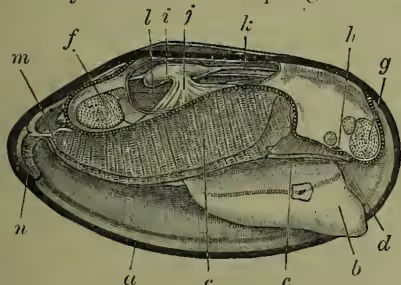
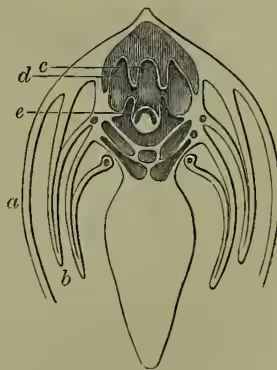
Structure.—(a) The body of the bivalve can usually be split along the middle line into similar halves; it is bilaterally symmetrical. It is usually compressed from side to side, the breadth or thickness being small in proportion to the other dimensions. (b) The ventral surface of the animal—i.e. where the valves gape, is usually produced into a very characteristic ploughshare-shaped muscular organ called the foot, which is used in boring and in locomotion, but tends to degenerate in the forms which are most inactive. From a gland frequently present in the posterior part of the foot, a viscid secretion is exuded in the form of threads (byssus) by which the attachment of the bivalve is effected. (c) From the middle line of the back—i.e. from the hinge of the shell—a flap of skin falls down each side of the body, covering the animal entirely with a double cloak, and closely adhering to the valves of the shell. These two mantle-skirts meet one another by their free margins on the ventral side when the shell is shut, but are of course separated when the foot is protruded through the gaping aperture. They are in the closest connection with the shell, which they in fact produce. The shell is an organic growth, and consists of three layers: (a) soft and cuticular, (b) prismatic, and (c) mother-of-pearl. The growth takes place on the internal surface, and at the margin of the mantle. The concentric lines and the modifications of colour remain as indices of the rhythm of growth. In many forms the mantle is drawn out into a pair of lips forming a double tube or siphon. Through this the water, circulated by the gills, passes in and out. Many forms lie buried in the mud with the open ends of the siphons protruded. In Pecten, Lima, and others, the margin of the mantle bears numerous tentacle-like processes. (d) Between each mantle-skirt and the side of the body proper, lie the large and prominent gills, which are covered with ciliated cells, causing currents of water which not only purify the blood spread out upon the plates, but whip minute food-particles to the inconspicuous mouth. They are indeed more nutritive than respiratory. (e) There is seldom any marked difference between the head and tail end of the animal; in the middle line in front lies the mouth, and the food-canal ends in a similar position behind. The canal itself lies mainly in the plane dividing the body into halves, but exhibits more or less looping in the region of the foot. A large gland (the so-called liver) is situated far forward near the stomach expansion. Still further forward, in the region of the pharynx, there often is a blind pocket containing a curious clear cylinder (the crystalline style), which some regard as the equivalent of the rasper found in other molluscs. Flat tentacles occur on each side of the mouth and look like small gills. They are richly supplied with blood-vessels and nerves. (f) The shell is opened by the action of a passive tendinous band (ligament) which lies at the dorsal meeting-place of the two valves, and acts like a piece of india-rubber squeezed into the hinge-line of a closed door; the shell is shut by one or two great muscles (adductors) which run across from valve to valve. There are also muscles, more or less powerful according to habit, for working the foot. The marks made by the insertion of the muscles on the shell are readily seen inside the empty valves. (g) The nervous system consists of three chief pairs of ganglia, the anterior cerebral pair being united by connectives to a pair in the foot (pedal), and to a posterior pair called parieto-splanchnic or visceral. From these three centres numerous nerves are given off to the body generally. An auditory sac (otocyst) is found in close association with the pedal ganglia, and a close association with the pedal ganglia, and a patch of smelling or water-testing cells (osphradium) occurs at the base of the gills. Though eyes are never present on the reduced head, they sometimes occur in extraordinary abundance (to the number of many hundreds) along the margin of the mantle (e.g. Pecten, Arca). (h) The heart lies just below the hinge, and consists of a contractile median ventricle driving the blood to the body, and of two auricles symmetrically placed on each side, receiving purified blood from the gills. The ventricle usually grows round the gut, which thus appears to run right through the heart. The whole organ is inclosed in a special portion of the body-cavity known as the pericardium, and this is in indirect communication with the exterior by means of two (i) kidney-tubes (nephridia) which lie below the heart, and open externally on the sides of the body. (j) A pair of reproductive organs lie in the foot, and their ducts open laterally near the apertures of the kidneys, with which they are occasionally united. The sexes are generally separate, but may be united, and both those forms may occur within one genus (e.g. oyster).
Habit.—The majority of bivalves are marine forms, but not a few occur in fresh water. Between the rapidly swimming Lima and Pecten, and the entirely quiescent oyster, intermediate degrees of activity and passivity occur, but most decidedly incline towards the extreme illustrated by the oyster. In Lima and Pecten the valves are opened and shut with great rapidity, and swimming thus effected; in the razor-shell (Solen) water is forcibly squirted outwards from within the mantle-cavity, and the animal moves backwards; in the cockle (Cardium) the foot is vigorous enough to enable the mollusc to take small jumps; in many cases (Teredo, Pholas, Lithodonus, Xylophaga) settling down, but in some cases even this seems to be suppressed. In the Fresh-water Mussel (q.v.) (Anodonta) the larvæ are not liberated by the mother except in the presence of certain fishes such as sticklebacks. On the gills of the latter the larvæ become temporarily parasitic, and undergo very considerable metamorphosis.
Classification.—The Lamellibranchiata are usually classified according to the development of the closing muscles of the shell.
ORDER I.—Isomya. Anterior and posterior adductors approximately equal:
Sub-order I.—Integripallia, where the line attaching the lower margin of the mantle to the valve is a continuous curve and not inflected—e.g. Arca, Trigonia, Unio, Anodon, Lucina, Astarte, Tridacna, Chama, Cardium, Cyclas, Cyprina.
Sub-order II.—Sinupallia, where the line attaching the lower margin of the mantle to the valve is not a continuous curve, but inflected to form a sinus—e.g. Tapes, Venus, Tellina, Macla, Mya, Saxicava, Aspergillum, Pholas, Teredo.
ORDER II.—Heteromya. Anterior adductor decidedly smaller than posterior—e.g. Mytilus, Modiola, Lithodonus, Mulleria.
ORDER III.—Monomya. No anterior adductor, and no siphons—e.g. Cardiola, Avicula, Ostrea, Lima, Pecten.
Distribution.—Bivalves are found all over the world, though only a few species like Mytilus edulis and Saxicava arctica can be described as cosmopolitan. The marine forms occur from the shore level down to great depths, and the same species is not unfrequently found at the most diverse depths. Historically, the bivalves appear in the Cambrian strata, though only to a slight extent. In the Lower Silurian they are still far from numerous, but Barrande enumerates 1100 species from the Upper Silurian of Bohemia alone. The Heteromya at first preponderate. From the Upper Silurian onwards, bivalves are exceedingly abundant, and the satisfactory preservation of their shells makes them of great value as index fossils in determining the age of given strata. Among Lamellibranchs occur some of the best instances of types persisting throughout long periods.
Pedigree.—The bivalves must be regarded as a group which has developed along a line entirely different from that of the other molluscs. From an ideal ancestral mollusc like that sketched by Ray Lankester, two lines of progress have been followed. On the one hand, the shell has remained single, the head has not been reduced, the buccal apparatus has developed, and the life has been relatively active. This path has been followed by Gasteropods, Pteropods, and Cephalopods. On the other hand, along the other line, the mantle has become bilobed, the shell double, the gills large, plate-like, and nutritive, the head much reduced, and the life relatively passive. This path has been followed by the Lamellibranchs.
Economic Importance.—Many bivalves (oyster, mussel, cockle, clam, &c.) are used for food. Others are largely utilised as bait in sea-fishing. Pearls and mother-of-pearl are obtained from Meleagrina and other forms. The valves of Placuna are sometimes used for window-panes. Venus mercenaria and other types have been used by savage tribes for coinage. Larger shells are occasionally calcined for lime. The boring bivalves have an important destructive influence on piers and ship timber, but the custom of ensheathing in metal now renders their attack less effectual. See CONCHOLGY, MOLLUSCS, OYSTER, &c., and Huxley's Anatomy of Invertebrated Animals (Lond. 1877).