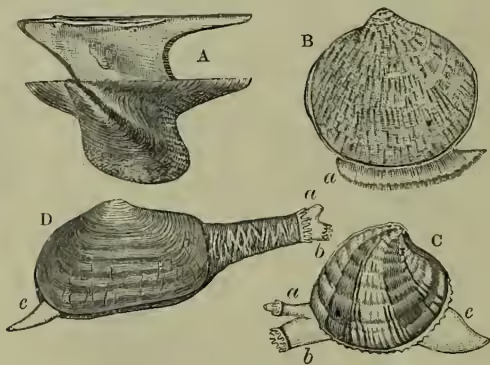
Bivouac (through Fr. from Ger. bei wache: bei, 'near,' and wachen, 'to watch') is the encampment of soldiers in the open air, without tents, where a permanent hole is bored in wood or stone; in the majority the foot is used for a slow creeping progression along the sand. From the nature of the nutrition, by the inwafing currents produced by the gills, it is evident that the food must consist of minute organisms. Algae, Diatoms, Infusorians, minute Crustacea, and the like form the principal diet.
Life-history.—In almost all cases the eggs are fertilised within the mantle-cavity. There they remain for some time sheltered in the gills, or even within special brood-chambers (Cyclas). In rare cases (Galeomma, Kellia) the larvæ issue as such from the genital apertures, but in the vast majority the eggs are developed as above noted within the mantle-cavity. The larvæ very generally enjoy a period of free-swimming life before every one remains dressed in his place, and with his weapons by him. It has always been necessary for opposing armies thus to pass the night before a battle; but the French revolutionary armies first introduced the practice of dispensing with tents throughout the campaign, thus greatly lessening their baggage-trains and increasing the celerity of their movements. No European army now carries tents for its combatant troops. At a distance from the enemy they are cantoned (see BILLETING) in the villages on the line of march. When an engagement is imminent they bivouac. Each battalion, or other unit, has its allotted space, in the centre of which the arms are piled in quarter column. Round the piles of arms each company has its sleeping-ground marked out. A bivouac would, if possible, be placed under the shelter of trees, or so as to be protected from wind by hedges. Improvised screens of straw, heather, &c. would be used, and large fires lighted. But the health of troops always suffers if bivouacked constantly in bad weather. In India and other hot countries it is found necessary to carry tents still, and the bivouac is never resorted to if it can be avoided.