Blackcock, HEATH-FOWL, or BLACK GROUSE (Tetrao tetrix), a species of Grouse (q.v.), abundant in Britain wherever there are moors of considerable extent, and more particularly where there are bogs and morasses with rank herbage, or, adjacent to the moors, natural woods or young plantations of pine and fir. Comparatively rare in the south of England, the blackcock becomes more common towards the north, and is very plentiful in the mountainous parts of Scotland. It is found in some of the Hebrides, but not in the Orkney or Shetland Isles. The only other British species, the Capercailzie (q.v.) or Wood-grouse, became some time ago virtually extinct in Britain, but the noble bird has now been reinstated. On the continent of Europe it occurs both in mountainous and marshy countries, as on the Alps and in Holland; it is found as far south as the Apennines, and as far north as the forests of Lapland; it abounds in most parts of Scandinavia, where it is carefully protected, the males only being killed, but these in great numbers for the London market; it is diffused over almost all parts of Russia, and is found in Siberia. Its range is restricted to the
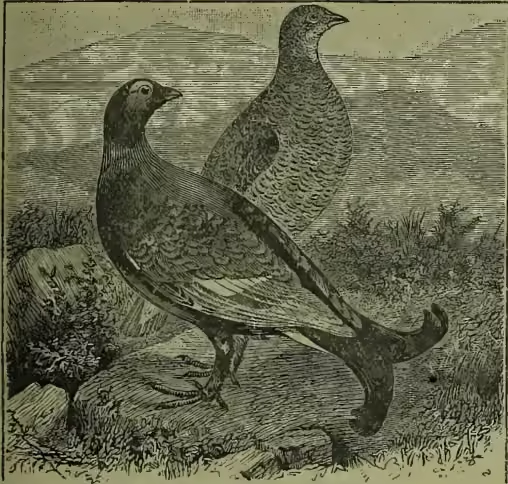
Eurasian continent. The male is much larger than the female, sometimes weighing as much as 4 lb., while the female weighs only about 2 lb. They also differ very much in plumage. The male is of a shining bluish-black colour, with a conspicuous white bar on the wings below the ends of the great wing-coverts, and a mixture of black and white on the legs; there is a piece of bare scarlet skin above the eye; the outer feathers on either side of the tail are elongated and curve outwards, giving it a very peculiar appearance. The female, called the Gray Hen, is of a rusty-brown colour, darkest on the upper parts, everywhere barred and mottled with a darker colour; the tail is straight and only slightly forked at the end. The young males resemble the females in plumage. The shank in this species is feathered, but not the toes. The flight, though heavy, is strong and rapid, and the birds can also run with much agility. It is a gregarious bird, but in winter the sexes generally keep in separate flocks. In spring the males resort to elevated and open spots, where they crow, and also make a sound which has been likened to the whetting of a scythe, thus inviting the females to repair to them; they strut and trail their wings like turkey-cocks, and fierce contests often take place among them. They are polygamous, and pay no attention to the females during incubation, nor do they take any part in rearing the young. The nest is of the simplest construction, a few straws or the like, placed together among tall heath, or under the shelter of a low thick bush. The eggs, six to eight in number, are yellowish-white, speckled with orange-brown, and about 2 inches long. The usual food consists of the seeds of rushes and other plants, berries, insects, worms, the tender shoots of heath, leaves, &c. But the blackcock sometimes visits cornfields and stubbles to feed on corn, is frequently to be found in turnip-fields near plantations in hilly districts, and, at least in winter, eats the young shoots of pines, firs, birches, and alders. It is highly esteemed for the table. The shooting season is from 20th August to 10th December.
Hybrids between different species of grouse, and even between grouse and pheasant, are said to exist, but not much reliable information is available. Thus it is probable that the bird called Tetrao hybridus or medius, sometimes found in the Scandinavian peninsula and other parts of Europe, is a hybrid between the Black Grouse and the Capercaillie, Tetrao urogallus (q.v.). The Ptarmigans (q.v.) or Brown Grouse are nearly allied.